
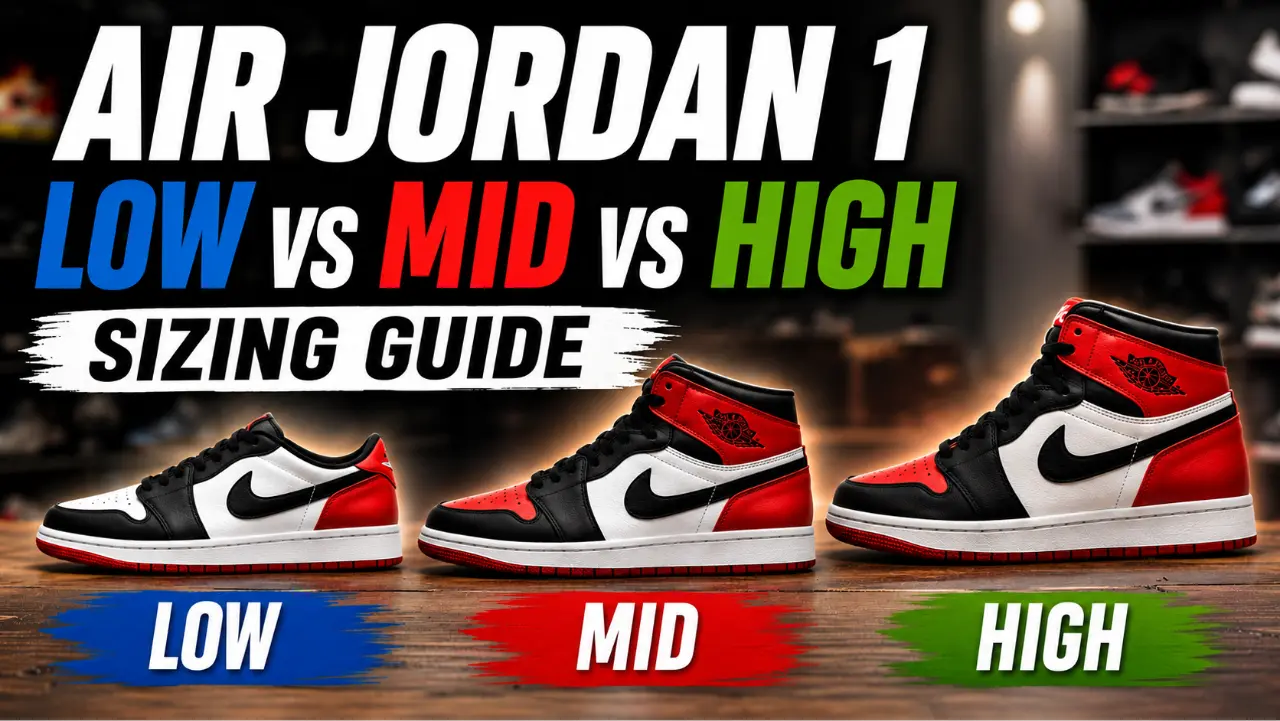
If you’re wondering whether the Air Jordan 1 Low, Mid, and High fit the same, the answer is mostly yes.
I’ve worn all three, along with special releases like the High ’85, Low OG, Travis Scott Low OG, and several Mid variations.
Most follow the same sizing, but a few don’t.
The Low OG fits a little longer than the High, the High ’85 has a narrower forefoot, and some Mid releases can feel much tighter because of their stiff leather.
Here’s the short version before we dive into the details.
Quick Answer
- Air Jordan 1 High OG: True to size.
- Air Jordan 1 High ’85: True to size for most. Very wide feet should consider going up half a size.
- Air Jordan 1 Mid: True to size, although some pairs feel tighter until the leather softens.
- Air Jordan 1 Mid SE: True to size.
- Air Jordan 1 Low OG: 1/2 down for narrow to average feet. True to size for slightly wide or wide feet.
- Air Jordan 1 Low OG ‘Banned’: Fits like every other Low OG.
- Travis Scott x Air Jordan 1 Low OG SP: Same fit as the Low OG. Just remember it’s sold in women’s sizing, so you’ll need to convert your size before ordering.
If you only remember one thing, remember this: get your regular Jordan 1 size. The Low OG is the only version where I’d seriously consider another size, and even then, it depends on your foot shape and the fit you’re after.
If you’re also deciding between a Jordan 1 and a Dunk, my comparison of how the Air Jordan 1 and Nike Dunk fit side by side makes the differences much easier to spot before you buy.
See my guide on how to measure your feet at home before choosing your Air Jordan 1 size.

Now, before we compare the different Jordan 1 models, it helps to know what I’m using as my reference point….
My Air Jordan Sizing Profile
- Brannock Size: US 9 (9D to 9E)
- Foot Shape: Slightly wide forefoot
- Preferred Fit: Snug and secure without squeezing my toes
- Regular Jordan 1 High OG Size: US 9
- Jordan 1 Low OG Size: Usually US 9, although I can wear an 8.5 if I want a closer fit
- Typical Nike Size: US 9 in most lifestyle models
I’ve been wearing Jordan 1s for years, and I’ve owned or tried everything from standard Highs and Mids to Low OGs and special releases like the High ’85, Travis Scott Low OG, and the Virgil Abloh Archive High.
One thing I’ve learned is that not every Jordan 1 deserves the same sizing advice.
That’s why this guide doesn’t treat every Jordan 1 as if it’s identical. I’ll point out where the sizing stays consistent, where certain releases break the pattern, and how my recommendations change depending on your foot shape.
See my Air Jordan 1 vs Air Force 1 sizing comparison to see which one offers more room and whether you should wear the same size in both.
Air Jordan 1 High vs Mid vs Low Sizing

Can You Wear the Same Size in All Three?
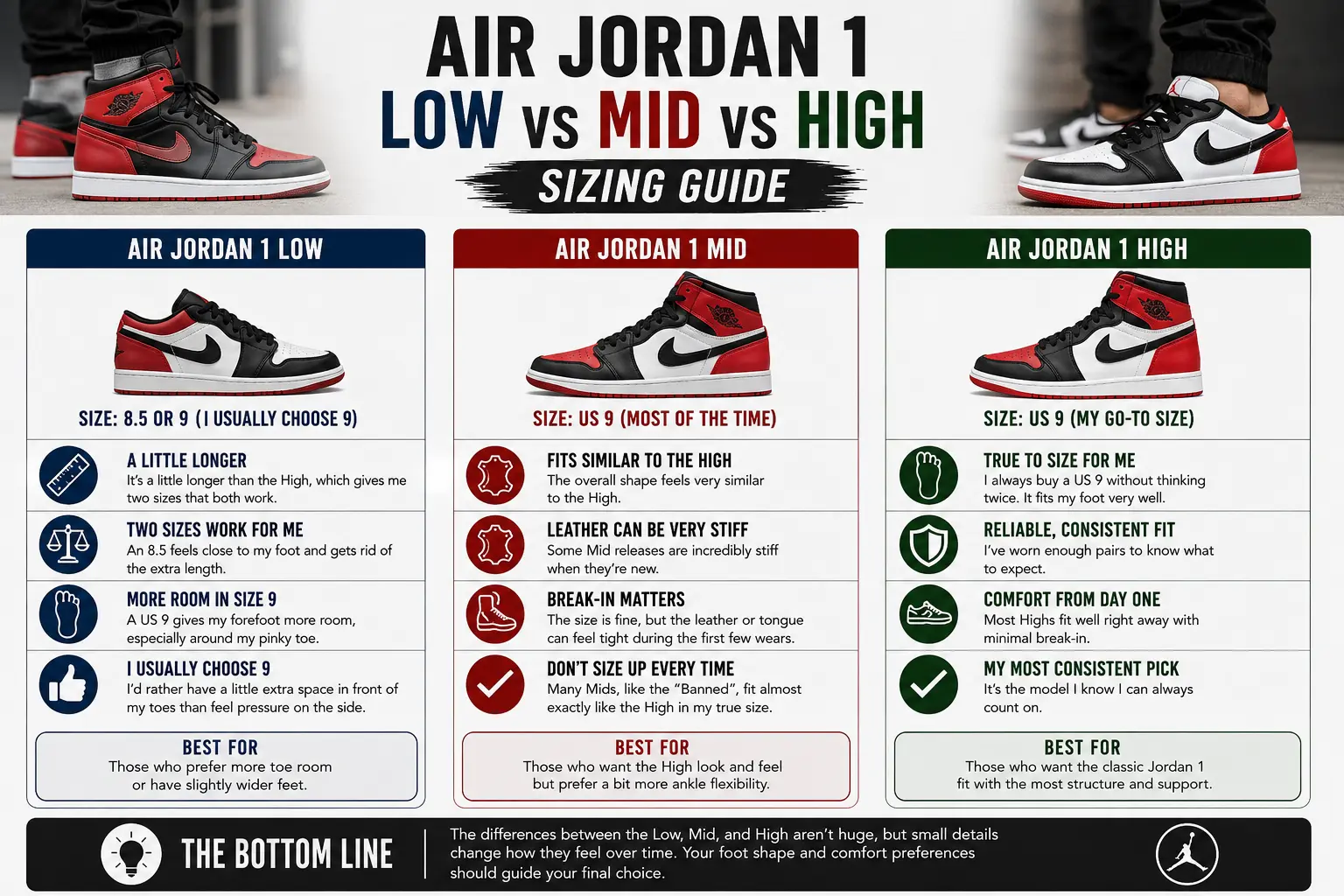
Whenever I buy a regular Air Jordan 1 High, I order a US 9 without giving it much thought. I’ve done it enough times to know what I’m getting.
The shoe fits my foot well, so I’ve never felt the need to experiment with another size.
The Mid starts out the same.
I still buy a US 9 because the overall shape feels very similar to the High. Where things change is the leather.
Some Mid releases are incredibly stiff when they’re new. They don’t necessarily fit smaller, but they can feel much tighter during the first few wears.
My wife bought a pair in her usual size and thought they were almost painful to wear. I had a similar experience with my Maison Château Rouge pair.
The size was fine, but the tongue kept digging into the top of my foot whenever I walked.
Because of experiences like that, I understand why some people size up in certain Mid releases.
That doesn’t mean I’d do it every time.
My Jordan 1 Mid “Banned” fits almost exactly like my Highs. I bought my usual size, wore them for a few days, and never questioned my choice.
The Low OG is the one that makes me think.
It’s a little longer than the High, which gives me two sizes that both work. An 8.5 feels close to my foot and gets rid of the extra length, while a US 9 gives my forefoot more room, especially around my pinky toe.
I usually choose the US 9.
I’d much rather see a little extra space in front of my toes than spend the whole day noticing pressure on the side of my foot.
That’s why my sizing advice changes from one Jordan 1 to another.
It’s rarely because one model is dramatically bigger or smaller. More often, it’s a small difference that changes how the shoe feels once you’ve been wearing it for a few hours.
See my complete Air Jordan sizing guide to see which models run true to size and which ones are worth sizing up or down in.
If you found what you needed here, add Size Chart Guru as a Preferred Source on Google to discover more sizing guides.
Which Sneaker Runs Bigger?
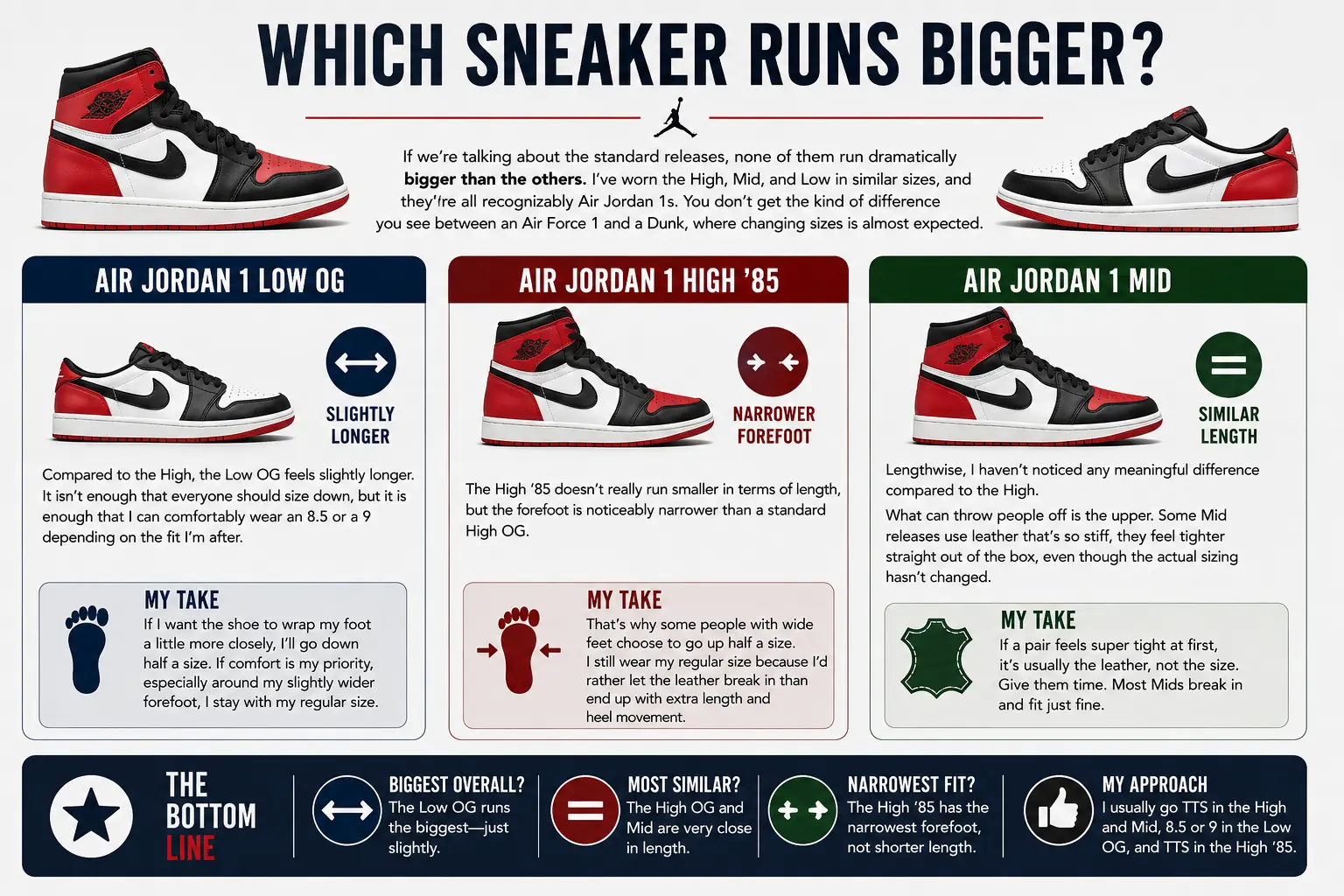
If we’re talking about the standard releases, none of them run dramatically bigger than the others.
I’ve worn the High, Mid, and Low in similar sizes, and they’re all recognizably Air Jordan 1s. You don’t get the kind of difference you see between an Air Force 1 and a Dunk, where changing sizes is almost expected.
That said, the Low OG is the exception.
Compared to the High, it feels slightly longer. It isn’t enough that everyone should size down, but it is enough that I can comfortably wear an 8.5 or a 9 depending on the fit I’m after.
If I want the shoe to wrap my foot a little more closely, I’ll go down half a size. If comfort is my priority, especially around my slightly wider forefoot, I stay with my regular size.
The High ’85 goes in the opposite direction.
It doesn’t really run smaller in terms of length, but the forefoot is noticeably narrower than a standard High OG.
That’s why some people with wide feet choose to go up half a size. I still wear my regular size because I’d rather let the leather break in than end up with extra length and heel movement.
The Jordan 1 Mid sits somewhere in between.
Lengthwise, I haven’t noticed any meaningful difference compared to the High. What can throw people off is the upper.
Some Mid releases use leather that’s so stiff they feel tighter straight out of the box, even though the actual sizing hasn’t changed.
So if you’re wondering which Jordan 1 runs the biggest, my answer is the Low OG. It’s only by a small margin, but it’s the one model that gives me the option of going down half a size without feeling cramped.
The High OG and Mid are much closer to each other, while the High ’85 stands apart because of its narrower forefoot rather than its overall size.
See my Nike SB Dunk vs Nike Dunk sizing comparison to see how the extra padding changes the fit.
What Actually Feels Different?
People often ask whether the Low, Mid, and High fit the same, but I think a better question is whether they feel the same.
After wearing all three, I’d say no.
The Air Jordan 1 High is the version that feels the most balanced to me. Nothing really stands out, and that’s exactly why I like it.
The forefoot has enough room to stay comfortable, my heel feels planted, and I never find myself adjusting the laces after I leave the house. Once it’s on, I don’t really think about the fit again.
The first thing I notice when I put on the Low OG is the extra length. It’s not a huge difference, but it’s enough that I can tell almost immediately.
Going down half a size gets rid of that extra room and makes the shoe feel more connected to my foot. I stay true to size, and that gives my toes a little more freedom.
The Mid doesn’t feel different because of its shape. It feels different because of the materials.
Some pairs have leather that’s surprisingly soft from day one. Others feel almost rigid until they’ve been broken in.
My Jordan 1 Mid “Banned” felt very similar to my Highs, while other Mid releases took much longer to become comfortable.
The Maison Château Rouge pair was probably the best example. The size itself wasn’t the problem, but the tongue kept pressing into the top of my foot whenever I walked.
That’s why I don’t think it’s accurate to say every Jordan 1 Mid feels the same. The sizing is usually consistent, but the materials can completely change your first impression of the shoe.
Which Works Best for Wide Feet and Narrow Feet?
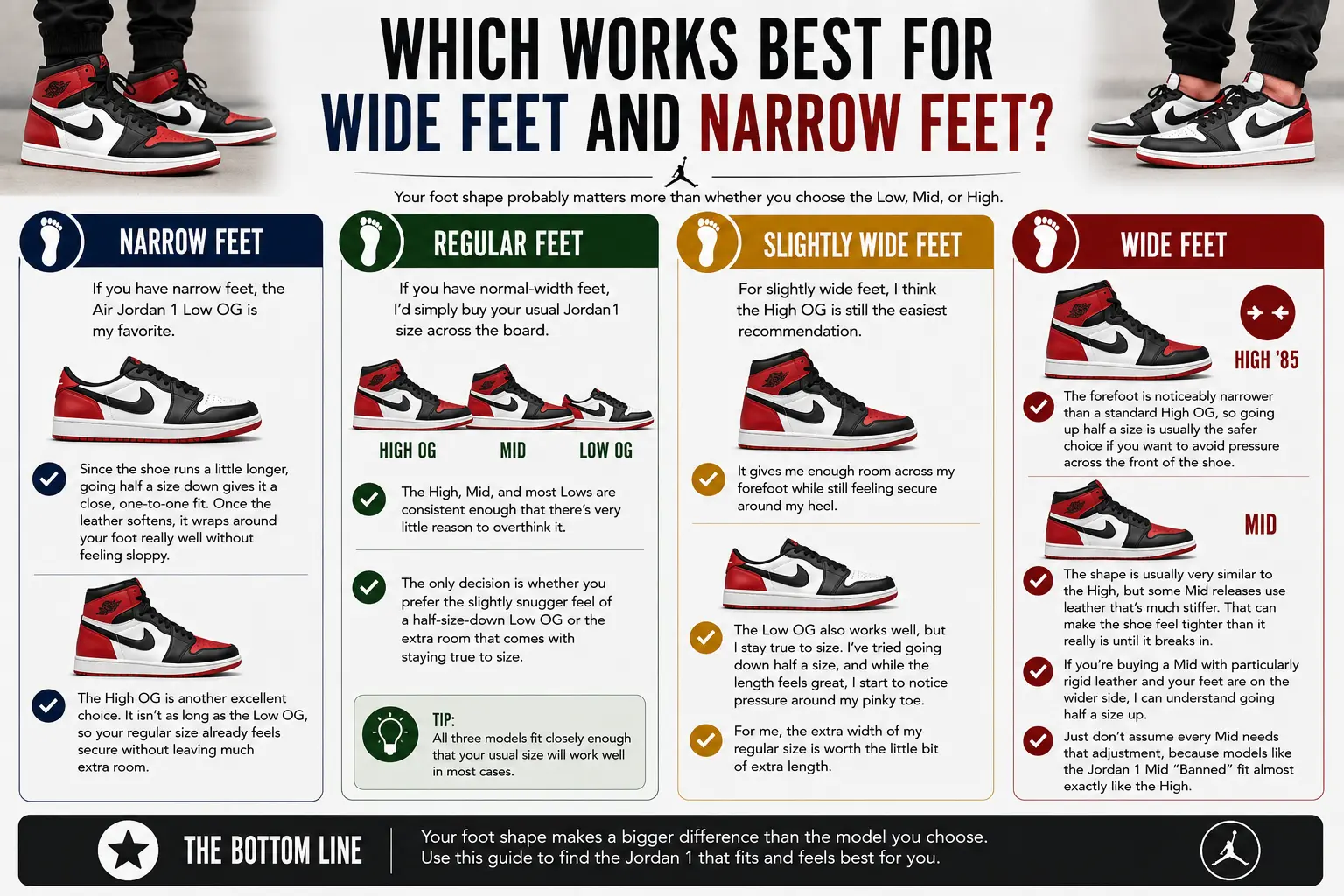
Your foot shape probably matters more than whether you choose the Low, Mid, or High.
Narrow Feet
If you have narrow feet, the Air Jordan 1 Low OG is my favorite.
Since the shoe runs a little longer, going half a size down gives it a close, one-to-one fit. Once the leather softens, it wraps around your foot really well without feeling sloppy.
The High OG is another excellent choice. It isn’t as long as the Low OG, so your regular size already feels secure without leaving much extra room.
Regular Feet
If you have normal-width feet, I’d simply buy your usual Jordan 1 size across the board. The High, Mid, and most Lows are consistent enough that there’s very little reason to overthink it.
The only decision is whether you prefer the slightly snugger feel of a half-size-down Low OG or the extra room that comes with staying true to size.
Slightly Wide Feet
For slightly wide feet, I think the High OG is still the easiest recommendation. That’s the model I never have to second-guess. It gives me enough room across my forefoot while still feeling secure around my heel.
The Low OG also works well, but I stay true to size. I’ve tried going down half a size, and while the length feels great, I start to notice pressure around my pinky toe.
For me, the extra width of my regular size is worth the little bit of extra length.
Wide Feet
If you have very wide feet, I’d be more careful with the High ’85. The forefoot is noticeably narrower than a standard High OG, so going up half a size is usually the safer choice if you want to avoid pressure across the front of the shoe.
The Jordan 1 Mid is a little harder to generalize.
The shape is usually very similar to the High, but, again, some Mid releases use leather that’s much stiffer. That can make the shoe feel tighter than it really is until it breaks in.
If you’re buying a Mid with particularly rigid leather and your feet are on the wider side, I can understand going half a size up.
Just don’t assume every Mid needs that adjustment, because models like the Jordan 1 Mid “Banned” fit almost exactly like the High.
Which Jordan 1 Is Right for You?
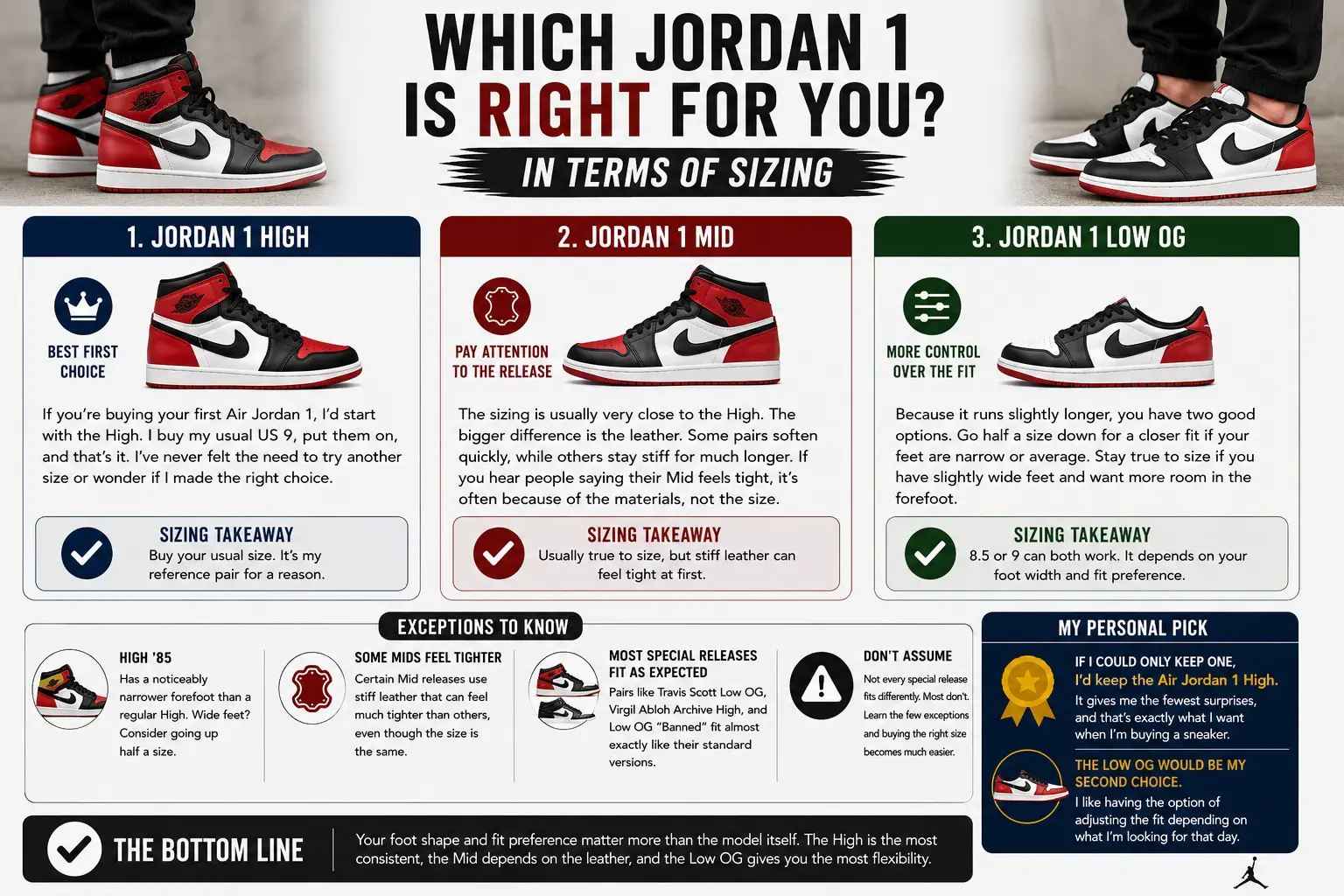
If you’re buying your first Air Jordan 1, I’d start with the Jordan High.
It’s the pair I always use as my reference because I know exactly how it fits. I buy my usual US 9, put them on, and that’s it. I’ve never felt the need to try another size or wonder if I made the right choice.
The Jordan Mid is a good option if you prefer that look, but I’d pay attention to the specific release you’re buying.
The sizing is usually very close to the High. The bigger difference is the leather. Some pairs soften quite quickly, while others stay stiff for much longer.
If you hear people saying their Mid feels tight, it’s often because of the materials rather than the actual size.
The Low OG is the pair I’d choose if you like having a little more control over the fit.
Because it runs slightly longer, you have two good options. If your feet are narrow or average, going down half a size gives the shoe a closer fit.
If your feet are slightly wide like mine, staying true to size gives your forefoot more room without making the shoe feel loose.
Before you pull the trigger, there are a couple of exceptions worth remembering.
The High ’85 has a noticeably narrower forefoot than a regular High, so people with wide feet may be happier going up half a size.
Some Jordan 1 Mid releases can feel much tighter than others because of their stiff leather. On the other hand, pairs like the Travis Scott Low OG, Virgil Abloh Archive High, and Low OG “Banned” fit almost exactly like their standard versions.
If I could only keep one, I’d keep the Air Jordan 1 High.
It gives me the fewest surprises, and that’s exactly what I want when I’m buying a sneaker. The Low OG would be my second choice because I like having the option of adjusting the fit depending on what I’m looking for that day.
Whichever model you choose, don’t assume every special release fits differently. Most of them don’t. Once you know the few exceptions, buying the right size becomes much easier.
Air Jordan 1 High vs Mid vs Low Sizing FAQs
Does leather quality affect the fit?
Yes, more than many people realize.
I’ve worn Jordan 1s that felt comfortable almost immediately, while others needed several wears before they stopped feeling stiff. The actual size didn’t change. The leather did.
That’s why two Jordan 1s in the same size can leave completely different first impressions. If a pair feels firm straight out of the box, I’d give it some time before deciding you bought the wrong size.
Can I wear the same Jordan 1 size in every colorway?
Most of the time, yes.
I wear the same size in the vast majority of Jordan 1 releases. The exceptions are usually models with a different shape, like the High ’85, or the Low OG, which feels slightly longer than the regular High.
Different materials can also change how a shoe feels during the first few wears, but that doesn’t always mean you need a different size.
What’s the biggest sizing mistake people make with Jordan 1s?
Sizing up too quickly.
A lot of people put on a brand-new pair, notice the leather feels stiff, and immediately assume they need a bigger size. Sometimes they do, but often the shoe just needs to break in.
I’d only change sizes if your toes are actually hitting the front or your foot feels heavily compressed. If it’s just a little snug, especially around the forefoot, I’d wear them a few more times before making that decision.
Do the Air Jordan 1 Low, Mid, and High stretch over time?
They do, but only to a point.
The leather usually becomes softer and more flexible after a few wears, especially around the forefoot. That can make the shoe feel noticeably more comfortable.
What doesn’t really change is the length. If your toes are already touching the front of the shoe, don’t expect the break-in process to solve that.
Should I size up if my Jordan 1 feels tight at first?
Not necessarily.
Jordan 1s often feel firmer when they’re brand new, particularly if they use stiffer leather. That initial tightness usually fades as the upper softens.
I’d only consider sizing up if your foot feels genuinely cramped or your toes don’t have enough room. If the shoe just feels a little snug, I’d give it a chance to break in first.
Do Air Jordan 1s feel different after they’re broken in?
Definitely.
I’ve noticed this most with certain Jordan 1 Mid releases. Once the leather loosened up, they felt much closer to my Highs than they did when I first took them out of the box.
Why does my Jordan 1 feel tight across the pinky toe?
That’s usually a width issue rather than a length issue.
I’ve experienced it myself in the Low OG when I went down half a size. The length felt great, but the side of the shoe pressed against my pinky toe.
If that’s happening, staying true to size is often the better solution. You’ll gain a little more room across the forefoot without making the shoe feel loose.
Will thick socks change the size I should buy?
Usually, no.
If you always wear thick socks, it’s worth trying your Jordan 1s on with the same type of socks you’ll wear most often. I wouldn’t buy a different size just because you occasionally wear thicker socks. It’s better to size the shoe for your everyday use.
Does ankle height change the fit?
Not as much as people think.
Some people assume the High fits tighter because it covers more of your ankle. In reality, the biggest difference is how the shoe feels around your ankle, not how it fits your foot. The length and forefoot are much more important when choosing your size.
Why does the Jordan 1 Low OG feel longer than the High?
That’s simply how the shoe is built.
The difference isn’t huge, but it’s enough that I can comfortably wear two different sizes. That’s something I don’t experience with the High. If you have narrow or average-width feet, going down half a size often creates a really nice fit. With slightly wider feet, I’d stay true to size.
Should I get Jordan 1s online or try them on first?
If this is your first pair, I’d try them on in a store if you have the chance.
Once you know how a standard Jordan 1 High OG fits, buying future releases online becomes much easier because you’ll have a reliable reference point.
Can replacing the insole make a Jordan 1 fit tighter?
Yes.
A thicker aftermarket insole reduces the amount of space inside the shoe. Sometimes that’s enough to improve the fit if your pair feels slightly loose. Just keep in mind that it also reduces the vertical space over your foot, so the shoe may feel tighter across the top.
Do Jordan 1s fit differently from modern Nike basketball shoes?
In my experience, yes.
Modern Nike basketball shoes like the Kobe or LeBron often wrap your foot much more tightly because they’re built for performance. The Jordan 1 is a lifestyle sneaker. It still feels secure, but it doesn’t hug your foot in quite the same way.
Are women’s Jordan 1s different from men’s?
The fit is generally the same.
The biggest thing to remember is the sizing conversion. Women’s Jordan 1s use women’s sizing, so you’ll need to convert to the correct equivalent if you’re used to buying men’s sizes.
For example, a men’s US 9 is usually a women’s US 10.5.
Can you fix a Jordan 1 that’s slightly too big?
Usually, yes.
If the shoe is only a little loose, thicker socks, a slightly thicker insole, or different lacing techniques can make a noticeable difference.
If the shoe is a full size too big, though, there isn’t a simple fix. At that point, I’d recommend exchanging it for the correct size instead.
Final Thoughts
The good news is that Nike hasn’t reinvented the fit every time it releases a new Air Jordan 1.
After wearing the High, Mid, Low OG, High ’85, and several collaborations, I’ve found that the overall sizing stays surprisingly consistent.
The differences are there, but they’re fairly small.
The High ’85 has a narrower forefoot. The Low OG feels a little longer. Some Mid releases can feel firmer because of the leather they use.
Those are the details worth paying attention to, not whether the shoe has a different colorway or a famous collaborator attached to it.
If you’re still unsure where to start, I’d use the Air Jordan 1 High OG as your reference. From there, it’s much easier to judge whether another version will fit the same, slightly tighter, or slightly longer.
Hopefully my experience helps you avoid the trial and error that comes with buying Jordan 1s online.
And if you’ve owned a pair that fit differently from the ones I covered here, let me know in the comments. I’d love to hear how they worked for you.