
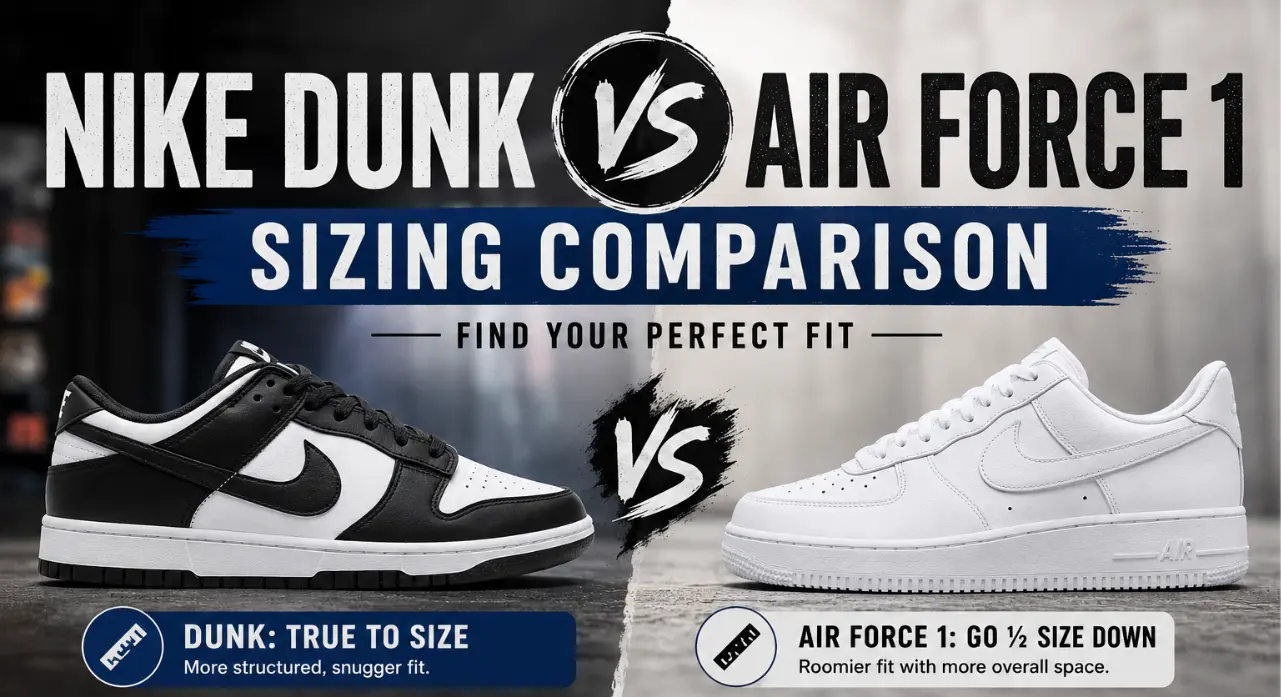
Nike Dunk vs Air Force 1 sizing is one of those comparisons that seems straightforward until you actually wear both.
They might both be Nike lifestyle sneakers, but they fit differently enough that I wouldn’t buy them in the same size without thinking about it first.
If you only want the quick answer, here it is:
- The Air Force 1 runs bigger, and I recommend going half a size down for most people.
- The Nike Dunk fits true to size and feels more structured around the foot.
- The Air Force 1 gives you more room through the toe box and forefoot.
- The Dunk feels more secure and slightly more supportive, especially through the middle of the foot.
For me, that means wearing a US 8.5 in the Air Force 1 and a US 9 in the regular Dunk Low.
But that’s only part of the story.
Not every Dunk fits the same.
Some releases, like the Dunk Low SP, feel a little roomier than a standard Dunk. Others, like the Dunk Low QS, feel noticeably snugger.
And if you’re looking at an SB Dunk, that’s a completely different fit again because of the extra padding.
In this comparison, I’ll show you exactly how the Air Force 1 and the Dunk differ in length, width, toe box shape, midfoot fit, heel lockdown, and how they actually feel once you’ve been wearing them for a while.
I’ll also point out the Dunk and Air Force 1 versions that don’t follow the usual sizing, so you don’t get caught out by a special release or collab.
See my Nike SB Dunk vs regular Dunk sizing comparison before you pull the trigger.
Plus, you might find my Air Jordan 1 vs Air Force 1 sizing comparison useful, since it explains why I wear a different size in each of those two classics.

Nike Dunk vs Air Force 1 Sizing

TL;DR
If you’re deciding between the Nike Dunk and the Air Force 1, I’d start by thinking about the kind of fit you enjoy rather than the way the shoes look.
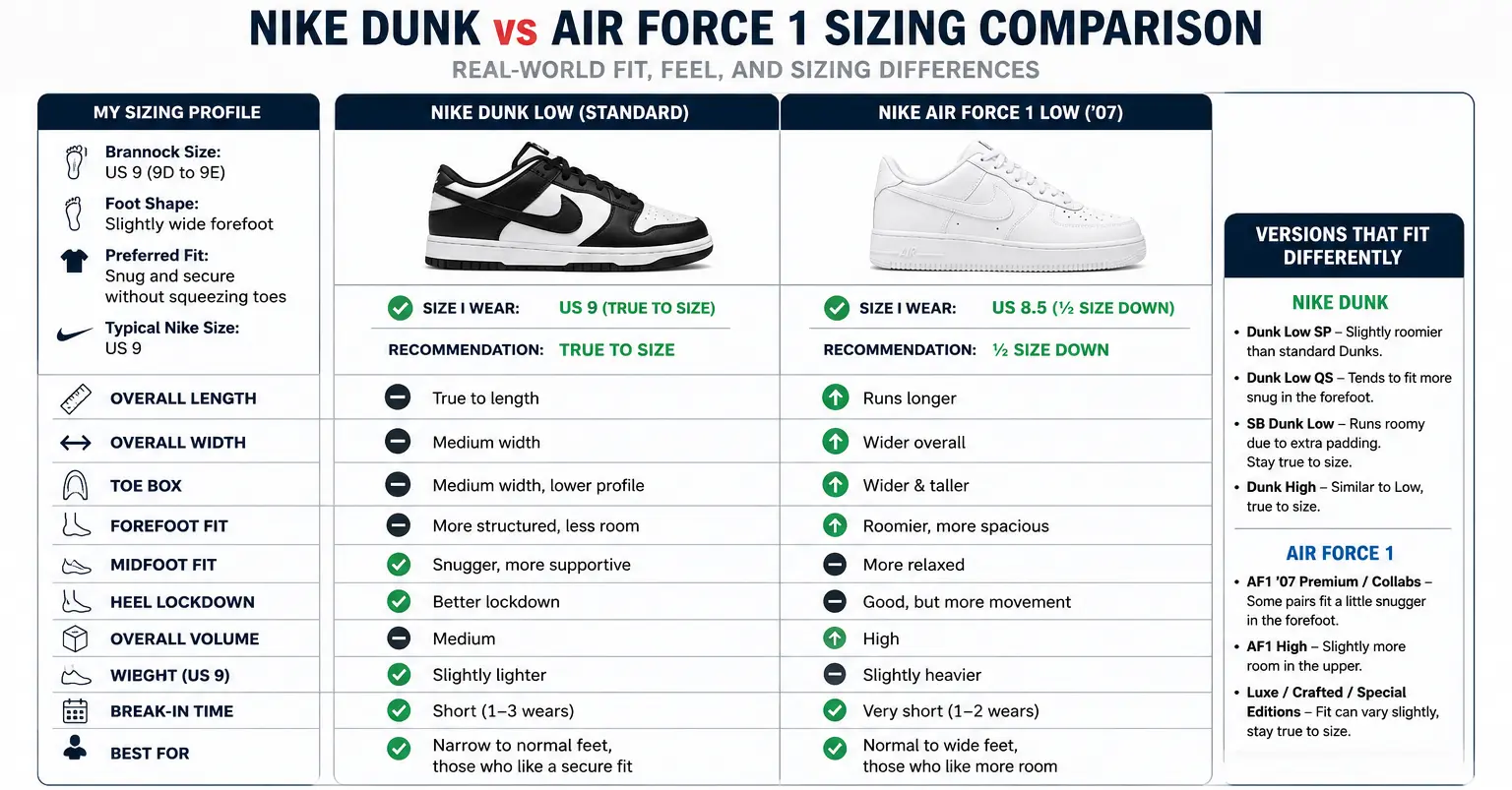
The Air Force 1 is the roomier of the two. It has more space around the forefoot, a taller toe box, and more internal volume, which is why I wear it half a size down.
The Nike Dunk fits much closer to my foot and feels more structured, so I stay true to size. Neither approach is better. It simply comes down to whether you prefer a relaxed fit or one that feels a little more connected.
See my complete Nike Dunk sizing guide for the sizing differences between SBs, SPs, Premiums, collabs, and other Dunk models.
My Sizing Profile
Before we compare the Nike Dunk and the Air Force 1, here’s a quick look at my foot shape and the sizes I actually wear. If your feet are similar to mine, there’s a good chance you’ll have a similar experience.
If not, use my recommendations as a starting point and adjust based on your own foot shape.
Here’s my sizing profile:
My Sizing Profile
- Brannock Size: US 9 (9D to 9E)
- Foot Shape: Slightly wide forefoot
- Preferred Fit: Snug and secure without squeezing my toes
- Typical Nike Size: US 9
- Nike Dunk (Regular): US 9 (True to size)
- Air Force 1: US 8.5 (½ size down)
I generally like my sneakers to feel close to my feet without being restrictive. That’s why I stay true to size in regular Dunks, which already have a structured fit, but go down half a size in the Air Force 1 because it naturally has much more room inside.
If you’re thinking about buying a standard pair or one of the many collabs, my Nike Air Force 1 sizing guide goes into much more detail on how different versions fit.
Which Shoe Runs Bigger?
If you’re coming from an Air Force 1 and wondering whether you can buy the Dunk in the same size, I’d stop you right there.
I wouldn’t.
Again, I wear a US 8.5 in the Air Force 1 and a US 9 in the regular Nike Dunk, and both give me the fit I’m looking for.
The reason is pretty simple.
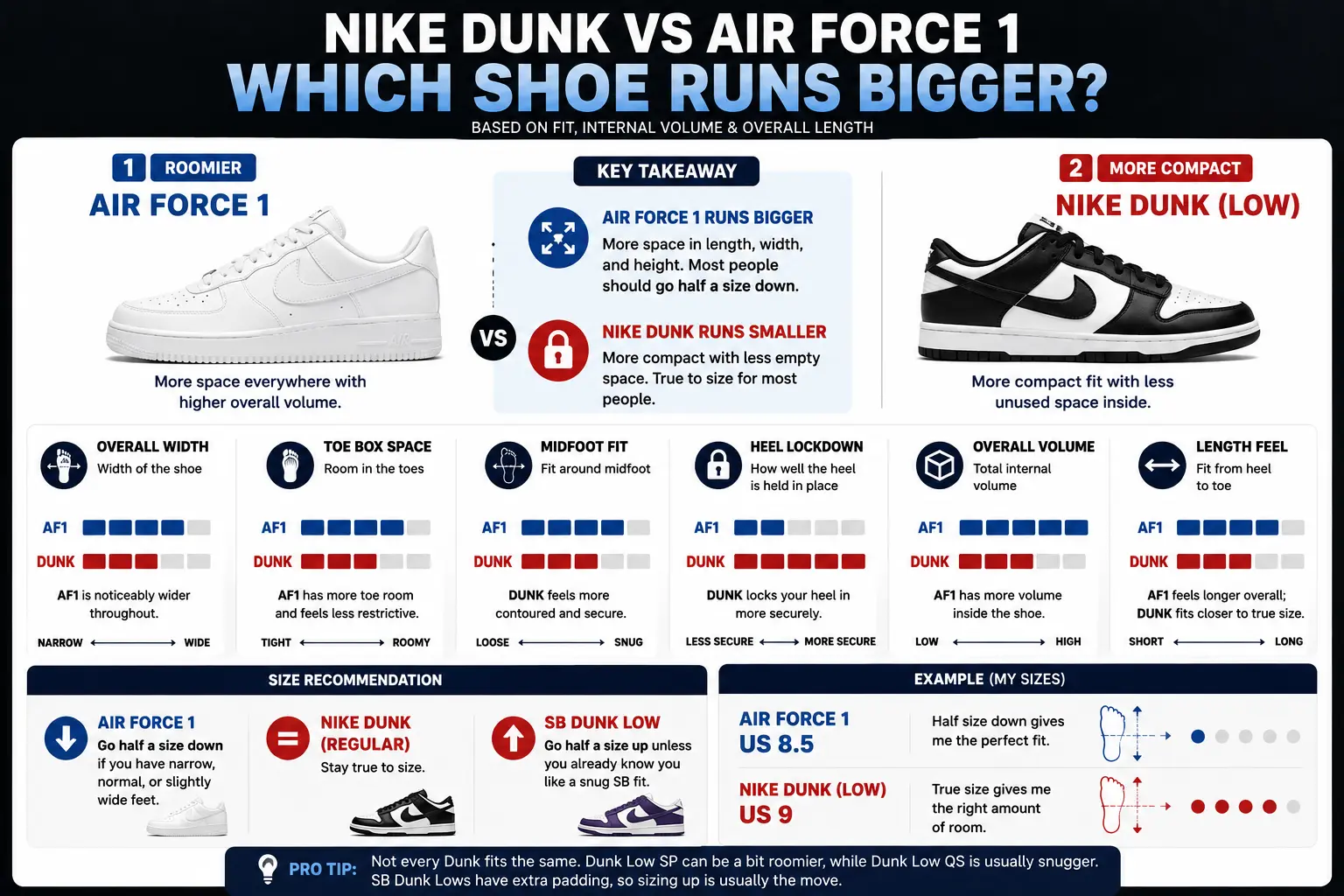
The Air Force 1 has more space everywhere.
When I wear my true size US 9, I end up with almost a full finger’s width in front of my toes. The shoe also feels much more open around my foot, so I naturally prefer going down half a size. That brings everything into proportion.
The Dunk doesn’t give me that extra space.
In my true size US 9, my toes sit exactly where I expect them to. It feels balanced from the first wear, so I’ve never been tempted to size down.
Length is only part of the story, though.
What really separates these two is the amount of empty space inside the shoe.
The Air Force 1 has noticeably more internal volume. There’s more room over the top of my toes, more space around the forefoot, and the fit feels relaxed even after sizing down.
The Dunk feels more compact. It isn’t cramped, but there’s less unused space around my foot, so the shoe feels more precise from the moment I lace it up.
One thing that’s worth mentioning is that not every Dunk follows this exact pattern.
For example, I found the Dunk Low SP to be a little roomier than a standard Dunk Low, while the Dunk Low QS felt noticeably snugger through the forefoot.
If you’re buying an SB Dunk Low, that’s a different fit altogether because of the extra tongue and collar padding, and I generally recommend going half a size up.
If Size Chart Guru helps with your sizing decisions, consider adding the site as a Preferred Source on Google.
My recommendation
- Air Force 1: Go half a size down if you have narrow, normal, or slightly wide feet.
- Nike Dunk (regular): Stay true to size.
- SB Dunk Low: Go half a size up unless you already know you like a snug SB fit.
See my New Balance 550 vs Air Force 1 sizing comparison to see how they differ on foot after wearing both.
Width Comparison
The first time I switched from the Air Force 1 to the Dunk, I noticed the difference in width almost immediately.
Not because the Dunk was narrow, but because the Air Force 1 had spoiled me with how much room it gives you.
See my Air Force 1 vs Adidas Samba sizing comparison to see how the two fit.
Forefoot
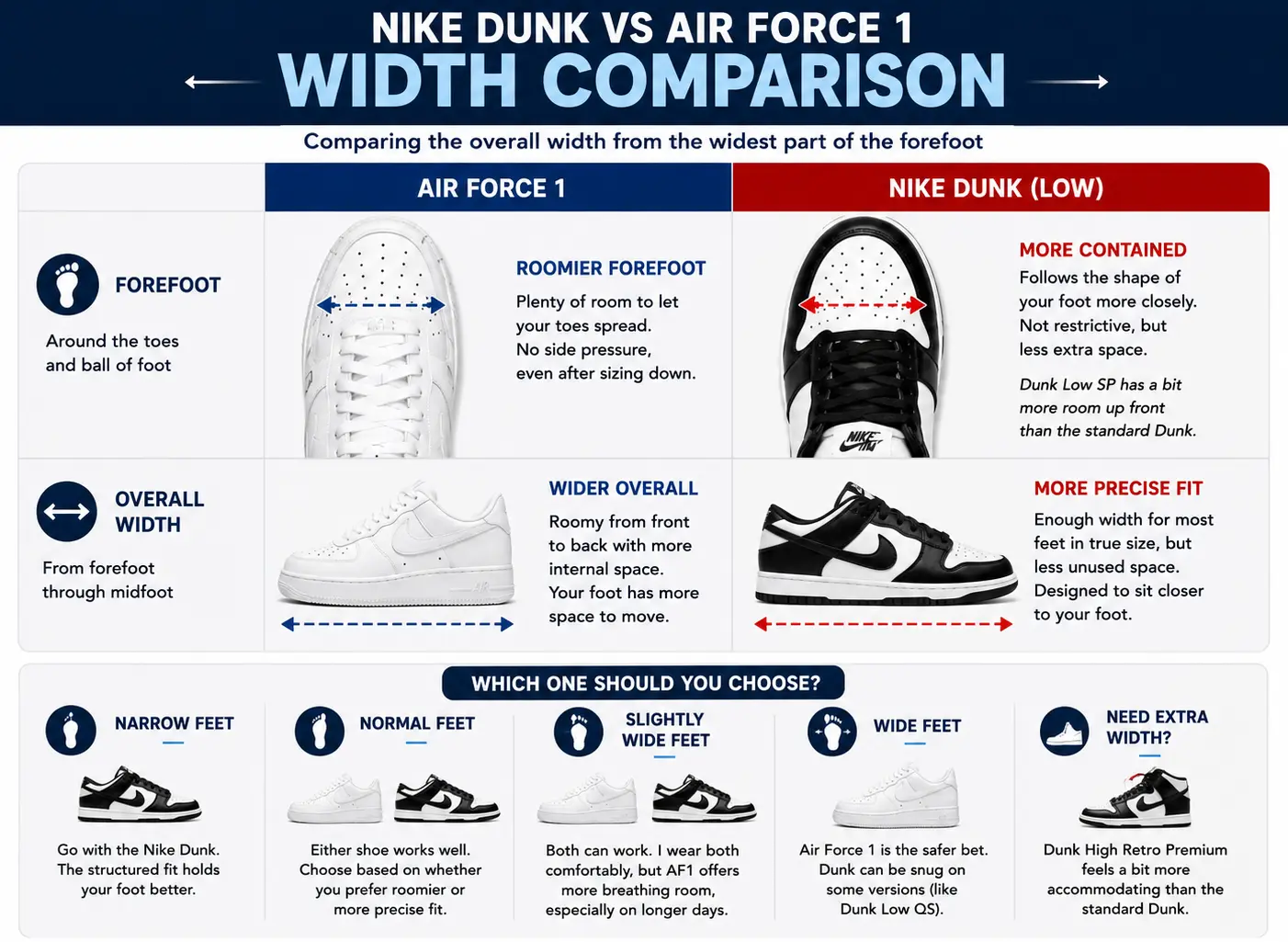
If your forefoot likes a little breathing room, the Air Force 1 is hard to beat.
Even after going down half a size, I never feel my foot pressing against the sides of the shoe. My toes can spread naturally, and there’s enough space that I almost forget about the fit after a few minutes.
The Dunk approaches things differently.
It keeps my forefoot a little more contained. I wouldn’t call it restrictive, but I definitely notice the shoe following the shape of my foot more closely than the Air Force 1.
That extra structure is something I actually enjoy because it makes the shoe feel more stable yet still comfortable.
One exception worth mentioning is that the Dunk Low SP has a little more room through the forefoot than a standard Dunk, so if you’ve worn one before, don’t expect every Dunk to feel quite as spacious.
See my Nike Dunk vs Adidas Samba sizing comparison to see how the two fit side by side.
Overall Width
Looking at the shoe as a whole, the Air Force 1 is still the wider option.
It’s roomy from the forefoot right through the middle of the shoe, which is one of the reasons it works so well for people who don’t like snug-fitting sneakers.
The regular Dunk offers enough width for my slightly wide feet in my true size, but there’s also less unused space around my foot. It feels like Nike designed it to sit a little closer rather than letting your foot move around inside.
See my Air Jordan sizing guide for the major models and the ones that fit differently.
Which One Should You Choose?
If you have narrow feet, I’d lean towards the Nike Dunk. The more structured fit usually does a better job of holding your foot in place.
If you have normal feet, I think either shoe works well. It really comes down to whether you prefer a roomier fit or one that feels a little more precise.
If you have slightly wide feet, both can work. I wear both comfortably, but I appreciate the extra breathing room the Air Force 1 gives me, especially on longer days.
If you have wide feet, the Air Force 1 is the safer bet. The regular Dunk is still wearable for many people, but some versions, like the Dunk Low QS, feel noticeably snugger.
On the other hand, if you’re looking at the Dunk High Retro Premium, I found it to be a little more accommodating than the standard Dunk, making it a better choice if you need a bit of extra width.
Now, if you’re building a Nike collection, my complete Nike sizing guide compares dozens of models so you can see which ones fit similarly and which ones don’t.
See my Air Jordan 1 High vs Mid vs Low fit comparison to see the small differences that can affect your size choice.
Toe Box Comparison
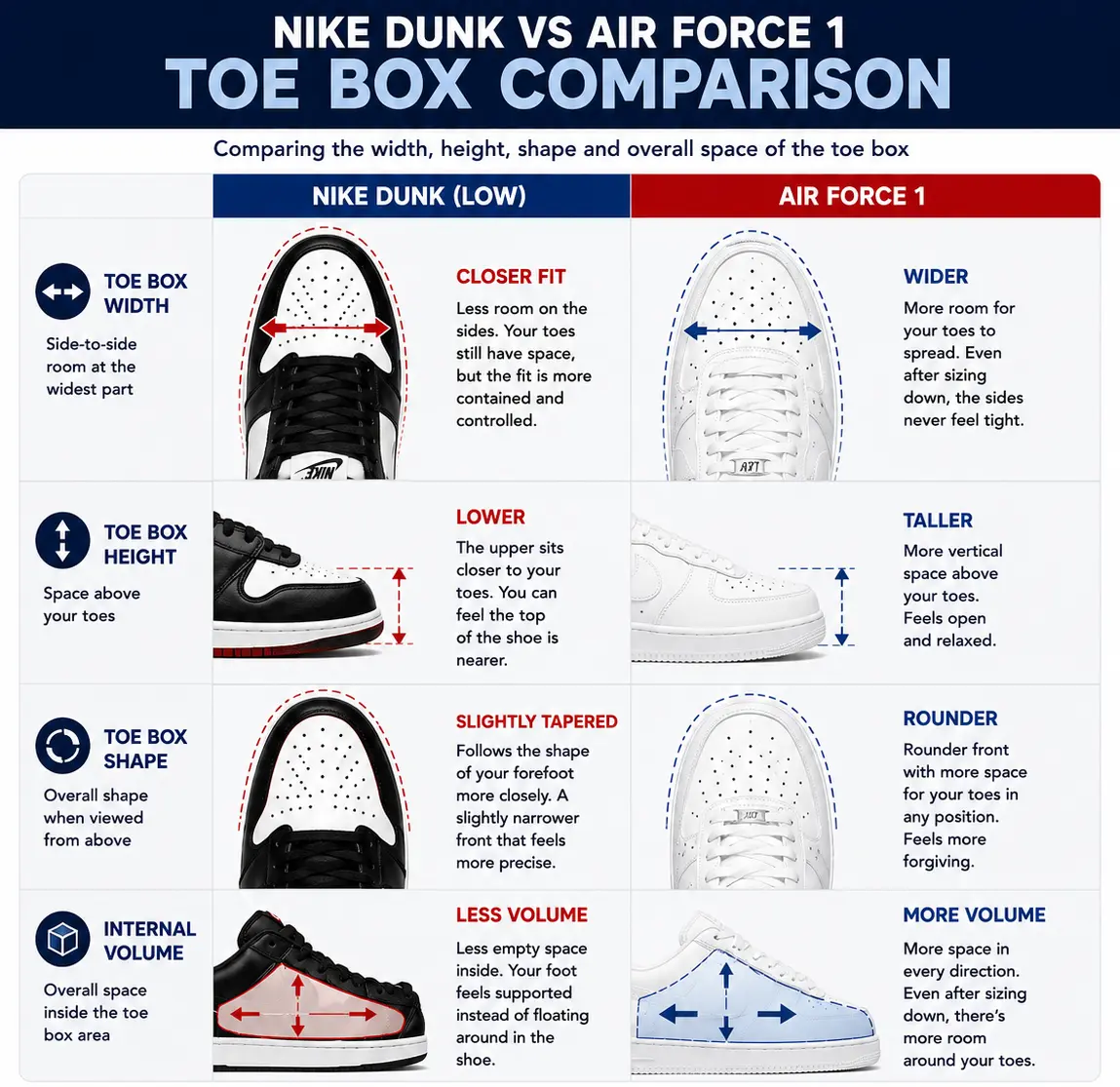
For me, this is where the two shoes stop feeling even remotely similar. I can wear both comfortably, but the experience around my toes is completely different.
Toe Box Width
The Air Force 1 gives my toes noticeably more room to spread.
Even after going down half a size, I never feel like the sides of the toe box are closing in on my foot. It’s one of those shoes I can wear all day without ever thinking about my toes.
The Dunk keeps everything a little closer.
My toes still have enough room to move, but there’s less space on either side, so the front of the shoe feels more controlled. That’s one of the reasons I think the Dunk feels more structured than the Air Force 1.
Toe Box Height
Another difference I noticed is the amount of space above my toes.
The Air Force 1 has a taller toe box, so there’s more air between the top of my toes and the upper, which contributes to the relaxed feel the shoe is known for.
The Dunk sits lower and doesn’t press down on my toes, but I can definitely tell the upper is closer to my foot.
Toe Box Shape
If you put both shoes side by side, the difference is easy to see. The Air Force 1 has a rounder front that gives your toes plenty of room no matter where they sit.
The Dunk has a slightly more tapered shape. It follows the outline of my forefoot more closely, which I actually prefer because it makes the shoe feel more precise.
Internal Volume
The Air Force 1 doesn’t just have a wider or taller toe box. There’s simply more space inside it. Even after sizing down, I still have more room around my toes than I do in a true-to-size Dunk.
The Dunk uses that space differently. There’s less empty volume inside the front of the shoe, so my foot feels more supported instead of floating inside the toe box.
My Take
If toe room is one of your biggest priorities, I’d choose the Air Force 1 every time. It has the wider shape, the taller toe box, and the most internal volume of the two.
If you prefer a toe box that follows the shape of your foot a little more closely, the Nike Dunk strikes a really nice balance. It never feels cramped on my slightly wide feet, but it also doesn’t leave me with the extra space I get in the Air Force 1.
Again, the Dunk Low SP has a little more room through the toe box, while the Dunk Low QS feels noticeably snugger across the front of the foot.
If you’re buying an SB Dunk Low, expect an even more compact feel because the extra padding takes up some of the space inside the shoe.
Midfoot Comparison
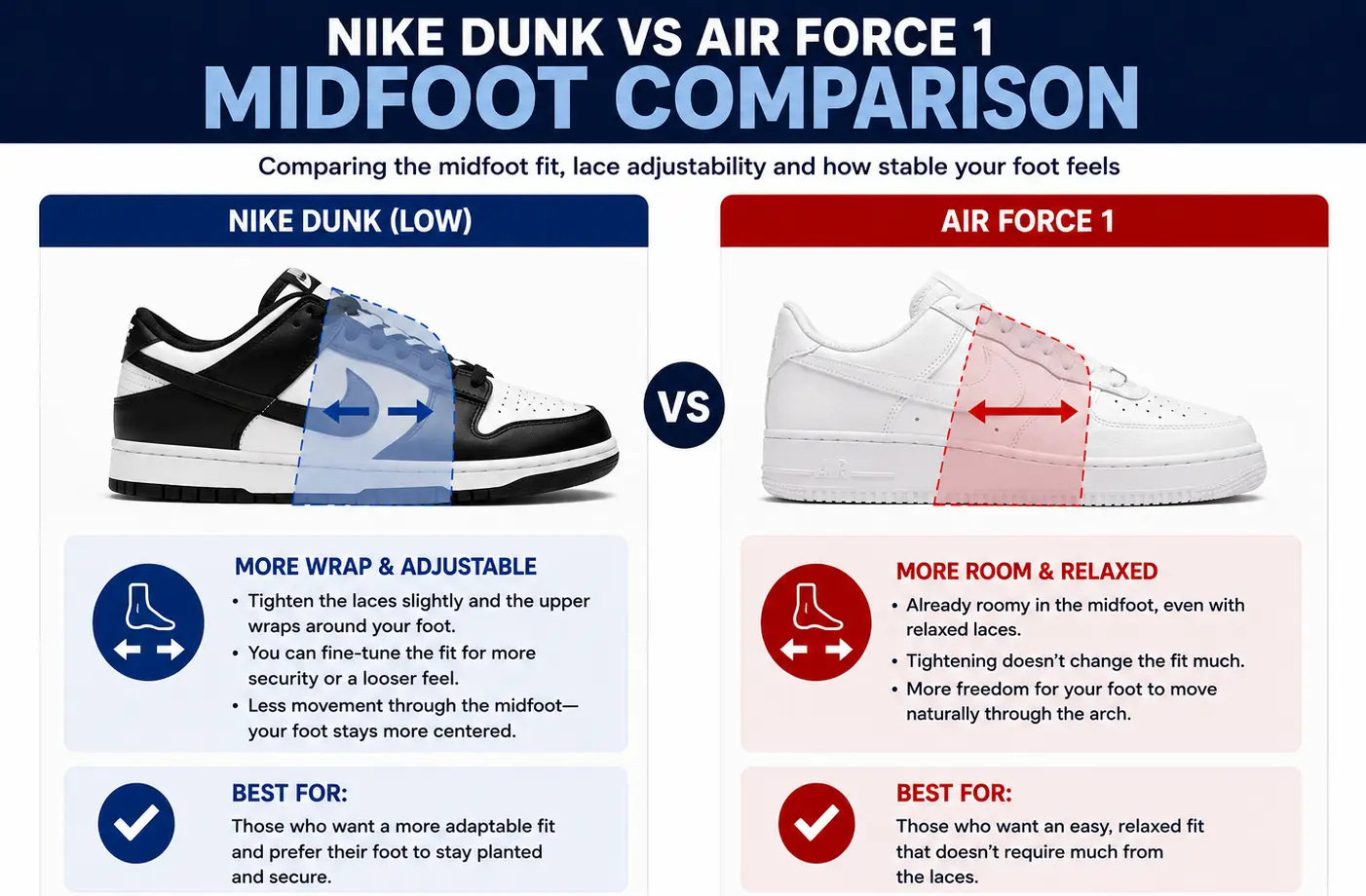
The midfoot is where I noticed myself changing the way I lace each shoe.
With the Air Force 1, I don’t have to think about it very much.
I usually leave the laces fairly relaxed because the shoe already has enough room through the middle of my foot.
Tightening them a lot doesn’t really change the fit in a noticeable way. It just makes the upper feel a little firmer without giving me much extra support.
With the Dunk, a small adjustment to the laces makes a much bigger difference. If I tighten them slightly, I can feel the upper wrapping around the arch and the sides of my foot, which gives the shoe a more secure feel.
That’s one of the reasons I think the Dunk feels more adaptable. I can wear it a little looser for casual use or cinch it down when I want a more locked-in fit.
I also notice less movement through the middle of my foot.
In the Air Force 1, my foot has a bit more freedom to shift naturally as I walk. It’s not enough to make the shoe feel unstable, but the fit is definitely more relaxed through the arch.
The Dunk keeps everything more centered.
As I walk, my foot stays in place instead of moving inside the shoe, and that gives me a better sense of where the shoe is underfoot.
It’s a subtle difference, but after a full day of wearing both, it’s something I always notice.
One thing to keep in mind is that SB Dunks feel different again. The thicker tongue and extra padding fill more of the space around the midfoot, so they naturally wrap your foot more than a regular Dunk.
If you like a shoe that doesn’t ask much of you, the Air Force 1 has the easier, more relaxed fit through the midfoot.
If you enjoy being able to fine-tune the fit with the laces and prefer your foot to stay more planted inside the shoe, I think the Nike Dunk does a better job.
Heel Lockdown Comparison
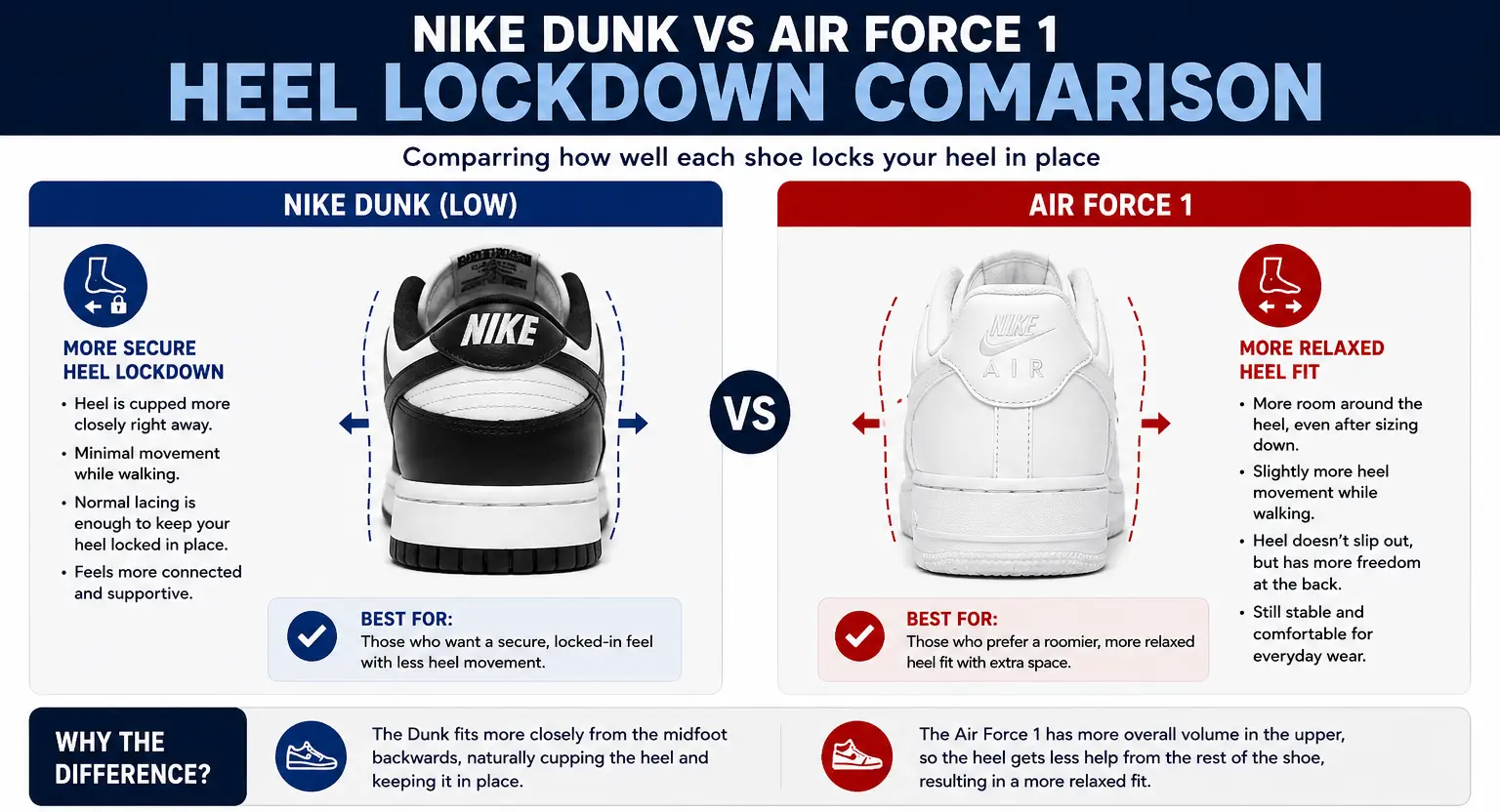
Both of these sneakers hold my heel reasonably well, but they don’t do it in the same way.
The Nike Dunk feels more secure straight away.
As soon as I lace it up, the back of the shoe cups my heel nicely, so I don’t notice much movement when I’m walking. I don’t have to overtighten the laces to get that feeling either. A normal lace tension is enough to keep everything in place.
The Air Force 1 is a little different.
Even after going half a size down, I still notice a bit more heel movement than I do in the Dunk. It’s not heel slip in the sense that my foot is coming out of the shoe, but there’s a little more freedom at the back with each step.
I think that’s simply a result of how the shoe is built.
The Air Force 1 has more room throughout the upper, so the heel doesn’t get as much help from the rest of the shoe. The Dunk fits more closely from the midfoot backwards, and that naturally helps keep your heel where it belongs.
Does that make the Air Force 1 unstable?
Not at all.
I’ve walked for hours in mine without any problems. The wider platform gives the shoe a planted, confidence-inspiring feel, even if the heel isn’t held quite as tightly.
The Dunk just feels a little more dialed in.
When I change direction quickly or walk at a faster pace, I notice my foot and the shoe moving together more consistently. It’s a small difference, but once you’ve worn both for a while, it’s hard not to notice.
My Take
If a secure heel is high on your priority list, I’d give the edge to the Nike Dunk.
If you prefer a more relaxed fit and don’t mind a little extra movement around the heel, the Air Force 1 is still excellent for everyday wear. The extra room never bothered me, but the Dunk is the shoe that feels more locked in from the first step.
How They Feel On Foot
On paper, the Nike Dunk and the Air Force 1 don’t seem that far apart. Once you start wearing them, though, they have completely different personalities.
The Air Force 1 is the kind of shoe I don’t think about once it’s on my feet.
I slip it on, tie the laces, and get on with my day. There’s a relaxed feel to it that comes from having a little extra space around your foot.
Nothing feels forced, and nothing feels like it’s trying to hold your foot in a particular position.
It also feels very planted.
The wider platform and larger shape give every step a solid, grounded feel. It’s not a shoe that encourages you to move quickly.
Instead, it feels steady and dependable, which is one of the reasons I reach for it when I know I’ll be walking around all day.
The Nike Dunk gives me a different impression.
The first thing I notice is that it follows my foot more closely. As I walk, the shoe bends where my foot bends, so it almost disappears beneath me after a while.
I don’t notice extra space or movement inside the shoe because there really isn’t much.
That makes it feel more responsive.
I’m not talking about cushioning or performance. I simply feel more connected to the shoe. Whether I’m turning a corner, walking up stairs, or changing direction, the Dunk reacts a little more like an extension of my foot than the Air Force 1 does.
But neither feeling is better.
Some days I want the easygoing character of the Air Force 1. Other days I want the more connected feel of the Dunk.
For me, that’s the biggest difference between them, and it’s something you only really appreciate after you’ve spent time wearing both.
Which Shoe Fits Your Foot Shape?
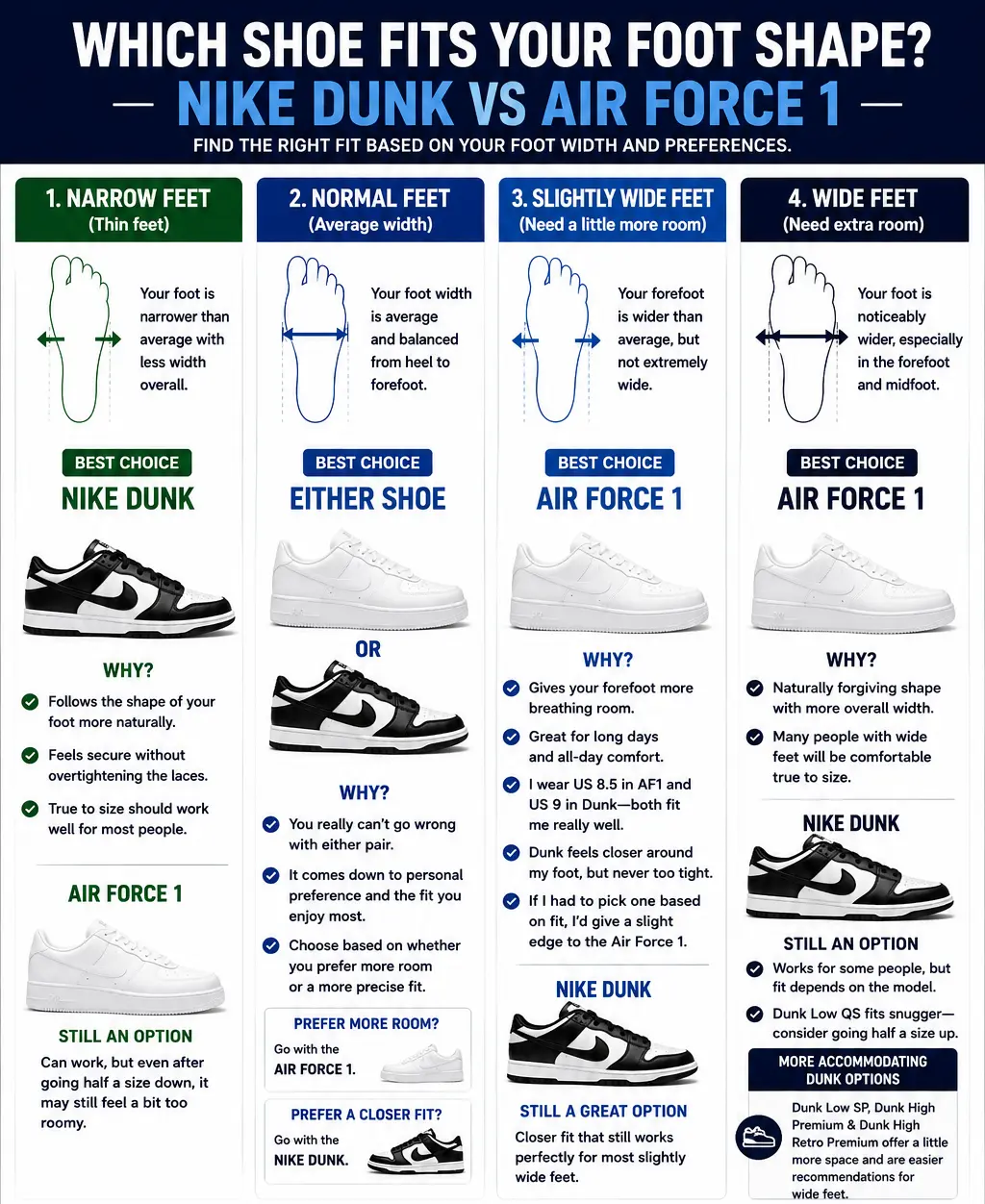
By now, you’ve probably realized that this isn’t really about which shoe is “better.” It’s about which one matches your feet.
Here’s who I think each shoe suits best after wearing both for years.
Narrow Feet
If you have narrow feet, I’d start with the Nike Dunk.
The shape follows your foot more naturally, so you’ll probably appreciate the closer fit through the middle of the shoe. It feels secure without needing to crank down on the laces, and true to size should work well for most people.
The Air Force 1 can still work, but even after going half a size down, it may still feel a little roomier than you’d like.
Normal Feet
If your feet are average in width, I don’t think you can go wrong with either pair. This is where personal preference takes over.
If you like having a bit of extra room and an easygoing fit, I’d lean towards the Air Force 1.
If you prefer your shoes to feel a little more precise and closer to your feet, I’d choose the Nike Dunk.
Slightly Wide Feet
This is the category I fall into, so it’s the one I feel most confident talking about. Again, I wear a US 8.5 in the Air Force 1 and a US 9 in the regular Dunk, and both fit me really well.
The Air Force 1 gives my forefoot a little more breathing room, which I appreciate on long days. The Dunk feels closer around my foot, but never tight enough to make me wish I’d gone up a size.
If I had to pick one based purely on fit, I’d probably give a slight edge to the Air Force 1, simply because it accommodates my forefoot a little more naturally.
Wide Feet
If your feet are genuinely wide, I’d start with the Air Force 1.
Its shape is naturally forgiving, and many people with wide feet will be comfortable staying true to size.
The regular Dunk can still work, but this is where the specific version becomes important.
Some models, like the Dunk Low QS, fit noticeably snugger than a standard Dunk, so I’d be more inclined to go half a size up if I had wide feet.
On the other hand, I found the Dunk Low SP, Dunk High Premium, and Dunk High Retro Premium to be a little more accommodating than the standard Dunk, making them easier recommendations if you need a bit of extra space.
My Recommendation
If your priority is giving your feet as much room as possible, I’d choose the Air Force 1.
If you like your sneakers to feel a little more structured without becoming restrictive, I’d go with the Nike Dunk.
Personally, I enjoy wearing both. I just reach for a different pair depending on the kind of fit I’m in the mood for.
Who Should NOT Buy These Shoes?
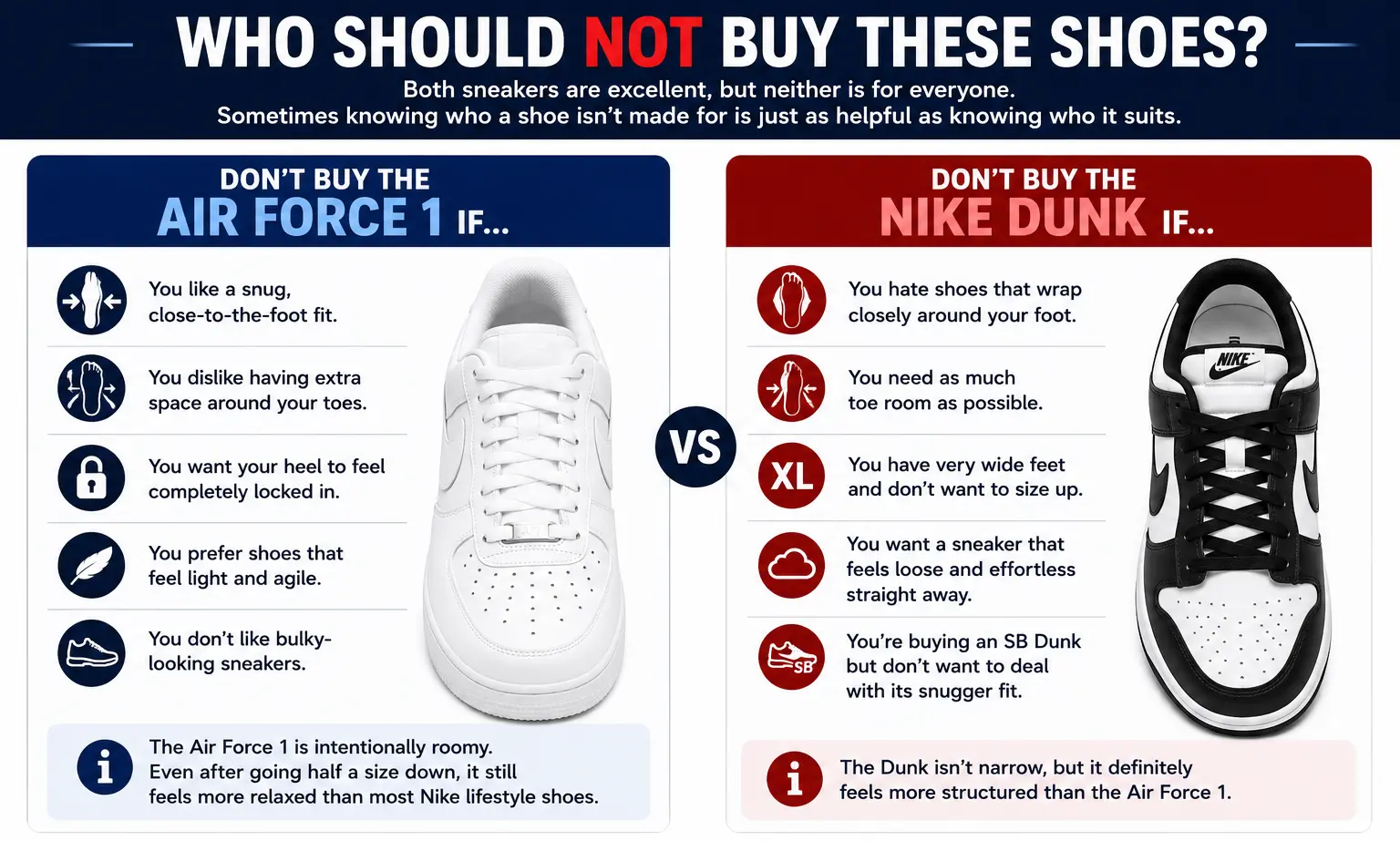
Both sneakers are excellent, but neither is for everyone.
Sometimes knowing who a shoe isn’t made for is just as helpful as knowing who it suits.
Don’t Buy the Air Force 1 If…
- You like a snug, close-to-the-foot fit.
- You dislike having extra space around your toes.
- You want your heel to feel completely locked in.
- You prefer shoes that feel light and agile.
- You don’t like bulky-looking sneakers.
The Air Force 1 is intentionally roomy. Even after going half a size down, it still feels more relaxed than most Nike lifestyle shoes.
Don’t Buy the Nike Dunk If…
- You hate shoes that wrap closely around your foot.
- You need as much toe room as possible.
- You have very wide feet and don’t want to size up.
- You want a sneaker that feels loose and effortless straight away.
- You’re buying an SB Dunk but don’t want to deal with its snugger fit.
The Dunk isn’t narrow, but it definitely feels more structured than the Air Force 1.
Not Every Version Fits the Same
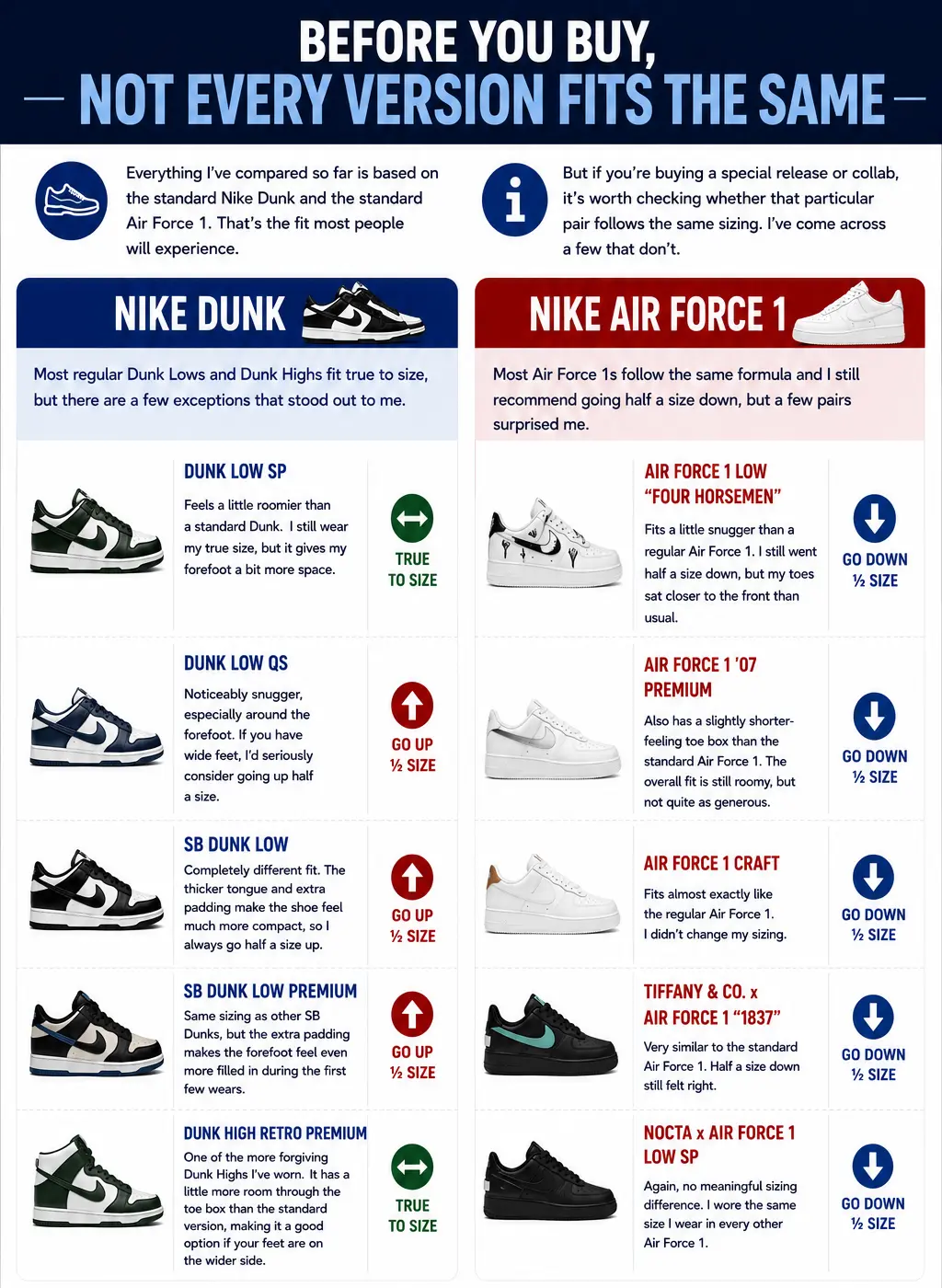
Everything I’ve compared so far is based on the standard Nike Dunk and the standard Air Force 1.
That’s the fit most people will experience.
But if you’re buying a special release or collab, it’s worth checking whether that particular pair follows the same sizing. I’ve come across a few that don’t.
Nike Dunk
Most regular Dunk Lows and Dunk Highs fit true to size, but there are a few exceptions that stood out to me.
Dunk Low SP: Feels a little roomier than a standard Dunk. I still wear my true size, but it gives my forefoot a bit more space.
Dunk Low QS: Noticeably snugger, especially around the forefoot. If you have wide feet, I’d seriously consider going up half a size.
SB Dunk Low: Completely different fit. The thicker tongue and extra padding make the shoe feel much more compact, so I always go half a size up.
SB Dunk Low Premium: Same sizing as other SB Dunks, but the extra padding makes the forefoot feel even more filled in during the first few wears.
Dunk High Retro Premium: One of the more forgiving Dunk Highs I’ve worn. It has a little more room through the toe box than the standard version, making it a good option if your feet are on the wider side.
Nike Air Force 1
Most Air Force 1s follow the same formula and I still recommend going half a size down, but a few pairs surprised me.
Air Force 1 Low “Four Horsemen”: Fits a little snugger than a regular Air Force 1. I still went half a size down, but my toes sat closer to the front than usual.
Air Force 1 ’07 Premium: Also has a slightly shorter-feeling toe box than the standard Air Force 1. The overall fit is still roomy, but not quite as generous.
Air Force 1 Craft: Fits almost exactly like the regular Air Force 1. I didn’t change my sizing.
Tiffany & Co. x Air Force 1 “1837”: Very similar to the standard Air Force 1. Half a size down still felt right.
NOCTA x Air Force 1 Low SP: Again, no meaningful sizing difference. I wore the same size I wear in every other Air Force 1.
My Take
If you’re buying a regular Nike Dunk or a regular Air Force 1, the sizing advice from this comparison will work for the vast majority of people.
If you’re looking at a collab or special release, though, it’s worth checking whether that particular version changes the fit. Sometimes the difference is small, but when you’re spending good money on a pair of sneakers, it’s the kind of detail that can save you from ordering the wrong size.
How They Look On Foot
Even if the Nike Dunk and the Air Force 1 fit you equally well, they don’t create the same look once they’re on your feet.
That’s something I didn’t really appreciate until I started wearing them with the same outfits.
The Air Force 1 has a much bigger presence.
The thick sole, wider shape, and generous upper make it look like a substantial sneaker. It fills out baggier jeans and relaxed trousers really well because it has enough visual weight to balance the outfit.
It’s also a shoe that looks wider than it actually feels. Even after sizing down half a size, it still has that chunky, unmistakable Air Force 1 silhouette.
The Nike Dunk isn’t a slim sneaker in the way the Adidas Samba is, but it definitely looks leaner than the Air Force 1. The sole isn’t as bulky, the upper sits closer to your foot, and the whole shoe has a cleaner profile from heel to toe.
That makes it incredibly versatile.
Whether I’m wearing straight-leg jeans, cargos, or shorts, the Dunk never feels like it’s dominating the outfit. It blends in a little more while still looking like a classic basketball sneaker.
Another thing I’ve noticed is how each shoe changes with different color blocking.
Simple two-tone Dunk colorways tend to make the shoe look even sleeker because the paneling stands out so well.
The Air Force 1, especially in an all-white colorway, looks smoother and more solid. Your eye is drawn to the overall shape rather than the individual panels.
My Take
If you like sneakers with a chunkier, more substantial look, I’d go with the Air Force 1.
If you prefer a silhouette that’s a little cleaner, slimmer, and less bulky, I’d choose the Nike Dunk.
For me, neither looks better than the other. It depends entirely on the outfit. Some days I want the bold, unmistakable shape of the Air Force 1, and other days I want the cleaner proportions of the Dunk. That’s exactly why I still keep both in my rotation.
Which Shoe Should You Buy? (Decision Tree)
If you’re still undecided, here’s how I’d narrow it down.
You like having plenty of room around your foot
➡️ Go with the Air Force 1.
The extra space through the forefoot and toe box gives it a relaxed feel that works well if you don’t enjoy snug-fitting sneakers.
You prefer your shoes to feel secure
➡️ Choose the Nike Dunk.
It wraps around your foot more naturally, and once it’s laced up, everything feels held in place without being restrictive.
You have wide feet
➡️ Start with the Air Force 1.
Its roomier shape makes it the safer option for most wide-footed people. If you’re looking at a regular Dunk, it can still work, but you’ll need to pay more attention to the specific version you’re buying.
You have narrow feet
➡️ The Nike Dunk is likely to suit you better.
The closer fit helps prevent your foot from moving around inside the shoe, which gives it a more secure feel.
You’re buying your first pair
➡️ I’d recommend the Air Force 1.
The fit is forgiving, and sizing is straightforward for most people. Going half a size down usually gives you the balance of comfort and security that most people are looking for.
You already own an Air Force 1
➡️ Buy the Dunk in your regular Nike size.
For example, I wear a US 8.5 in the Air Force 1 but a US 9 in the regular Dunk.
You’re looking at an SB Dunk
➡️ Don’t use your regular Dunk size automatically.
SB Dunks have a much more padded interior, so I recommend going half a size up unless you already know you like a snug SB fit.
My Recommendation
If I had to recommend just one based purely on fit, I’d choose the Nike Dunk. I like the way it follows my foot and the more connected feel it gives me when I walk.
That said, the Air Force 1 is still the shoe I’d point most people towards if they’re after an easygoing, roomy fit or they simply want something that’s comfortable straight out of the box.
Neither is the better sneaker.
The right choice comes down to a simple question:
Do you want your shoes to feel like they’re wrapped around your feet, or do you want them to disappear beneath them? That’s the difference between the Dunk and the Air Force 1.
Dunk/AF1 vs Other Sneakers
If you already own another sneaker, here’s the size I’d get…
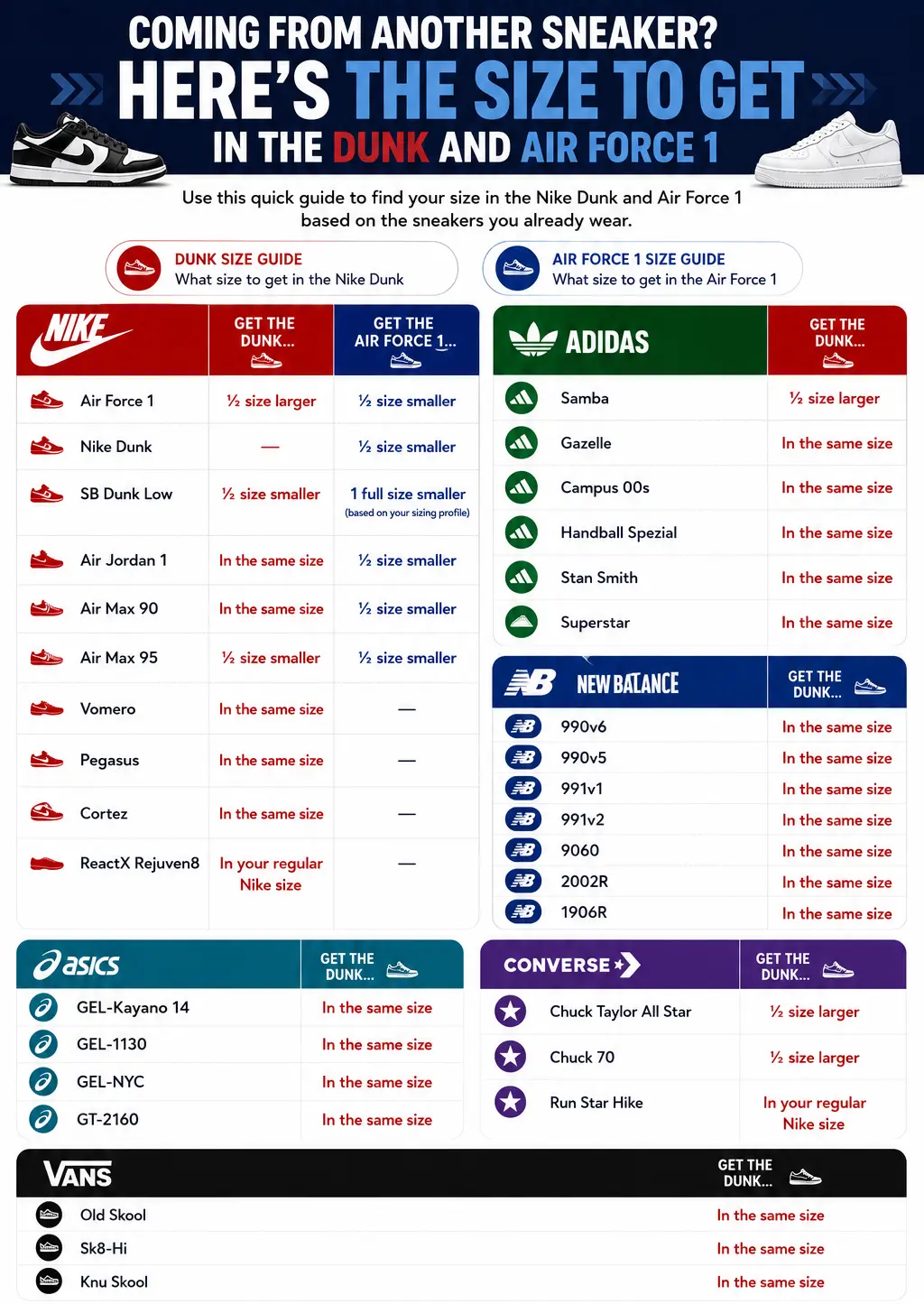
Use these popular Nike, Adidas, New Balance, ASICS, Converse, and Vans models as a quick sizing reference.
Nike
If you already wear…
- Air Force 1: Get the Nike Dunk ½ size larger.
- Nike Dunk: Get the Air Force 1 ½ size smaller.
- SB Dunk Low: Get the regular Dunk ½ size smaller.
- SB Dunk Low: Get the Air Force 1 1 full size smaller (based on your sizing profile).
- Air Jordan 1: Get the Nike Dunk in the same size.
- Air Jordan 1: Get the Air Force 1 ½ size smaller.
- Air Max 90: Get the Nike Dunk in the same size.
- Air Max 90: Get the Air Force 1 ½ size smaller.
- Air Max 95: Get the Nike Dunk ½ size smaller.
- Vomero: Get the Nike Dunk in the same size.
- Pegasus: Get the Nike Dunk in the same size.
- Cortez: Get the Nike Dunk in the same size.
- ReactX Rejuven8: Get the Nike Dunk in your regular Nike size.
See my guide to whether Nike Air Max models run small or big before choosing your size.
Adidas
If you already wear…
- Samba: Get the Nike Dunk ½ size larger.
- Gazelle: Get the Nike Dunk in the same size.
- Campus 00s: Get the Nike Dunk in the same size.
- Handball Spezial: Get the Nike Dunk in the same size.
- Stan Smith: Get the Nike Dunk in the same size.
- Superstar: Get the Nike Dunk in the same size.
See my guide to how Adidas sneakers fit to see how sizing changes across the brand.
New Balance
If you already wear…
- 990v6: Get the Nike Dunk in the same size.
- 990v5: Get the Nike Dunk in the same size.
- 991v1: Get the Nike Dunk in the same size.
- 991v2: Get the Nike Dunk in the same size.
- 9060: Get the Nike Dunk in the same size.
- 2002R: Get the Nike Dunk in the same size.
- 1906R: Get the Nike Dunk in the same size.
See my New Balance 990 sizing and fit guide to see how the different 990 models compare in sizing and overall feel.
ASICS
If you already wear…
- GEL-Kayano 14: Get the Nike Dunk in the same size.
- GEL-1130: Get the Nike Dunk in the same size.
- GEL-NYC: Get the Nike Dunk in the same size.
- GT-2160: Get the Nike Dunk in the same size.
See my Asics sneaker sizing and fit guide to see how sizing changes from one model to another.
Converse
If you already wear…
- Chuck Taylor All Star: Get the Nike Dunk ½ size larger.
- Chuck 70: Get the Nike Dunk ½ size larger.
- Run Star Hike: Get the Nike Dunk in your regular Nike size.
Vans
If you already wear…
- Old Skool: Get the Nike Dunk in the same size.
- Sk8-Hi: Get the Nike Dunk in the same size.
- Knu Skool: Get the Nike Dunk in the same size.
See my guide to how Vans fit and which models tend to run true to size.
Final Size Recommendation Table
| Category | Air Force 1 | Nike Dunk |
|---|---|---|
| Runs Big? | ✅ Yes | ❌ No |
| Recommended Size | ½ size down | True to size |
| Overall Length | Longer fit | True to length |
| Toe Box | Wide & roomy | Medium width |
| Toe Box Height | High | Medium |
| Forefoot | Spacious | Slightly snug |
| Midfoot Fit | Relaxed | More secure |
| Heel Lockdown | Good | Excellent |
| Overall Width | Wide | Medium |
| Overall Volume | High | Medium |
| Best for Wide Feet | ★★★★★ | ★★★☆☆ |
| Best for Narrow Feet | ★★★☆☆ | ★★★★★ |
| Everyday Wear | ★★★★★ | ★★★★☆ |
| Break-in | Very easy | Easy |
| Overall Feel | Relaxed & planted | Connected & structured |
Nike Dunk vs Air Force 1 Sizing Final Verdict
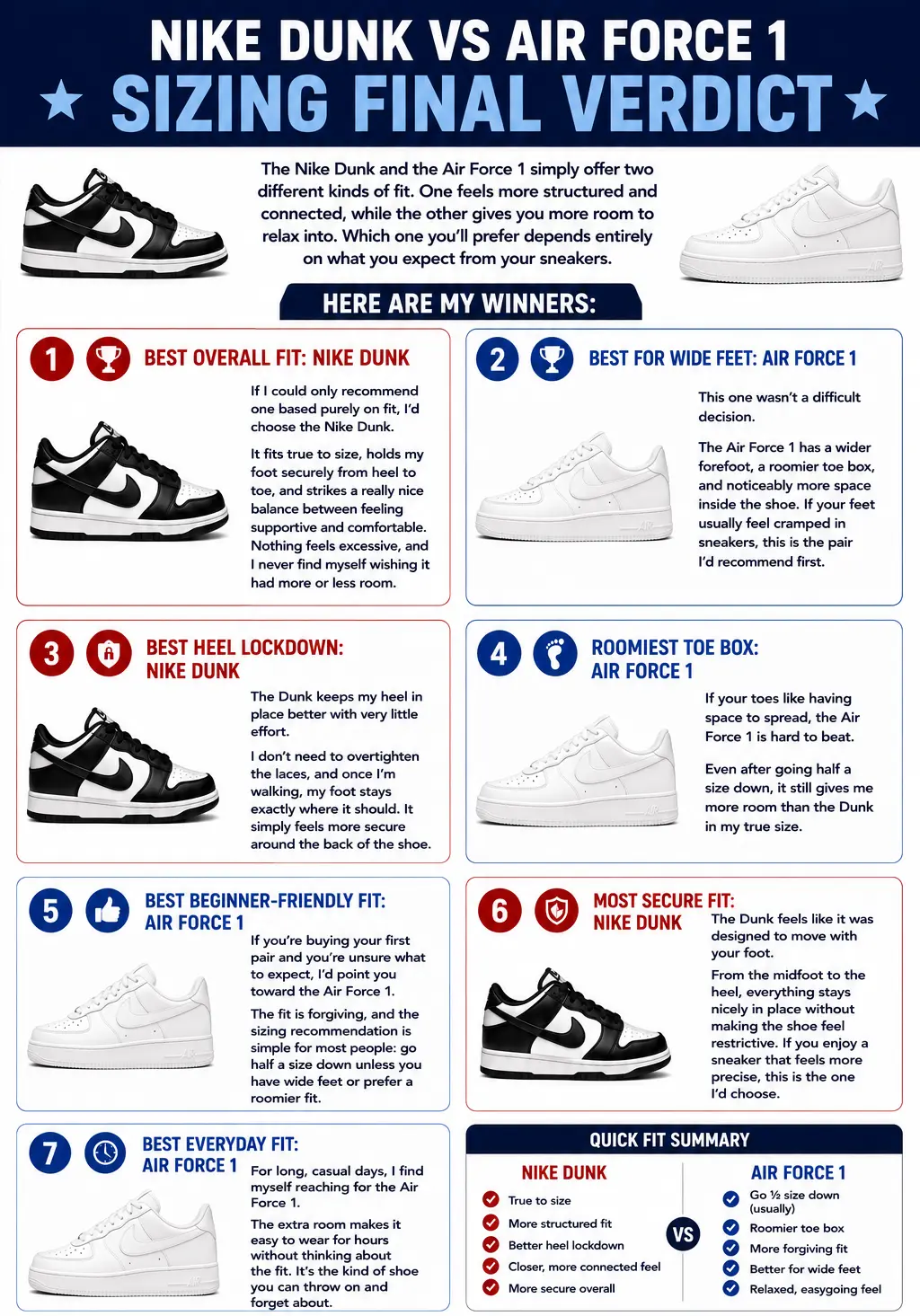
The Nike Dunk and the Air Force 1 simply offer two different kinds of fit. One feels more structured and connected, while the other gives you more room to relax into. Which one you’ll prefer depends entirely on what you expect from your sneakers.
Here are my winners:
🏆 Best Overall Fit: Nike Dunk
If I could only recommend one based purely on fit, I’d choose the Nike Dunk.
It fits true to size, holds my foot securely from heel to toe, and strikes a really nice balance between feeling supportive and comfortable. Nothing feels excessive, and I never find myself wishing it had more or less room.
🏆 Best for Wide Feet: Air Force 1
This one wasn’t a difficult decision.
The Air Force 1 has a wider forefoot, a roomier toe box, and noticeably more space inside the shoe. If your feet usually feel cramped in sneakers, this is the pair I’d recommend first.
🏆 Best Heel Lockdown: Nike Dunk
The Dunk keeps my heel in place better with very little effort.
I don’t need to overtighten the laces, and once I’m walking, my foot stays exactly where it should. It simply feels more secure around the back of the shoe.
🏆 Roomiest Toe Box: Air Force 1
If your toes like having space to spread, the Air Force 1 is hard to beat.
Even after going half a size down, it still gives me more room than the Dunk in my true size.
🏆 Best Beginner-Friendly Fit: Air Force 1
If you’re buying your first pair and you’re unsure what to expect, I’d point you toward the Air Force 1.
The fit is forgiving, and the sizing recommendation is simple for most people: go half a size down unless you have wide feet or prefer a roomier fit.
🏆 Most Secure Fit: Nike Dunk
The Dunk feels like it was designed to move with your foot.
From the midfoot to the heel, everything stays nicely in place without making the shoe feel restrictive. If you enjoy a sneaker that feels more precise, this is the one I’d choose.
🏆 Best Everyday Fit: Air Force 1
For long, casual days, I find myself reaching for the Air Force 1.
The extra room makes it easy to wear for hours without thinking about the fit. It’s the kind of shoe you can throw on and forget about.
My Final Take
I don’t think this comparison comes down to which sneaker is better.
If you enjoy having extra room, a generous toe box, and a relaxed fit, I’d go with the Air Force 1.
If you prefer a shoe that follows the shape of your foot more closely and gives you a more connected feel as you walk, I’d choose the Nike Dunk.
Personally, I wear both regularly.
The Air Force 1 is the pair I reach for when I want an effortless, roomy fit. The Dunk is the one I pick when I want something that feels a little more dialed in.
That’s why I keep an 8.5 in the Air Force 1 and a 9 in the regular Dunk. Those sizes let each shoe fit the way I think it was designed to.
Nike Dunk vs Air Force 1 Sizing FAQs
Are Nike Dunks the same size as Air Force 1?
No, and that’s one of the biggest mistakes people make.
I wear a US 9 in the regular Nike Dunk but a US 8.5 in the Air Force 1. The Air Force 1 naturally fits longer and has much more room inside, so going half a size down gives me a better fit. The Dunk fits much closer to true size, so I’ve never felt the need to change sizes.
Should I size up or down for the Air Force 1?
For most people, I’d recommend going half a size down.
That’s what has worked best for me after wearing multiple versions of the Air Force 1. The shoe naturally has a roomy toe box and plenty of internal volume, so sizing down helps eliminate the extra space without making it feel tight.
If you have genuinely wide feet or simply enjoy a roomier fit, staying true to size is still a good option.
Should I size up or down for Nike Dunks?
For regular Nike Dunks, I’d stay true to size. That’s the size that gives me the right balance between toe room and security.
The exception is SB Dunks. Because of the thicker tongue and extra padding, I always recommend going half a size up unless you already know you like a snug SB fit.
How do Nike Dunks fit compared to other Nike shoes?
Regular Dunks fit very much like I’d expect from a classic Nike lifestyle sneaker.
- Compared to the Air Force 1, they fit closer to the foot.
- Compared to the Air Jordan 1, they feel a little more structured.
- Compared to SB Dunks, they feel noticeably roomier because they don’t have all the extra padding.
For me, my regular Nike size works perfectly in the Dunk.
Are Nike Dunks wide?
I wouldn’t describe them as wide.
They’re fairly average in width, with enough room for my slightly wide forefoot when I wear my true size.
If you have very wide feet, the Air Force 1 will usually be the more accommodating choice. Some Dunk versions, like the Dunk Low SP and Dunk High Retro Premium, are a little more forgiving than the standard Dunk, while others, like the Dunk Low QS, feel noticeably snugger.
Do Nike Dunks and Air Force 1 stretch over time?
Yes, but only slightly.
As the upper softens, both shoes become more flexible and adapt better to your feet. What doesn’t happen is a dramatic increase in size. If your toes are already pressing hard against the front or sides of the shoe when it’s brand new, I wouldn’t expect break-in alone to solve the problem.
It’s always better to start with the correct size than hope the shoe stretches enough later.
Do Nike Dunk Lows fit the same as Dunk Highs?
For the most part, yes.
I wear the same size in both. The main difference is the feeling around your ankle. The High naturally gives you a little more support because of the taller collar, but the length and overall sizing remain very similar.
Some special editions, like the Dunk High Retro Premium, feel slightly roomier than a standard Dunk High, but I still wear my usual size.
How should Nike Dunks fit?
For me, the ideal Dunk fit is simple. My heel stays secure, my toes have enough room to move naturally, and nothing feels tight across the front of my foot. I don’t want my toes touching the end of the shoe, but I also don’t want unnecessary empty space inside. If your foot feels comfortably supported without sliding around as you walk, you’ve probably found the right size.
How long does it take to break in Nike Dunks and Air Force 1s?
Neither shoe takes very long to break in.
The Air Force 1 usually feels comfortable almost immediately because it has more room to begin with. The leather gradually softens over the first few wears, especially where it creases across the forefoot.
The Nike Dunk often feels a little stiffer straight out of the box, particularly around the toe box and side panels. I normally wear mine around the house for a couple of hours at a time before taking them out for a full day.
A few things that help:
- Wear them for shorter sessions during the first few days.
- Use slightly thicker socks if the leather feels stiff.
- Lace them normally instead of pulling them as tight as possible.
- Let the leather soften naturally with wear.
- Avoid using excessive heat or soaking the shoes in water.
After a handful of wears, both shoes usually feel noticeably more flexible.
Do Nike Dunk Lows fit wide feet?
They can, but it depends on how wide your feet are. I have a slightly wide forefoot and wear my regular size without any issues.
If your feet are significantly wider than average, you may prefer going half a size up, especially if you’re buying a snugger version like the Dunk Low QS or an SB Dunk Low.
If width is your biggest concern, I’d still recommend the Air Force 1 first because it simply gives you more room throughout the shoe.
How can I make my Nike Dunks fit bigger?
If your Dunks feel just a little snug, there are a few safe ways to create a bit more room.
One method that has worked well for me is wearing thick socks, putting the shoes on, and then using a hair dryer on medium heat for about 20 to 30 seconds at a time over the tight areas. As the leather warms up, walk around in the shoes until they cool down. This helps the upper mold to the shape of your feet.
Another option is using an adjustable shoe stretcher.
Leave it inside the shoe overnight, focusing on the toe box if that’s where you need the extra space. It’s a slower approach, but it’s also the most consistent if you’re trying to gain a little more width.
A few things I’d avoid:
- Don’t use high heat, as it can damage the leather and adhesives.
- Don’t expect the shoe to stretch by a full size. These methods only create a small amount of extra room.
- If your toes are heavily cramped or touching the front of the shoe, it’s usually a sign that the shoes are simply the wrong size.
In my experience, stretching works best for easing pressure on the sides of the forefoot, not for fixing a shoe that’s too short.
Final Thoughts
So, how do Nike Dunks fit compared to Air Force 1s?
For me, it comes down to one simple difference.
The Air Force 1 gives you more room to breathe. It has a wider fit, a roomier toe box, and enough extra space that I prefer going half a size down.
The Nike Dunk feels more balanced. I stay true to size, and it gives me the secure, close-to-the-foot fit that I personally enjoy without ever feeling restrictive.
Neither approach is right or wrong. It simply depends on how you like your sneakers to fit.
If you’re after a relaxed, easygoing fit, I’d point you towards the Air Force 1. If you prefer a sneaker that feels a little more connected to your foot, I think the Dunk is the better choice.
I’d love to hear about your experience too.
Do you wear the same size in both, or did you have to size up or down? Which pair fits you better, and do you have narrow, normal, or wide feet?
Leave a comment below and let me know.