
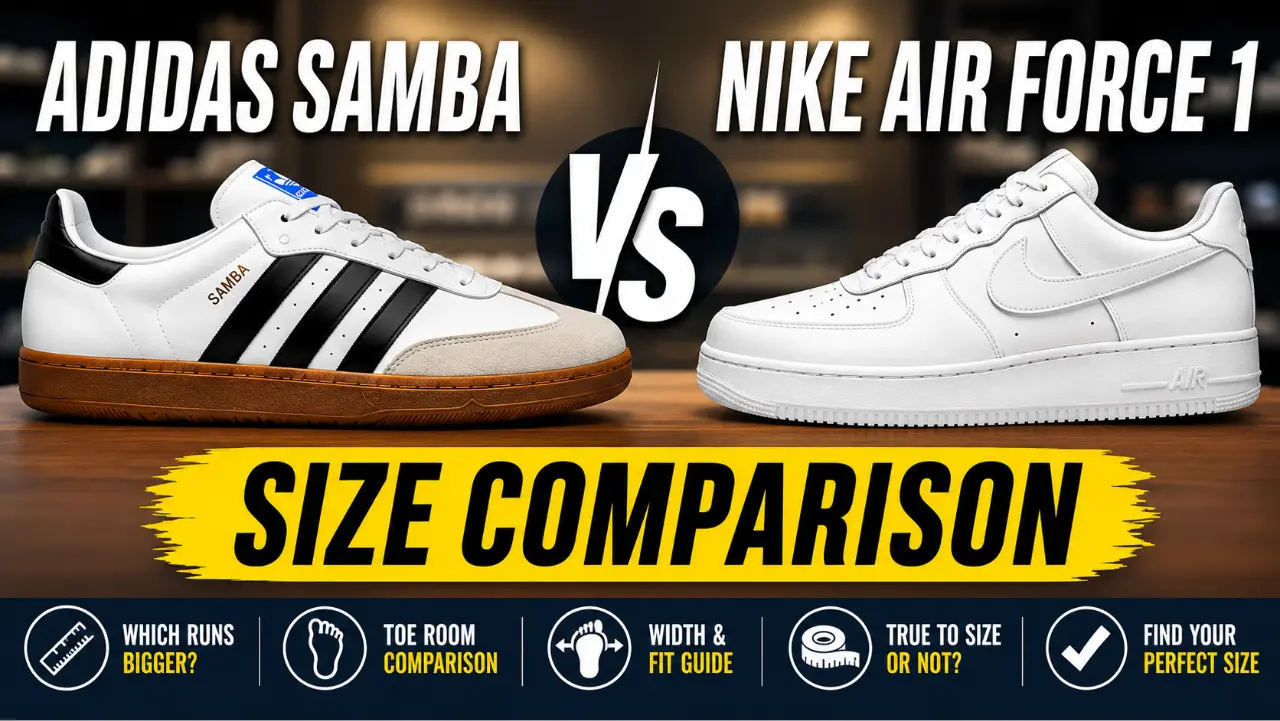
The Adidas Samba and Nike Air Force 1 may both be everyday classics, but they fit very differently.
If you’re wondering whether you can wear the same size in both, the answer is usually no.
If you only want the sizing advice, here’s the short version:
Quick Answer
The Nike Air Force 1 runs bigger. I recommend going half a size down for most people because it has a roomy toe box, generous internal volume, and a relaxed fit.
The Adidas Samba fits much closer to your foot. I recommend true to size for narrow or normal feet and half a size up for slightly wide or wide feet, since its narrow shape and lower-volume design can feel restrictive.
Most people shouldn’t wear the same size in both. The Air Force 1 and Samba have completely different fit philosophies, so your ideal size will often differ between them.

My Quick Recommendations
Nike Air Force 1
- Narrow feet: Half a size down
- Normal feet: Half a size down
- Slightly wide feet: Half a size down
- Wide feet: True to size
- High-volume feet: True to size
- Between sizes: Go down to the smaller size
Adidas Samba
- Narrow feet: True to size
- Normal feet: True to size
- Slightly wide feet: Half a size up
- Wide feet: Half a size up (although some people may still find the Samba too narrow)
- High-volume feet: Half a size up
- Between sizes: Go up to the larger size
The Air Force 1 has a generous fit with plenty of room around your foot, which is why most people are happier sizing down.
The Samba is built with a slimmer last and lower internal volume, so it usually feels much more fitted. If your feet are even slightly wide or high-volume, going up half a size often makes the fit more comfortable.
If you’re still unsure, the next section explains why I wear different sizes in each shoe and how I arrived at these recommendations through my own testing.
See my New Balance 550 vs Nike Air Force 1 sizing comparison to see how their fit, toe room, and overall feel compare.
Adidas Samba vs Nike Air Force 1 Sizing

Okay… but how do I know these recommendations are reliable?
Before recommending one size over another, I wanted to compare these sneakers the same way most people actually wear them.
Rather than judging them during a quick try-on, I spent time wearing both pairs under similar conditions to see how the fit changed throughout the day and after the materials started to soften.
Here’s what I focused on:
- I wore each pair over multiple days instead of making a decision after the first hour.
- I compared them with both thin and thicker socks to see how much sock choice affected the fit.
- I experimented with different lace tensions rather than sticking with the factory lacing.
- I paid attention to how they felt after several hours on my feet, not just when I first put them on.
- I compared every observation against my Brannock size (US 9D–9E) and the way other sneakers fit me.
No two feet are exactly alike, so I don’t expect everyone to reach the same conclusions I did. My goal is to explain why these shoes fit differently, giving you enough information to choose the size that makes the most sense for your own feet.
But before I get into the comparison, it helps to know what I’m comparing them against.
If your feet are similar to mine, there’s a good chance you’ll end up with the same sizing. If not, I’ll explain how I’d adjust the recommendations throughout this guide.
See my Nike Dunk vs Adidas Samba sizing comparison to see how the two fit after wearing both for months.
My Sizing Profile
- Brannock Size: US 9 (9D–9E)
- Foot Shape: Slightly wide forefoot
- Preferred Fit: Snug and secure with enough room for my toes to move naturally
- Typical Nike Size: US 9 in most lifestyle models
- Air Force 1 Size: US 8.5
- Samba Size: US 9.5
By the way, if you’re comparing the Samba with other Adidas classics, my Adidas Samba vs. Campus vs. Gazelle vs. Spezial size comparison gives you a clearer look at how all four models fit.
And if the Air Force 1 is the shoe you’re most interested in, you may also want to read my Air Force 1 vs. Air Jordan 1 size comparison to see how it fits next to another popular Nike model.
Like my sizing guides? You can add Size Chart Guru as a Preferred Source on Google to see more of my content.
Why I Wear Different Sizes
At first glance, my sizing probably looks confusing.
My Brannock size is a US 9, yet I wear a US 8.5 in the Nike Air Force 1 and a US 9.5 in the Adidas Samba.
It almost sounds backwards until you put both shoes on your feet.
The Air Force 1 has always felt generous on me. When I tried my usual US 9, I had almost a full finger’s width of space in front of my toes, and there was more room around my forefoot and midfoot than I like.
Dropping to a US 8.5 gave me the fit I was looking for. My toes still have enough room to move comfortably, but the shoe no longer feels oversized.
When I tried the Samba in my usual US 9, the length was acceptable, but the slim shape and lower toe box made the shoe feel much more restrictive than I’d expected.
Because I have a slightly wide forefoot, moving up to a US 9.5 gave my toes and forefoot the extra space they needed without making the shoe feel loose or sloppy.
That’s why my recommendations point in opposite directions.
The Air Force 1 is designed with more internal space throughout the shoe, so sizing down still leaves plenty of room.
The Samba isn’t unusually short. It just has a much slimmer, lower-volume design that wraps your foot more closely, especially around the forefoot.
Now, one of the easiest ways to avoid a bad fit is to measure both feet first. Here’s how to measure your feet at home effectively before ordering.
Now, if you’re not sure how to find your correct shoe size, take a few minutes to read my guide on how to measure your feet at home. It only takes a ruler and a sheet of paper, and it can save you from ordering the wrong size.
See my Adidas VL Court vs Samba sizing comparison to see how both shoes fit before you buy.
Which Runs Bigger?
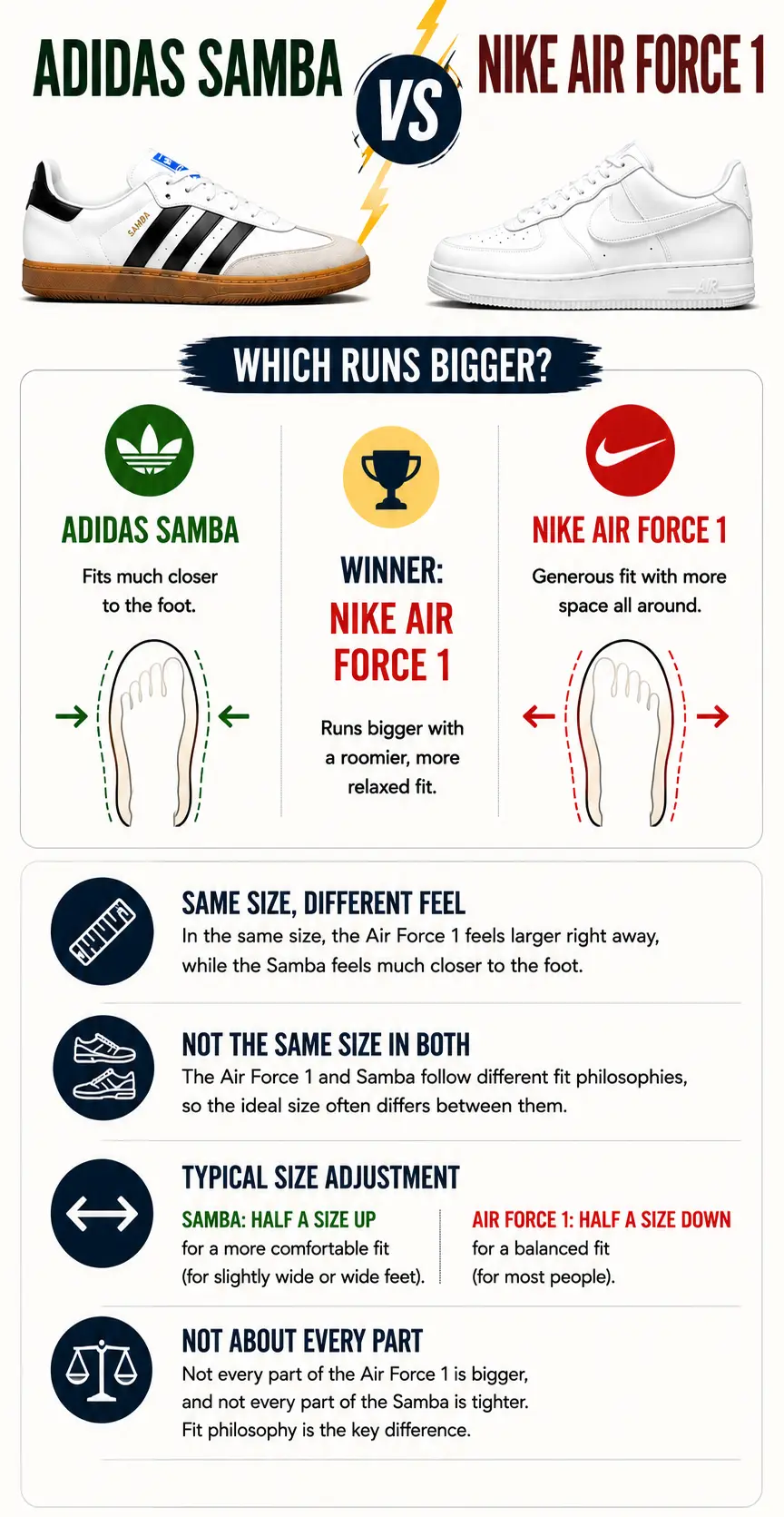
The short answer is the Nike Air Force 1.
If I put both shoes on in the same size, the Air Force 1 immediately feels like the larger shoe. The fit is more generous from the moment I put it on, while the Samba feels much closer to my foot.
That’s why I don’t recommend buying the same size in both.
For me, sizing down half a size in the Air Force 1 creates a balanced fit, while sizing up half a size in the Samba gives my slightly wide forefoot the room it needs.
The important thing to understand is that this doesn’t mean every part of the Air Force 1 is bigger or every part of the Samba is tighter.
They simply approach fit in very different ways.
To understand why they feel so different, you have to look at each part of the shoe individually. That’s exactly what I’ll do next.
See my Nike Dunk vs Air Force 1 sizing comparison for the differences in fit, width, and overall feel.
Breaking Down the Fit
Now that we’ve covered the overall sizing, let’s look at where these two sneakers actually fit differently.
This is the section that matters most because two shoes can both be the correct size yet feel completely different once they’re on your feet.
Rather than focusing on whether one runs big or small, I’m going to compare each part of the shoe individually.
Toe Room
The biggest difference between these two shoes starts at the front.
The Air Force 1 gives my toes much more freedom to move naturally. Even after sizing down half a size, I didn’t feel like my toes were competing for space.
They can spread out comfortably, which is one of the reasons the shoe feels so relaxed.
With the Samba, my toes sit closer together, and the front of the shoe feels much more structured around them. I especially notice this around my little toe, which is why going up to a US 9.5 works better for my slightly wide forefoot.
Another thing I notice is the space above my toes.
The Air Force 1 has noticeably more vertical room, so the upper rarely presses down on the top of my forefoot.
On the contrary, the Samba sits much lower, which makes the front of the shoe feel more fitted even when the length is correct.
Midfoot
The midfoot is where these sneakers have the most different personalities.
The Air Force 1 has a relaxed fit through the middle of the shoe. Once my foot is inside, it feels comfortable without needing much adjustment.
I can lace it fairly loosely and it still feels secure enough for everyday wear.
The Samba is much more responsive to how I lace it.
A small change in lace tension noticeably changes how the shoe hugs my foot. If I tighten the laces slightly, the fit becomes much more secure. If I loosen them, the shoe immediately feels more forgiving.
Because of that, I spend a little more time getting the Samba dialed in, while the Air Force 1 feels right almost immediately.
Heel
Despite their different shapes, both shoes hold my heel well once I have the correct size.
The Air Force 1 has a softer, more relaxed heel hold. My heel feels secure, but it isn’t locked in tightly, which matches the shoe’s easygoing fit.
I find the Samba keeps my heel more connected to the shoe. It feels like my foot and the sneaker move together more closely, especially when changing direction or walking at a quicker pace.
Neither gives me heel slip in the correct size, but they achieve that security in different ways.
Overall Width
If someone asked me which shoe feels wider, I’d answer the Air Force 1 without hesitation.
Its shape is more accommodating across the entire forefoot, which makes it a safe choice for most foot shapes.
The Samba is much less forgiving. It doesn’t just feel narrower in one specific area. The entire front half of the shoe has a slimmer profile, which is why people with wider or higher-volume feet often need to size up, or may simply prefer a different model altogether.
See my Air Jordan 1 High vs Mid vs Low sizing comparison to see how each version fits.
How It All Comes Together
Looking at each part individually helps explain why these shoes create such different first impressions.
The Air Force 1 never relies on one feature to feel roomy. Instead, the extra space comes from several small differences working together, giving the shoe a relaxed, forgiving fit.
When it comes to the Samba, every part of the upper sits a little closer to your foot, which creates a more precise, form-fitting feel. That’s why it can feel snug even when you’ve chosen the correct length.
Neither approach is better. They simply suit different preferences.
See my Nike sneaker sizing guide for how many of the brand’s most popular lifestyle and performance models fit.
Living With Each Fit
Sizing doesn’t stop mattering once you’ve picked the right pair.
After wearing both shoes regularly, I’ve noticed that they ask very different things from me. Neither becomes uncomfortable, but they do change how much attention I pay to the fit throughout the day.
Living With the Air Force 1
The Air Force 1 is one of those sneakers I can put on without giving it much thought.
Once I’ve laced it up, I rarely adjust it again. Whether I’m wearing thin socks or slightly thicker ones, the fit doesn’t change enough for me to notice.
Even after hours of walking, it feels much the same as it did when I first put it on.
That’s one of the advantages of its generous fit. It gives my foot enough space that small day-to-day differences, like sock thickness or minor foot swelling, rarely affect how the shoe fits.
Living With the Samba
The Samba is a little more particular.
I notice the fit much sooner if I switch to thicker socks, and even small changes in lace tension can make the shoe feel noticeably different.
If I lace it a bit tighter, it becomes much more secure. If I loosen it slightly, there’s an immediate increase in room around my foot.
Because the fit is naturally closer, getting the size right is also more important. Half a size can make a bigger difference in the Samba than it does in the Air Force 1, especially if your feet are slightly wide or high-volume.
Materials, Break-In & Fit Changes
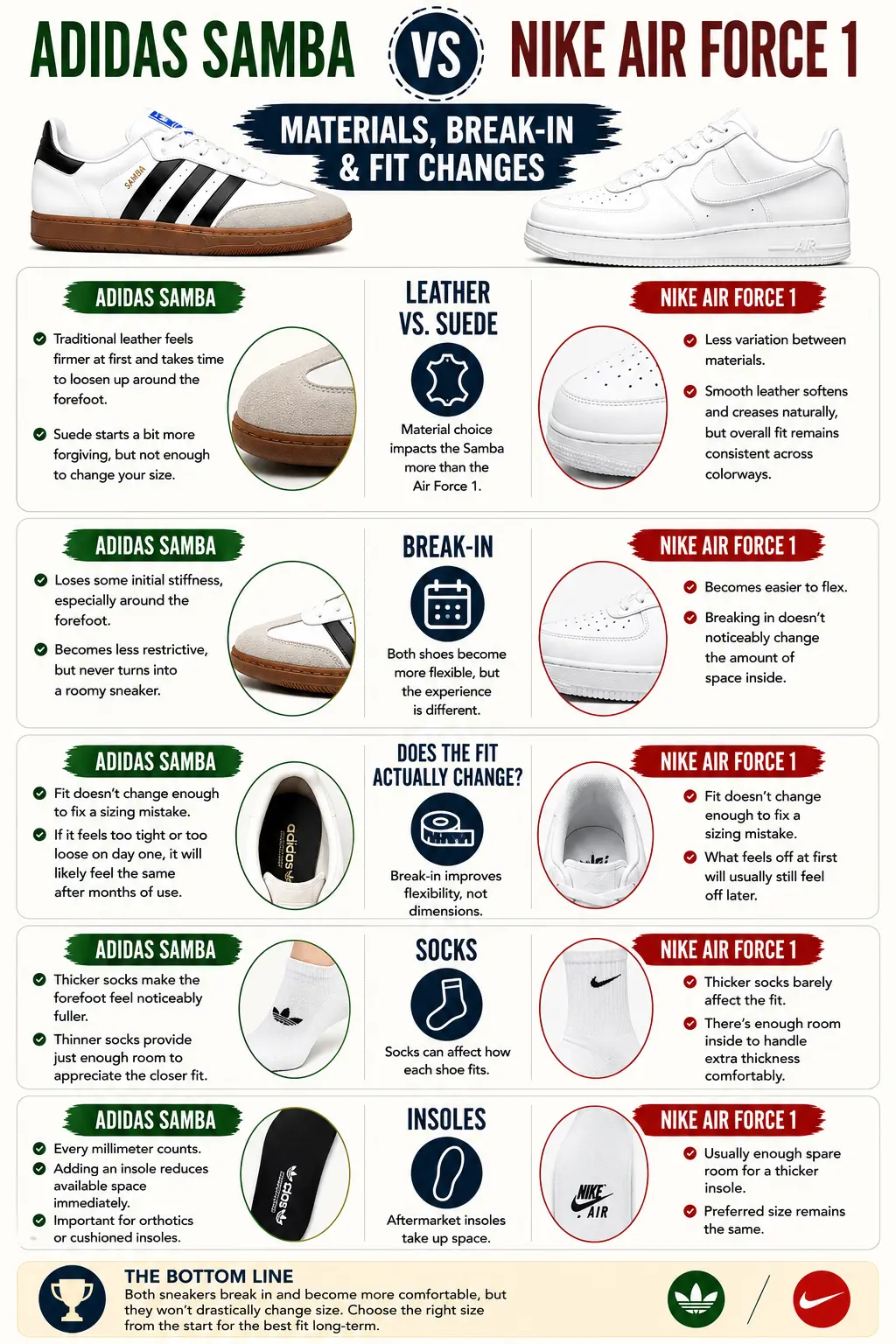
One thing I’ve learned after wearing both pairs is that the fit you experience on day one isn’t necessarily the fit you’ll have a few weeks later.
Neither sneaker changes dramatically, but both become more accommodating as the materials soften. The important thing is knowing what changes and what doesn’t.
Leather vs. Suede
Material choice has a bigger impact on the Samba than many people expect.
Traditional leather versions feel firmer at first and take a little time to loosen up around the forefoot. Suede pairs usually start off feeling a touch more forgiving, although the difference isn’t enough to justify changing your size.
With most Air Force 1s, I notice less variation between materials. Smooth leather gradually becomes softer and creases more naturally, but the overall fit stays remarkably consistent regardless of the colorway.
Break-In
After a couple of weeks, both shoes feel more flexible than they did straight out of the box. Where they differ is in how that flexibility changes the experience.
The Samba loses some of its initial stiffness, particularly around the front of the shoe. That makes it feel less restrictive, but it never transforms into a roomy sneaker.
By comparison, the Air Force 1 mostly becomes easier to flex. Because it already starts with a generous fit, breaking it in doesn’t noticeably change the amount of space inside.
Does the Fit Actually Change?
Not enough to fix a sizing mistake.
I’ve never had an Air Force 1 suddenly become half a size smaller or a Samba magically stretch enough to solve a cramped forefoot.
If the sizing feels clearly wrong on the first wear, it’s usually still the wrong size after months of use.
Think of break-in as improving flexibility rather than changing the dimensions of the shoe.
Socks
This is something I notice almost every time I switch pairs.
Thicker socks barely affect how my Air Force 1 fits because there’s already enough room inside to accommodate the extra material.
The Samba reacts very differently. A pair of thicker socks is enough to make the forefoot feel noticeably fuller, while thinner socks give me just enough breathing room to appreciate the shoe’s closer fit.
Insoles
Replacing the insole follows the same pattern.
There’s usually enough spare room inside the Air Force 1 to accommodate a slightly thicker aftermarket insole without changing my preferred size.
Inside the Samba, however, every millimeter counts. Adding a supportive insole reduces the available space immediately, which is worth remembering if you wear orthotics or prefer cushioned insoles.
Which Shoe Fits Your Foot Shape?
By now, you probably have a good idea of how these sneakers fit. The final question is whether your foot shape naturally suits one better than the other.
Here’s who I think each model works best for.
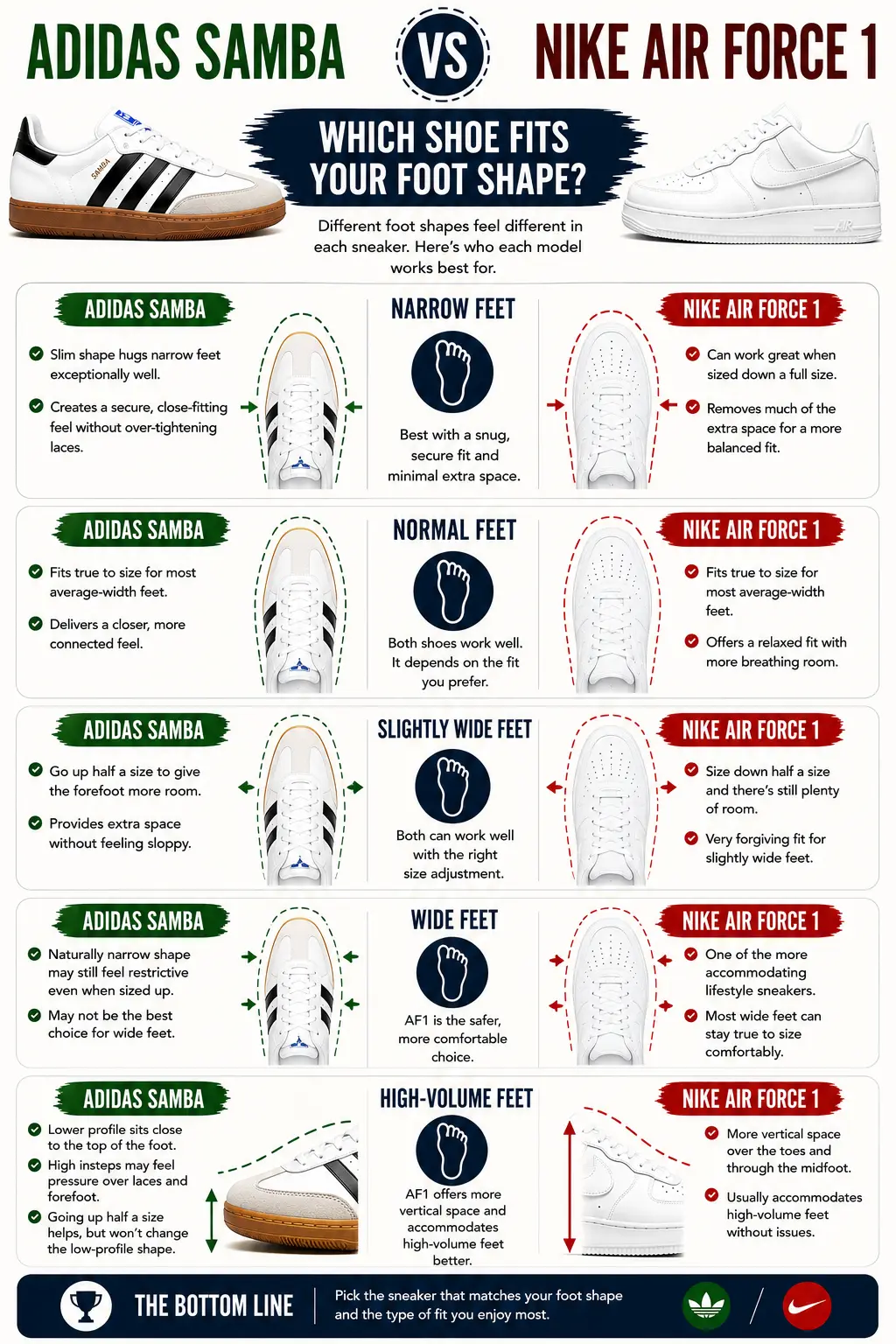
Narrow Feet
If your feet are naturally narrow, you’ll probably enjoy both shoes, but for different reasons.
The Samba’s slim shape wraps a narrow foot exceptionally well and creates a secure, close-fitting feel without needing to over-tighten the laces.
An Air Force 1 can work just as well, but I’d recommend sizing down a full size. Doing so removes much of the extra space and creates a more balanced fit.
Normal Feet
Most people with average-width feet should have no trouble with either model.
The choice comes down to the type of fit you prefer. If you like a relaxed sneaker with plenty of breathing room, the Air Force 1 is hard to beat. If you’d rather your shoe feel closer to your foot, the Samba delivers exactly that.
Slightly Wide Feet
Having a slightly wide forefoot, I can comfortably wear both shoes, but I don’t wear the same size in each.
Sizing down half a size in the Air Force 1 still leaves me with plenty of room, while going up half a size in the Samba gives my forefoot the extra space it needs without making the shoe feel sloppy.
If your feet are similar to mine, I think both models are excellent choices as long as you size them correctly.
Wide Feet
Once you move beyond slightly wide, knowing whether you have wide feet becomes more important because the differences between these two shoes are much more noticeable.
The Air Force 1 remains one of the more accommodating lifestyle sneakers available, and most wide-footed people should be comfortable staying true to size.
The Samba is a tougher recommendation. Even after sizing up, its naturally narrow shape may still feel restrictive around the forefoot. Some people make it work, but many will simply find that another Adidas model suits them better.
High-Volume Feet
Foot width isn’t the only thing that matters. The height of your foot can make just as much difference.
Because the Air Force 1 has more vertical space over the toes and through the midfoot, it usually accommodates high-volume feet without much trouble.
The Samba sits noticeably lower across the top of the foot. If you have a high instep, you’ll likely notice more pressure over the laces and forefoot, even if the length feels correct.
Going up half a size can help, but it won’t completely change the shoe’s naturally low-profile shape.
Which Shoe Should You Get?
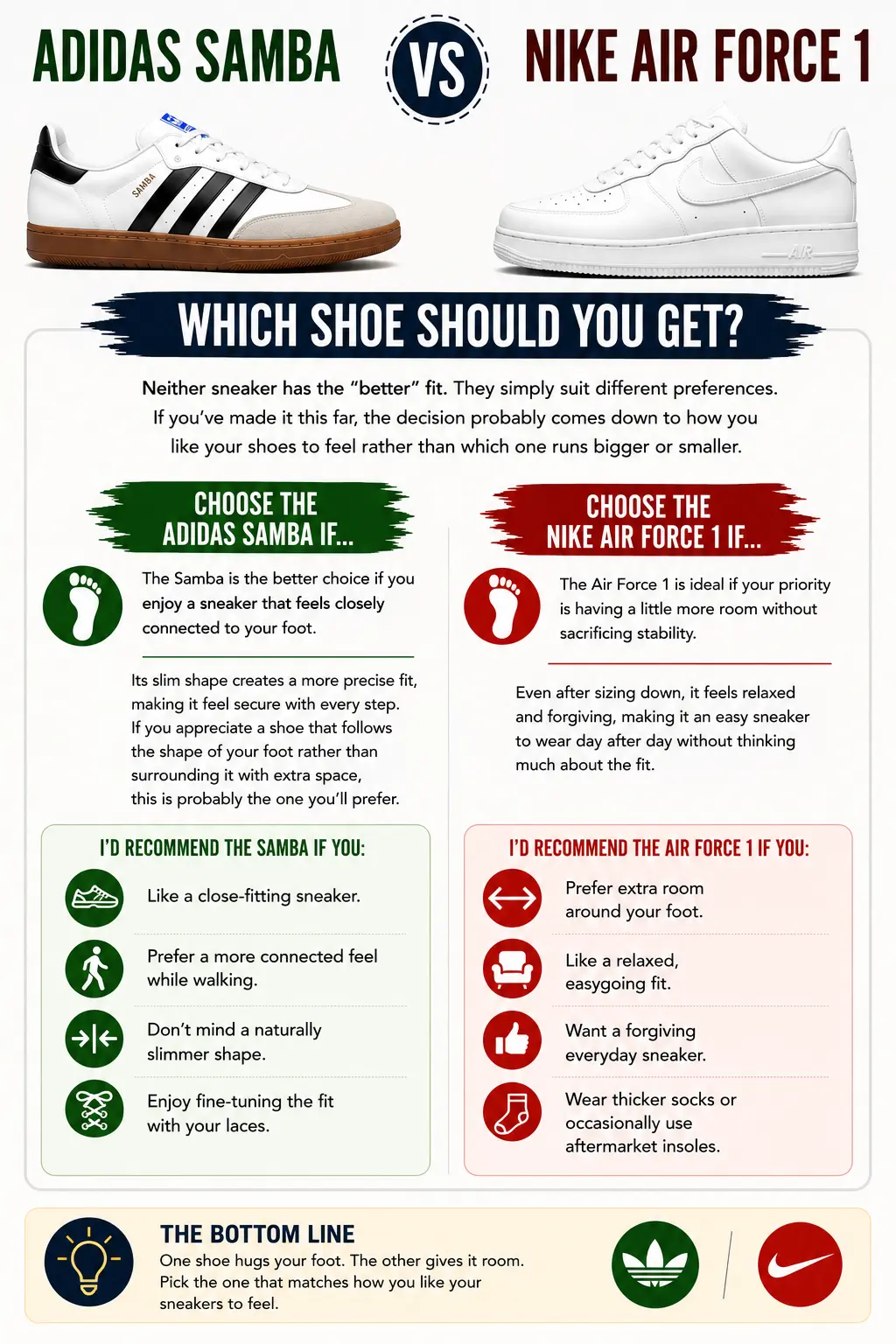
Neither sneaker has the “better” fit. They simply suit different preferences.
If you’ve made it this far, the decision probably comes down to how you like your shoes to feel rather than which one runs bigger or smaller.
Choose the Adidas Samba if…
The Samba is the better choice if you enjoy a sneaker that feels closely connected to your foot.
Its slim shape creates a more precise fit, making it feel secure with every step. If you appreciate a shoe that follows the shape of your foot rather than surrounding it with extra space, this is probably the one you’ll prefer.
I’d recommend the Samba if you:
- Like a close-fitting sneaker.
- Prefer a more connected feel while walking.
- Don’t mind a naturally slimmer shape.
- Enjoy fine-tuning the fit with your laces.
Choose the Nike Air Force 1 if…
The Air Force 1 is ideal if your priority is having a little more room without sacrificing stability.
Even after sizing down, it feels relaxed and forgiving, making it an easy sneaker to wear day after day without thinking much about the fit.
I’d recommend the Air Force 1 if you:
- Prefer extra room around your foot.
- Like a relaxed, easygoing fit.
- Want a forgiving everyday sneaker.
- Wear thicker socks or occasionally use aftermarket insoles.
Things That Surprised Me After Wearing Both
Before I bought both sneakers, I thought the biggest difference would simply be the size I needed. It turned out there was much more to it.
I Stopped Thinking About the Size Number
After wearing tens of sneakers over the years, one thing that surprised me was how quickly I stopped caring about the number printed on the box.
At first, wearing a sneaker in one size and another ine in another felt strange. After a while, I realized the number mattered far less than how each shoe actually fit my foot.
A Roomy Shoe Doesn’t Have to Feel Too Big
I expected the Air Force 1 to feel oversized because of how much people talk about its generous fit.
Instead, it simply felt more relaxed. Once I found the right size, it never felt sloppy or unstable. It just gave my feet a little more freedom to move.
The Samba Rewards Small Adjustments
I didn’t expect something as simple as changing socks or tightening the laces to make such a noticeable difference.
With the Samba, those small adjustments genuinely affect the overall fit. It made me realize why opinions on its sizing vary so much from person to person.
Break-In Was Less Dramatic Than I Expected
Before wearing both pairs regularly, I assumed the leather would transform the fit over time.
What actually changed was the flexibility, not the sizing. Both shoes became easier to wear, but neither suddenly fit like a different size.
The Biggest Lesson
More than anything, these two sneakers taught me that fit is about much more than length.
Toe-box shape, internal volume, foot height, socks, and even how tightly you lace your shoes all play a part. Once I started paying attention to those details, choosing the right size became much easier, not just for these two sneakers, but for almost every pair I bought afterward.
Common Sizing Mistakes
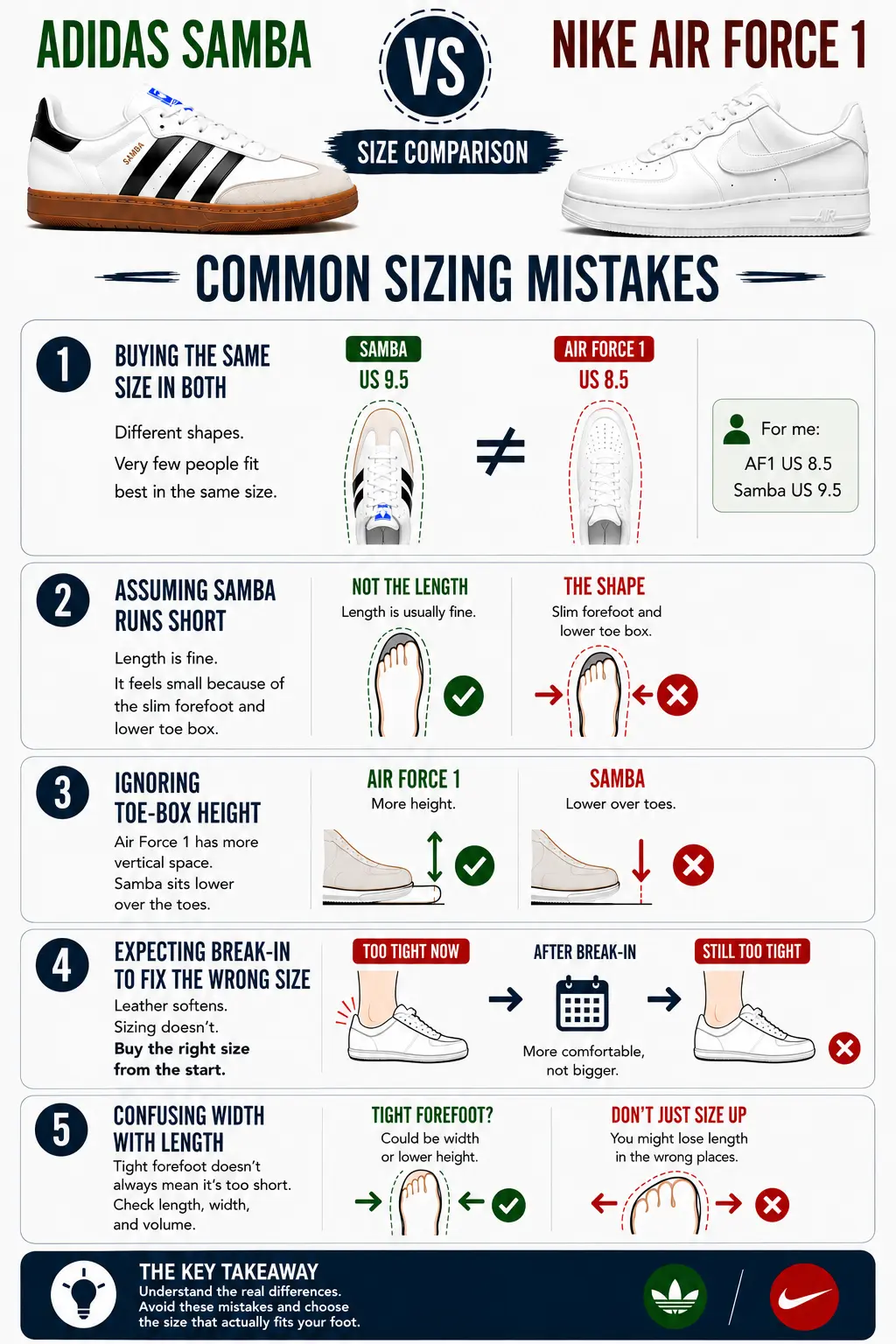
After trying both sneakers myself and reading hundreds of comments on Reddit, I’ve noticed that the same sizing mistakes come up again and again.
Buying the Same Size in Both
This is easily the most common mistake.
Many people assume that because both shoes are lifestyle sneakers from major brands, they should fit the same. In reality, they have completely different shapes.
For me, that means wearing a US 8.5 in the Air Force 1 and a US 9.5 in the Samba. Most people won’t end up with exactly the same size difference, but very few will find that both shoes fit best in the identical size.
Assuming the Samba Runs Short
A lot of people think the Samba feels small because it’s too short.
Most of the time, that’s not what’s happening.
The length is usually fine. What makes the shoe feel small is its slim forefoot and lower toe box. Those features create a snug first impression, even when your toes have enough length in front of them.
That’s why it’s important to judge the entire fit instead of focusing only on where your toes end.
Ignoring Toe-Box Height
Length is only one part of sizing.
The amount of space above your toes can completely change how a sneaker feels.
One reason the Air Force 1 feels so forgiving is that it has more vertical room inside the toe box. The Samba sits lower over the toes, which makes the fit feel much closer even if the length is identical.
If the top of your toes feels cramped, the problem may not be the length at all.
Expecting Break-In to Fix the Wrong Size
Leather softens. Sizing doesn’t.
Both sneakers become more flexible after a few weeks, but neither suddenly gains half a size in length or width. If a pair already feels obviously too tight or too loose, waiting for a break-in period probably won’t solve the problem.
Buy the size that feels right from the beginning.
Confusing Width With Length
This is probably the mistake that causes the most unnecessary sizing changes.
When a shoe feels tight across the forefoot, the first instinct is often to buy a longer size.
Sometimes that’s the right solution. Sometimes it isn’t.
A snug forefoot doesn’t automatically mean the shoe is too short. It could simply mean the shoe has a slimmer shape or a lower toe box.
Looking at length, width, and overall foot volume together will almost always lead to a better sizing decision.
Adidas Samba vs Nike Air Force 1 Sizing FAQs
Can I use my Air Force 1 size as a reference for the Samba?
Only if you remember that the Air Force 1 is your exception, not your baseline.
Many people size down in the Air Force 1 because it has more internal space. If that’s you, don’t automatically buy the same size in the Samba. Instead, compare the Samba to the size you normally wear in other Adidas or Nike lifestyle sneakers.
Why does the Samba feel tight even when there’s space in front of my toes?
This usually comes down to shape rather than length.
The Samba has a lower toe box and a slimmer forefoot than the Air Force 1, so your foot is surrounded more closely. It’s possible to have plenty of toe length while still feeling pressure around the front of the shoe.
Will the Samba become noticeably roomier over time?
It becomes softer, not dramatically bigger.
After the leather breaks in, the upper feels less restrictive, but the overall dimensions of the shoe stay almost the same. If the fit is painfully tight on day one, I wouldn’t expect break-in to solve the problem.
Does the Air Force 1 always require sizing down?
Not necessarily.
Most people with narrow or average-width feet prefer going down half a size, but that isn’t a universal rule. If you have wide feet, high-volume feet, or simply like a roomier fit, staying true to size can still be the better choice.
Which shoe is more forgiving if my feet swell during the day?
I’d give that advantage to the Air Force 1.
Its roomier fit leaves more space for small changes in foot volume throughout the day. The Samba has less extra room, so you’re more likely to notice those changes, especially if you’re already wearing a snug fit.
Which sneaker is easier to fit with custom orthotics?
In most cases, the Air Force 1.
Its larger interior makes it easier to accommodate thicker aftermarket insoles or orthotics without making the shoe feel cramped. The Samba has less spare room, so adding an orthotic can noticeably reduce the available space.
If I’m between sizes, should I make the same decision for both shoes?
Usually not.
Being between sizes affects each sneaker differently because they have completely different fit philosophies. In many cases, people end up sizing down in the Air Force 1 but up in the Samba, even though they’re choosing between the same two sizes.
Which sneaker is more forgiving if I order the wrong size?
The Air Force 1.
Because it has more room throughout the shoe, being slightly off with the sizing is often less noticeable. The Samba is less forgiving, so even a small sizing mistake tends to be obvious straight away.
Final Thoughts
The best fit comes from understanding how a sneaker matches your own feet. Two people can wear the same shoe size yet end up making completely different sizing decisions because their foot shape, fit preference, or even the socks they wear aren’t the same.
That’s why I always encourage using sizing guides as a starting point rather than a rulebook. Once you know whether you prefer a close-fitting sneaker like the Samba or a more relaxed fit like the Air Force 1, choosing the right size becomes much easier.
I hope this comparison has helped you narrow down your decision and given you the confidence to order the right pair the first time.
If you’ve worn both sneakers, I’d love to hear about your experience. Did you end up wearing the same size in each, or did your sizing differ like mine?