

A half shoe size is 1/6 inch, or roughly 4.23 mm (0.42 cm), in the traditional US sizing system.
Not much, right? Well, there’s more to the story, and those 4.23 mm won’t tell you much about how a shoe will actually fit.
I wear a US 9 in the regular Nike Dunk Low, but I need a 9.5 in the SB Dunk Low. Then there’s the Air Force 1, where I actually go down to an 8.5 because the 9 leaves too much room in front of my toes.
And here’s something worth thinking about. If your shoes are tight across the sides, would going half a size up really help?
You might gain a little width, sure, but you’re also buying a longer shoe. That extra length could be the last thing you need.
That’s why I wouldn’t make a sizing decision based on the 4.23 mm figure alone. You need to figure out what’s actually causing the fit problem before deciding whether to size up or down.
Let’s get into it.
How Much Bigger is a Half Size in Shoes
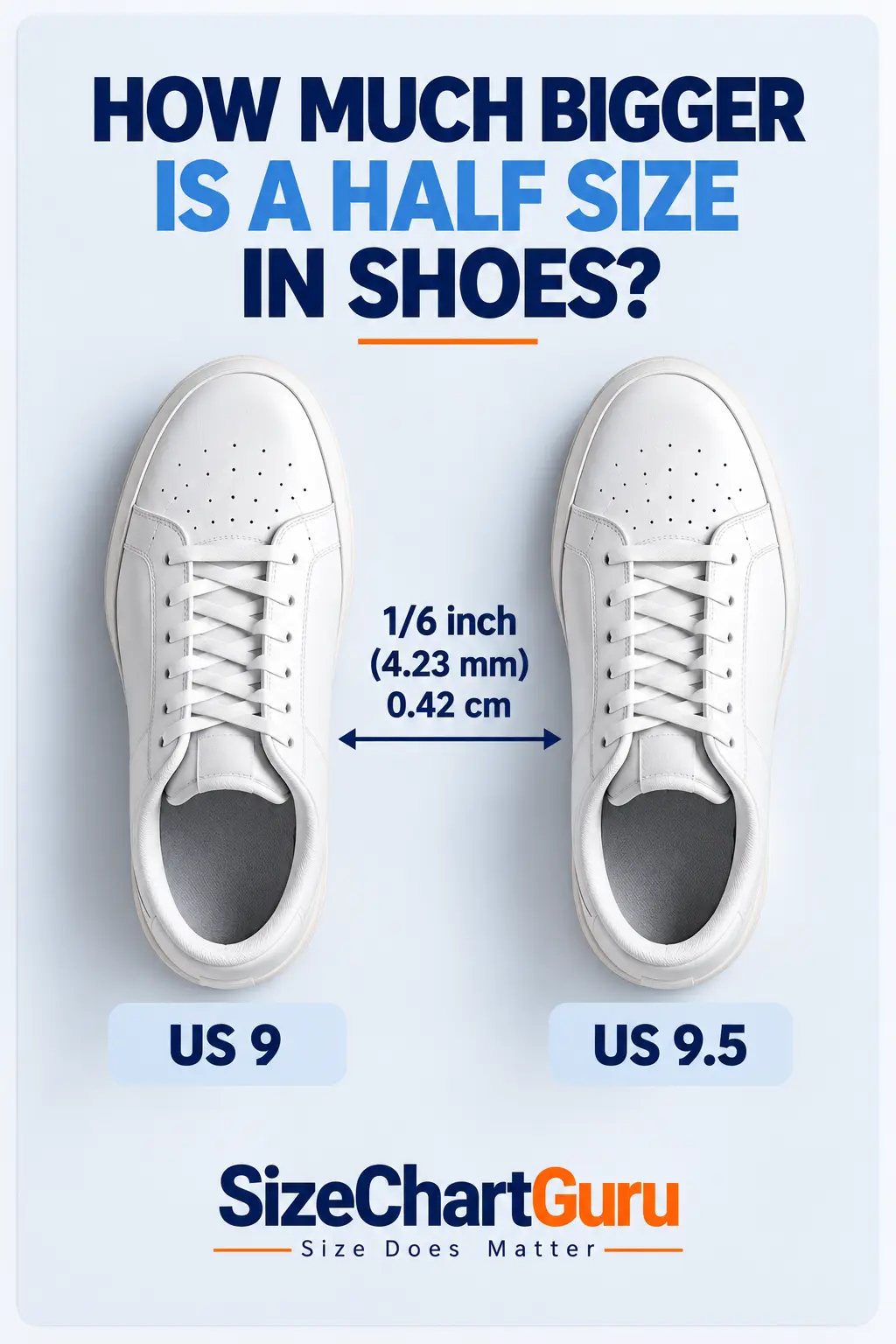
Half a US shoe size is 1/6 inch, or 4.23 mm (0.42 cm). Go up a full size and you’re looking at 8.47 mm.
Here’s the math for anyone curious about the exact differences.
| Size Increase | Inches | MM | CM |
|---|---|---|---|
| Half size | 1/6 | 4.23 | 0.42 |
| Full size | 1/3 | 8.47 | 0.85 |
| 1.5 sizes | 1/2 | 12.70 | 1.27 |
Now, why on earth is a half size 1/6 of an inch? Why not a nice, round 5 mm?
Blame the barleycorn.
Seriously. The traditional US shoe sizing system uses the barleycorn, an old unit of measurement equal to one-third of an inch. That’s one full shoe size. Cut it in half, and you get 1/6 inch.
The math doesn’t change from one half size to the next. A US 8 to 8.5 is the same 4.23 mm increment as a 9 to 9.5.
Just don’t confuse that with measuring the actual shoes. Put a size 9 and 9.5 side by side, and you won’t necessarily find a 4.23 mm difference in the space inside them.
And as we’ll see, even the numbers published on brand size charts don’t always match that old barleycorn calculation.
Does Half a Shoe Size Make a Noticeable Difference?
Oh, absolutely. Especially when you’re already pretty close to getting the right fit.
Take my Nike Air Force 1s. I’m a US 9 in most Nike sneakers, including the regular Dunk Low, but I wear an 8.5 in the Air Force 1.
I’ve tried the 9, and there’s just more space in front of my toes than I like. The 8.5 gets rid of some of that extra room without making the toe box feel cramped.
And we’re only talking about half a size here.
I see a similar difference when comparing my US 9 Dunk Low with my US 9.5 Samba. I explain why in my Nike Dunk vs Adidas Samba sizing comparison.
Of course, a half-size change won’t feel equally dramatic in every shoe. A stiff leather boot and a soft mesh sneaker aren’t going to behave the same way, even if the numbers on their size labels match.
But when a shoe is almost right, those few millimeters can be surprisingly noticeable.
Does Going Up Half a Size Make Shoes Wider?
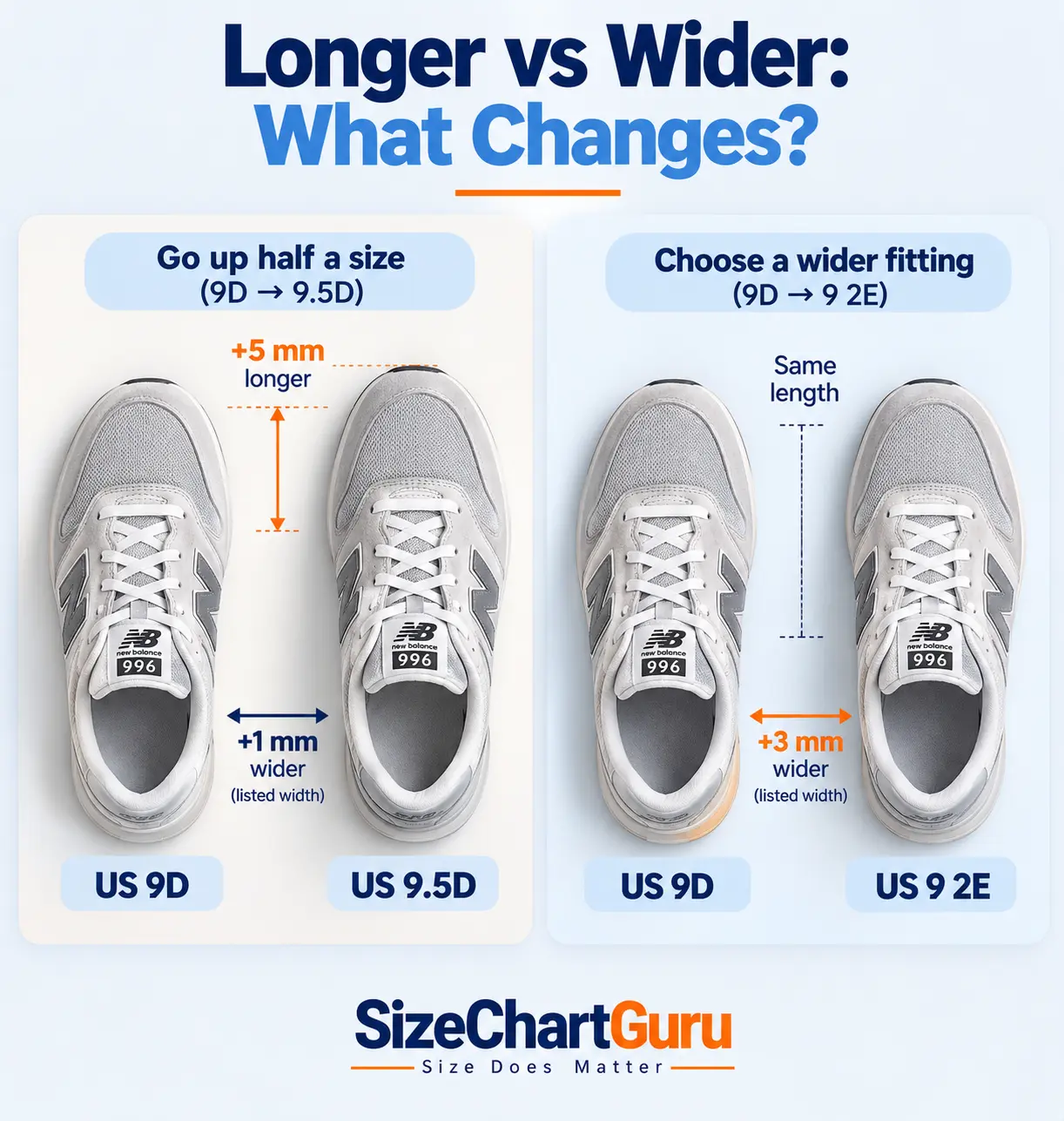
Yes, a little. Shoes generally get wider as you move up in length, even when you stick with the same width letter. But don’t expect a half-size increase to suddenly turn a narrow shoe into a wide one.
New Balance actually puts numbers to this, which I wish more brands would do.
Here’s what its men’s size guide shows for foot length and width, including both standard D and wide 2E fittings:
| US Size | Length (cm) | Length (mm) | Width (cm) | Width (mm) |
|---|---|---|---|---|
| 9D | 27.0 | 270 | 10.4 | 104 |
| 9 2E | 27.0 | 270 | 10.7 | 107 |
| 9.5D | 27.5 | 275 | 10.5 | 105 |
| 10D | 28.0 | 280 | 10.6 | 106 |
Source: New Balance Men’s Size and Width Guide
Look at the jump from a 9D to a 9.5D. The listed foot length increases by 5 mm, but the width measurement changes by just 1 mm.
Now compare a 9D with a 9 in 2E. The length stays at 270 mm, but the width goes from 104 to 107 mm. That’s 3 mm more width without moving up in length.
These are New Balance’s foot-sizing measurements, not the amount of space inside the shoes. Still, the comparison shows why going wider may make more sense than going longer when the length already fits.
Not sure how to tell if you have wide feet? I’ve put together a guide to figuring out whether your feet are wide to help you find out.
Why Do People Go Half a Size Up or Down?
If every shoe fit the same, we’d all have a much easier time buying them. Unfortunately, a US 9 in one sneaker can feel nothing like a US 9 in another.
I’ve had shoes where I needed to go half a size up because they felt too snug, and others where I went down because there was more room than I wanted.
Then you’ve got shoes like the Kobe 6 Protro, where the size you prefer can change depending on whether you’re playing basketball or just wearing them casually.
And boots? They bring their own sizing headaches.
There are a few reasons people end up changing sizes, and I’ve run into quite a few of them myself.
| Reason | Shoe Examples | What You’re Trying to Fix |
|---|---|---|
| Runs long or roomy | Nike Air Force 1, some New Balance 990 models | Get rid of excess length |
| Runs snug | Nike SB Dunk Low, Kobe 6 Protro | Give the foot more room |
| Needs more forefoot room | Adidas Samba, Air Jordan 4, some Asics models | Ease pressure across the forefoot when a larger size is appropriate |
| Different fit preference | Kobe 6 Protro | Choose between a tighter performance fit and more casual comfort |
| Different boot sizing conventions | Red Wing, White’s, John Lofgren | Account for the boot’s last and the size used as a reference |
And a half-size adjustment isn’t necessarily the answer to every fit problem. Sometimes the shoe is simply the wrong shape for your foot.
Should You Go Half a Size Up or Down?
I’ve bought shoes that were too roomy, and I’ve squeezed into pairs I probably should’ve sized up in. Neither is much fun.
I’ve also tried going up half a size to get more toe room, only to find the heel too loose. So I wouldn’t judge a larger size by how it feels around the toes alone.
So, when does changing sizes actually make sense?
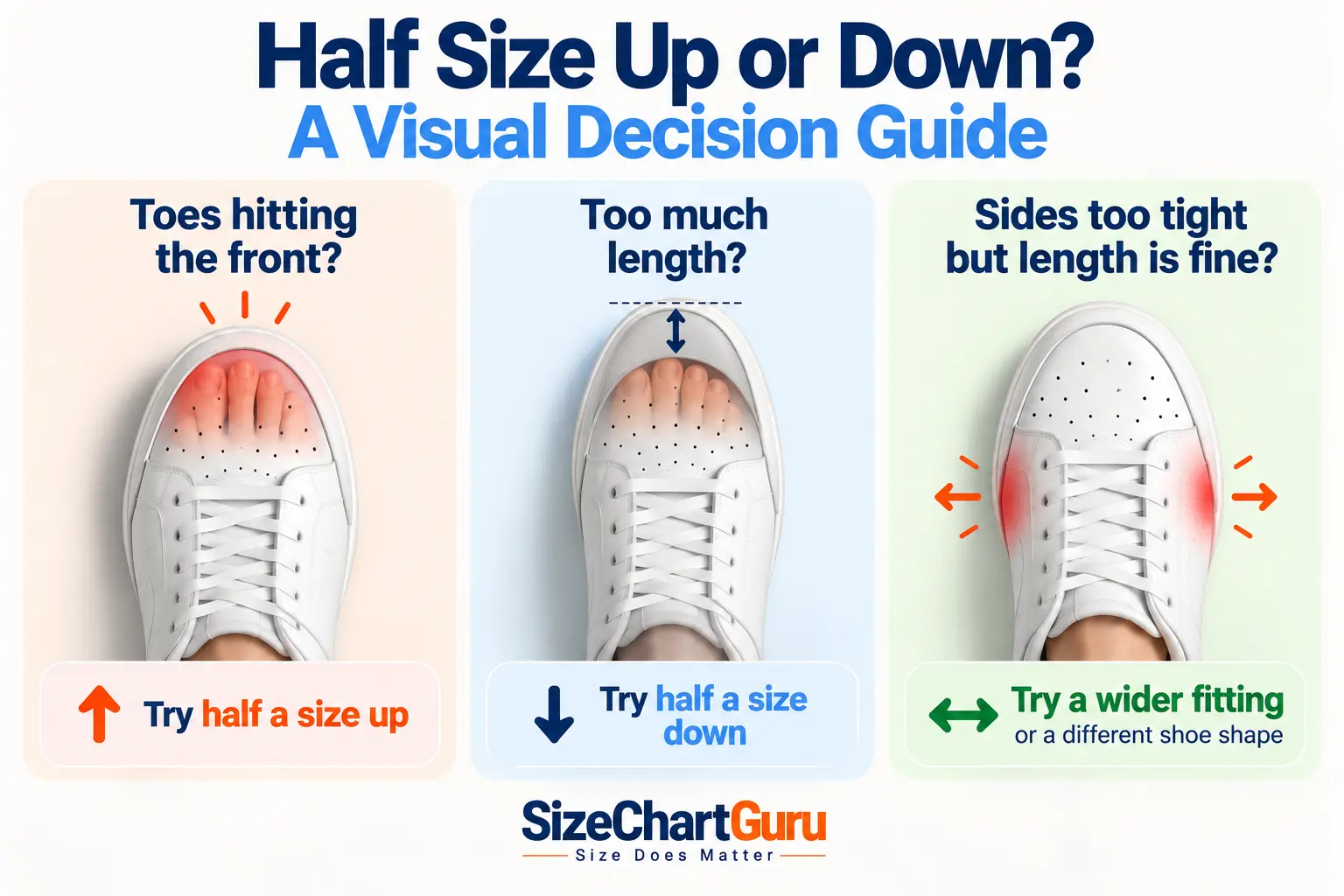
If the length feels right but the sides are tight, your foot shape might be the problem, not your shoe size.
When Should You Go Half a Size Up?
If your toes keep hitting the front of the shoe, I’d try the next half size. There’s only so much you can do with a shoe that’s too short.
And sometimes the length isn’t the only issue.
I wear a US 9 in my regular Nike Dunk Lows. No complaints there. But put me in an SB Dunk Low, with all that extra padding around the tongue, and I’m much happier in a 9.5.
Of course, I’d still check the heel before keeping the larger pair. A little extra toe room is nice. Having your heel lift with every step isn’t.
When Should You Go Half a Size Down?
Too much empty space in front of your toes? Going down half a size might be exactly what you need.
Heritage boots are where this advice comes up a lot.
The Red Wing Iron Ranger, for instance, is often sized half a size down from your usual sneaker size. Since I normally wear a US 9 in sneakers, the first Iron Ranger I’d pull off the shelf to try would be an 8.5.
And please don’t buy boots that crush your toes because someone online promised the leather would stretch. Leather can give a little across the foot, but you shouldn’t count on a boot becoming longer.
When Should You Choose a Wider Model Instead?
Here’s a situation I see people get wrong: the shoe has plenty of room in front of the toes, but the little toe is getting squeezed.
So they go half a size up.
They’ve gained some length they didn’t need, and there’s no guarantee the extra width will be enough. Worse, the heel might start slipping.
If the length was already right, I’d look for a wider fitting first. A D-to-2E change, where available, lets you address width without automatically adding more length.
Of course, not every sneaker comes in multiple widths. Sometimes you have to try a different model with a more accommodating toe box. There’s no point buying a longer shoe just to give your little toe some breathing room.
When Might Your Preferred Fit Change the Size You Choose?
My Kobe 6 Protro is a good example of how I can prefer two different sizes in the same shoe.
For basketball, I’m sticking with my true size. When I’m playing, I like my foot held firmly in place. I don’t want to be thinking about my shoes halfway through a game.
Walking around in Kobes is a different story.
If I were buying them mainly for casual wear, I’d seriously consider going half a size up. I’d also look at that option for someone with wider feet who finds the usual size too restrictive.
You can see why two people might buy different sizes in the Kobe 6 and both be happy with their choice.
There’s a limit, though. A performance fit should feel secure, not painful. If your toes are jammed against the end or you’re getting numbness from the pressure, that’s not good lockdown. That’s a shoe that doesn’t fit.
Half a Size Up or Down From What?
Here’s something that gets overlooked in shoe sizing advice. Someone tells you to go half a size down, but half a size down from what, exactly?
Your Brannock measurement? Your everyday sneakers? Or the size you usually buy from that particular brand?
Say you measure a US 9 on a Brannock Device, but most of your sneakers are a 9.5.
Now you read a review telling you to go half a size down.
If the reviewer means half a size below your Brannock measurement, you’d be looking at a US 8.5. But if they’re talking about your usual sneaker size, you’d end up with a US 9.
That’s two different sizes from the exact same advice.
I’ve run into this quite a bit when researching heritage boots. You’ll see someone recommend going half a size down in a particular boot, and then another person insists they went true to size.
Sometimes they’re actually wearing the same size. One is comparing it to their sneakers, while the other is talking about their Brannock measurement.
It gets even more confusing when you’re switching between models from the same brand. The size you wear in one boot might not be the size you’d start with in another.
My advice? Whenever someone says to size down, I want to know what size they’re starting with. Without that little detail, the recommendation isn’t nearly as useful as it sounds.
How Do You Choose Between Two Half Sizes?
Let’s say you’re stuck between a US 9 and 9.5. You’ve tried them both, neither feels terrible, and you’re starting to wonder whether those few millimeters are even worth worrying about.
They are. But I wouldn’t spend twenty minutes staring at the space in front of my toes, either.
Here’s how I’d work through it.
1. Measure Both Feet
If there’s a Brannock Device around, use it. And don’t be surprised if your left foot and right foot give you slightly different numbers. Mine aren’t the only feet in the world that refuse to be perfectly identical.
The longer foot needs enough space, so don’t choose a size based on whichever foot gives you the smaller reading.
No Brannock Device? You can take your measurements at home. I’ve explained the process in my guide to measuring your feet.
There’s another measurement on a Brannock Device that deserves some attention: heel-to-ball length.
That’s the distance from your heel to the ball of your foot, and it helps determine your arch-length size. Not everyone’s toes take up the same proportion of their foot. That’s why the Brannock Device has a separate arch-length measurement in the first place.
And when the two readings disagree, I wouldn’t ignore the arch-length number. I’d want to see how the shoe bends when I walk.
2. Check the Manufacturer’s Size Chart
I’d pull up the brand’s chart before deciding between the two sizes.
Say your foot measures 27 cm. Rather than assuming that automatically makes you a US 9 everywhere, see what the manufacturer actually lists for that measurement.
And be careful about what the chart is measuring. Some brands publish recommended foot lengths, which aren’t the same thing as the space inside the shoe.
You also won’t learn much about the padding around the tongue or how narrow the toe box feels from a row of numbers. For that, you still need to try the shoes.
3. Try Both Sizes With Your Usual Socks
Bring the socks you’re actually going to wear.
Thick hiking socks can change how a boot feels quite a bit. And if you’re shopping for everyday sneakers, there’s no reason to test them in heavy winter socks you never wear.
I’d also put on both shoes. It’s tempting to try one size on your left foot and the other on your right, but that’s not a particularly fair comparison if your feet are different sizes.
Give each pair a proper try.
4. Check the Toes, Sides, Heel, and Flex Point
I don’t have some complicated fitting ritual. There are just four areas I pay close attention to:
Toes: I want some breathing room up front. If my longest toe is touching the end while I’m standing, I’m already suspicious of that size.
Forefoot: My feet are slightly wide, so I pay particular attention to the little-toe side. A bit of contact is normal. Feeling squeezed isn’t.
Heel: A small amount of movement can happen, particularly in new leather boots. But I don’t want my heel popping up and down with every step.
Flex point: I check whether the shoe bends around the ball of my foot. If the crease is digging into my toes, something’s off.
I’ve had enough experience with stiff footwear to pay attention to that last one. If a leather shoe keeps digging into the top of my foot whenever I take a step, I’m not going to ignore it just because the toe room looks fine.
5. Walk Around in Both Sizes
This is where I’d spend the most time.
Walk across the store, turn around, pick up the pace a little. I’d also try walking up and down a few steps if the store has them. It’s a good way to check whether your foot stays put inside the shoe.
I’d try the 9 first, then the 9.5, and probably go back to the 9 once more. I like switching between them a couple of times because it’s easier to pick up on small differences that way.
If the 9 keeps pushing against my toes but the 9.5 stays comfortably on my foot, I’m taking the 9.5. On the other hand, if the 9 already has enough toe room, I wouldn’t buy the longer pair just because it feels a little more spacious.
And if I’m still not happy after trying both? I’d rather leave the store empty-handed than spend money on shoes I’m already trying to talk myself into liking.
Why Do Shoe Size Charts Show Different Half-Size Measurements?
Remember the 4.23 mm figure we worked out earlier? Nike’s size chart doesn’t quite follow it.
Look at the men’s US 9 and 9.5. The size 9 is listed at 10 5/16 inches, and the 9.5 at 10 1/2 inches.
That works out to a 3/16-inch jump. In millimeters, it’s 4.76 rather than 4.23.
Not quite the number we started with.
| US Size | Foot Length (in) | Foot Length (mm) |
|---|---|---|
| 9 | 10 5/16 | 261.94 |
| 9.5 | 10 1/2 | 266.70 |
| Difference | 3/16 | 4.76 |
So why the difference?
The old barleycorn system gives us the mathematical spacing between shoe sizes. Nike isn’t publishing that calculation here. It’s telling you which foot length corresponds to each size on its chart.
Nike also lists those foot lengths in fractions of an inch, which can affect the difference you get when converting them to millimeters. But we don’t know exactly how Nike arrived at each number, so I wouldn’t assume it’s all down to rounding.
There’s another detail I think is easy to miss.
Foot length on Nike’s chart doesn’t mean the length inside a Nike shoe. Nike even mentions that the CM number on its shoe boxes isn’t the same as the foot-length measurement in its size chart.
And that old 4.23 mm calculation? I still think it’s useful. I just wouldn’t take a ruler to the inside of a size 9.5 and expect to find exactly 4.23 mm more space than in the 9.
Is Half a Shoe Size the Same in US, UK, and EU Sizing?
Not exactly. And this is where shoe size conversions can get a little confusing.
The US and UK systems both use the old barleycorn measurement, so half a size works out to 4.23 mm in either system.
European sizing follows a different system called the Paris point. One full EU size is 6.67 mm, and half of that would be roughly 3.33 mm.
So a half size in the US isn’t quite the same jump as a half size in Europe.
One thing I like about Mondopoint is that the numbers are based on foot length in millimeters. A 270 and a 275 are 5 mm apart. Nice and straightforward.
EU sizes aren’t quite as tidy when you’re comparing them with US sizes. Not every brand uses European half sizes, either. You might see EU 42 and 42.5 from one manufacturer, while another jumps straight from 42 to 43.
And what about men’s versus women’s US sizes?
The traditional 4.23 mm half-size increment is the same for both. The numbering is different, though, and so are the usual width conventions. A men’s standard width is typically D, while women’s standard is B.
So even when two sizes look like close equivalents on a conversion chart, I wouldn’t assume the shoes will fit alike.
Frequently Asked Questions About Half Shoe Sizes
Would You Rather Wear Shoes Half a Size Bigger or Smaller?
Give me a little extra room over cramped toes any day. At least with a roomy shoe, I might be able to get away with wearing thicker socks or adding an insole.
But don’t take that as a reason to buy shoes that are half a size too big. If your heel keeps slipping or your foot slides around, you’ve got a different problem on your hands.
Should You Always Go Up Half a Size If You’re Between Sizes?
No. I’d try both sizes before making that call.
If the smaller size has enough toe room and holds your foot comfortably, why go bigger? But if your toes are pressing against the front, I wouldn’t force myself into it just because the larger size feels a little less snug.
And if neither size feels right, there’s always the possibility that the shoe’s shape just doesn’t agree with your foot.
Should Running Shoes Be Half a Size Bigger?
You’ve probably heard the advice to buy running shoes half a size larger than your everyday sneakers. There’s a reason people say it. Your feet can swell during a run, and you need enough room up front to avoid banging your toes, especially on downhills.
But I wouldn’t automatically add half a size to every running shoe. Some already have plenty of room, and your everyday sneaker size might not be the best reference anyway.
I’d pay more attention to how the running shoe fits when you’re standing and moving, preferably later in the day when your feet may be a little larger.
Will Leather Boots Stretch Half a Size?
They might loosen up across the sides or over the instep, depending on the leather and construction. But don’t expect a boot that’s too short to magically grow longer.
I’ve seen plenty of advice telling people to buy tight leather boots and let the break-in period sort everything out. I’m not a fan of that approach.
A little stiffness is one thing. Toes jammed against the front? I’d be looking at another size.
Can You Fix Shoes That Are Half a Size Too Big With Socks or Insoles?
Before giving up on a slightly loose pair, I’d try them on with the socks I normally wear in winter. That extra thickness might be enough to make the fit more comfortable. If not, an insole is another option.
Just watch what happens over the top of your foot. Add a thick insole to a shoe that already fits closely across the instep, and you might end up creating a new pressure point.
And if you’re having to stuff the shoe just to stop your foot sliding around, I’d question whether you bought the right size.
Is Half a Shoe Size the Same for Kids’ Shoes?
In the traditional US system, the half-size increment is still 1/6 inch, or about 4.23 mm.
The tricky part with kids is that their feet are growing, and they aren’t always great at telling you when their shoes have become too small.
I’d check the fit regularly rather than assuming the next half size will last a certain number of months. And while growing room matters, buying shoes so large that a child struggles to walk comfortably isn’t a great solution either.
Final Thoughts
So, how much bigger is a half size in shoes? Traditionally, it’s about 4.23 mm, but that number alone won’t tell you whether you should size up or down.
I’ve worn shoes where half a size made all the difference, and others where changing sizes didn’t fix the problem at all.
Before buying another size, I’d figure out whether the problem is actually the length. I’ve made the mistake of sizing up for more width and ending up with too much room in front of my toes.
Have you ever gone up or down half a size and noticed a big difference? Or did it barely change anything?
Drop the shoe model and the sizes you’ve tried in the comments. I’m interested to see how much of a difference half a size made for you.