
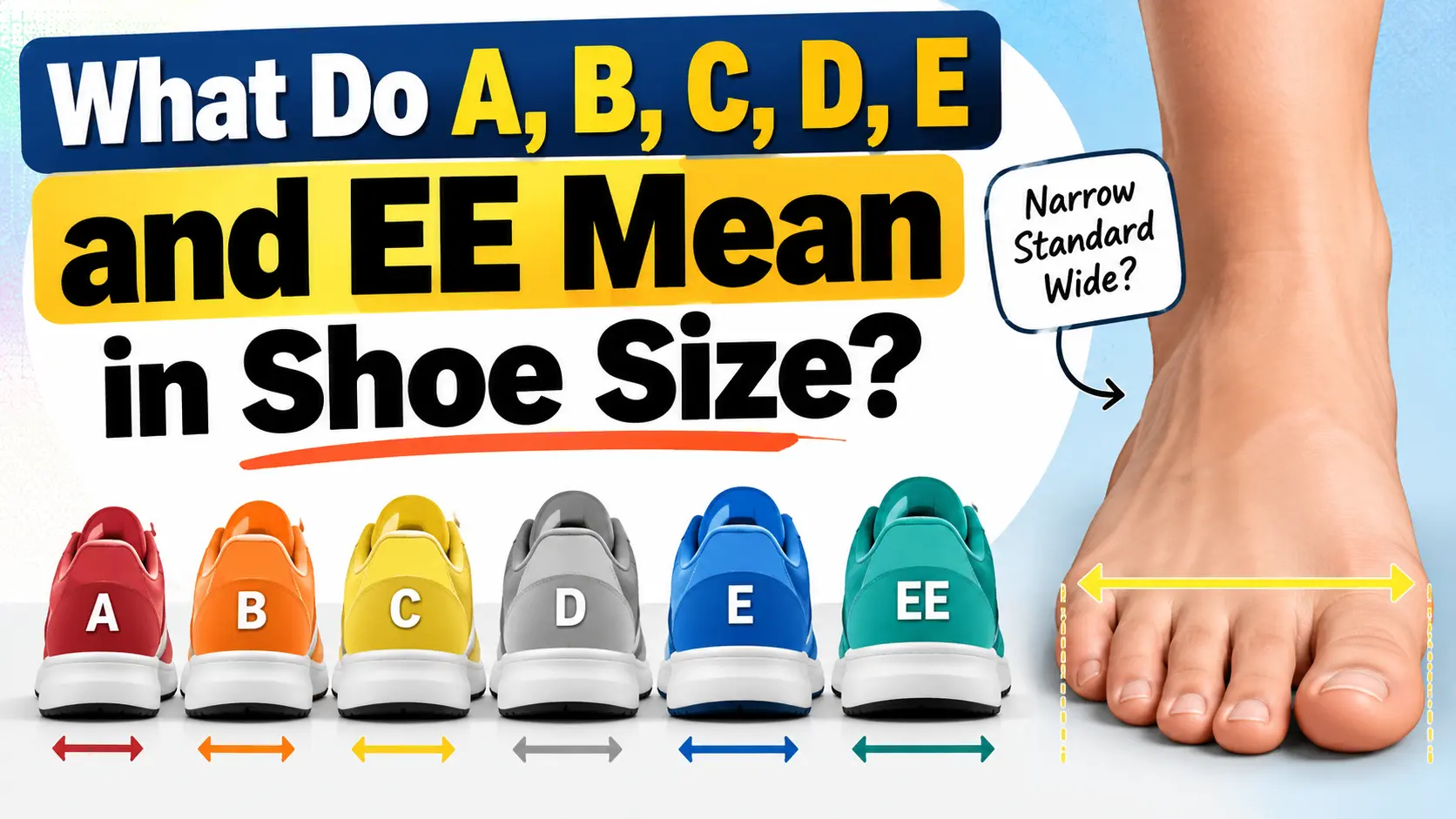
Let’s cut to the chase…
The number in a shoe size represents the length, while the letter represents the width. So, a US 9D means a size 9 length with a D width.
As the width designation progresses from narrower widths such as A and B toward E, EE and beyond, the fitting generally gets wider.
But the letter alone doesn’t tell the whole story. The same width letter can mean something different in men’s and women’s sizing, and width categories don’t translate into one universal physical measurement across all shoes.
Below, I’ll break down what A, B, C, D, E, EE, 2E, 4E and other common shoe width labels, including M (Medium), W (Wide) and XW (Extra Wide), actually mean.

What Do A, B, C, D, E and EE Mean in Shoe Size?
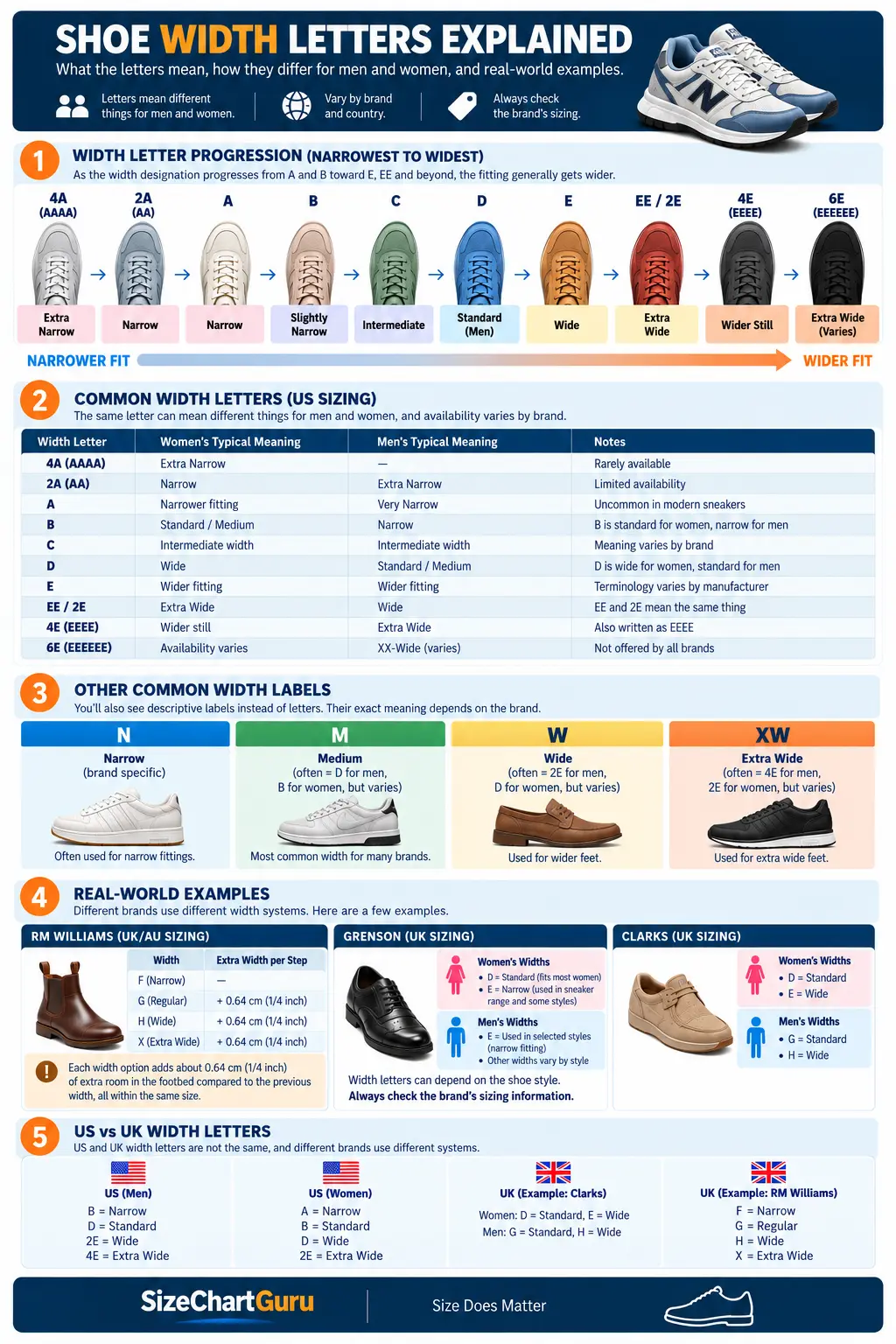
If you prefer visuals, here’s an infographic that summarizes everything you need to know about shoe width letters at a glance.
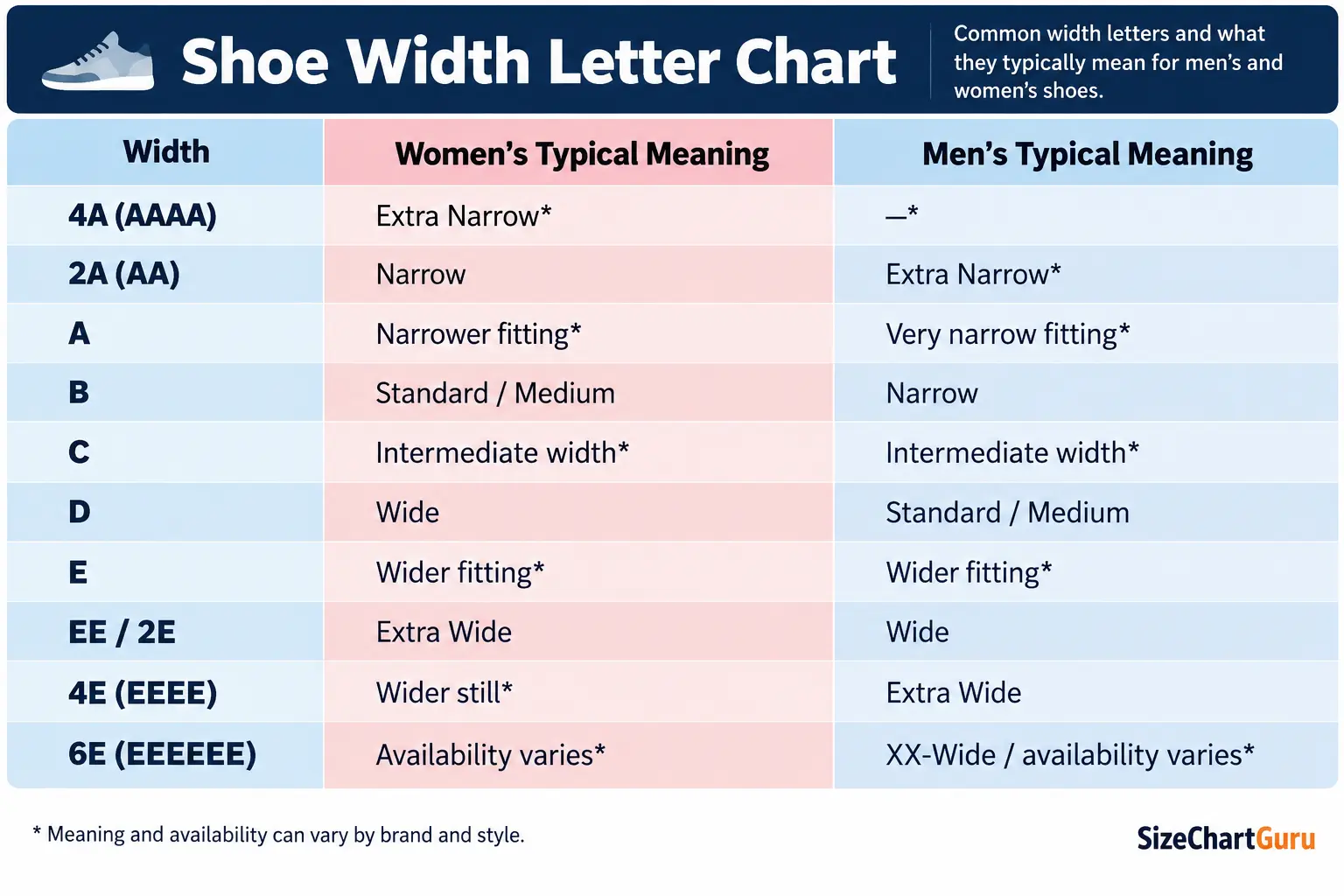
Shoe Width Letter Chart
Shoe width letters generally move from narrower designations such as A and B toward wider designations such as D, E, 2E and 4E.
The important catch is that the same letter does not always mean the same category for men and women. For example, B is typically standard for women but narrow for men, while D is typically wide for women but standard for men.
| Width | Women’s Typical Meaning | Men’s Typical Meaning |
|---|---|---|
| 4A (AAAA) | Extra Narrow* | —* |
| 2A (AA) | Narrow | Extra Narrow* |
| A | Narrower fitting* | Very narrow fitting* |
| B | Standard / Medium | Narrow |
| C | Intermediate width* | Intermediate width* |
| D | Wide | Standard / Medium |
| E | Wider fitting* | Wider fitting* |
| EE / 2E | Extra Wide | Wide |
| 4E (EEEE) | Wider still* | Extra Wide |
| 6E (EEEEEE) | Availability varies* | XX-Wide / availability varies* |
If you’d like to save a copy for easy reference, here’s the Shoe Width Letter Chart as an image that you can download.
Asics and Brooks, for example, both use that pattern, while other letters such as A, C, E, 4A and 6E are less consistently labeled or offered.
So treat this chart as a decoder for the letters, not as a promise that every shoe labeled 2E, for example, has exactly the same physical width.
Even within one brand, width differences can vary with shoe size, and manufacturers may not offer every designation shown above.
See my Sneaker Width Chart.
What Does A Mean in Shoe Size?
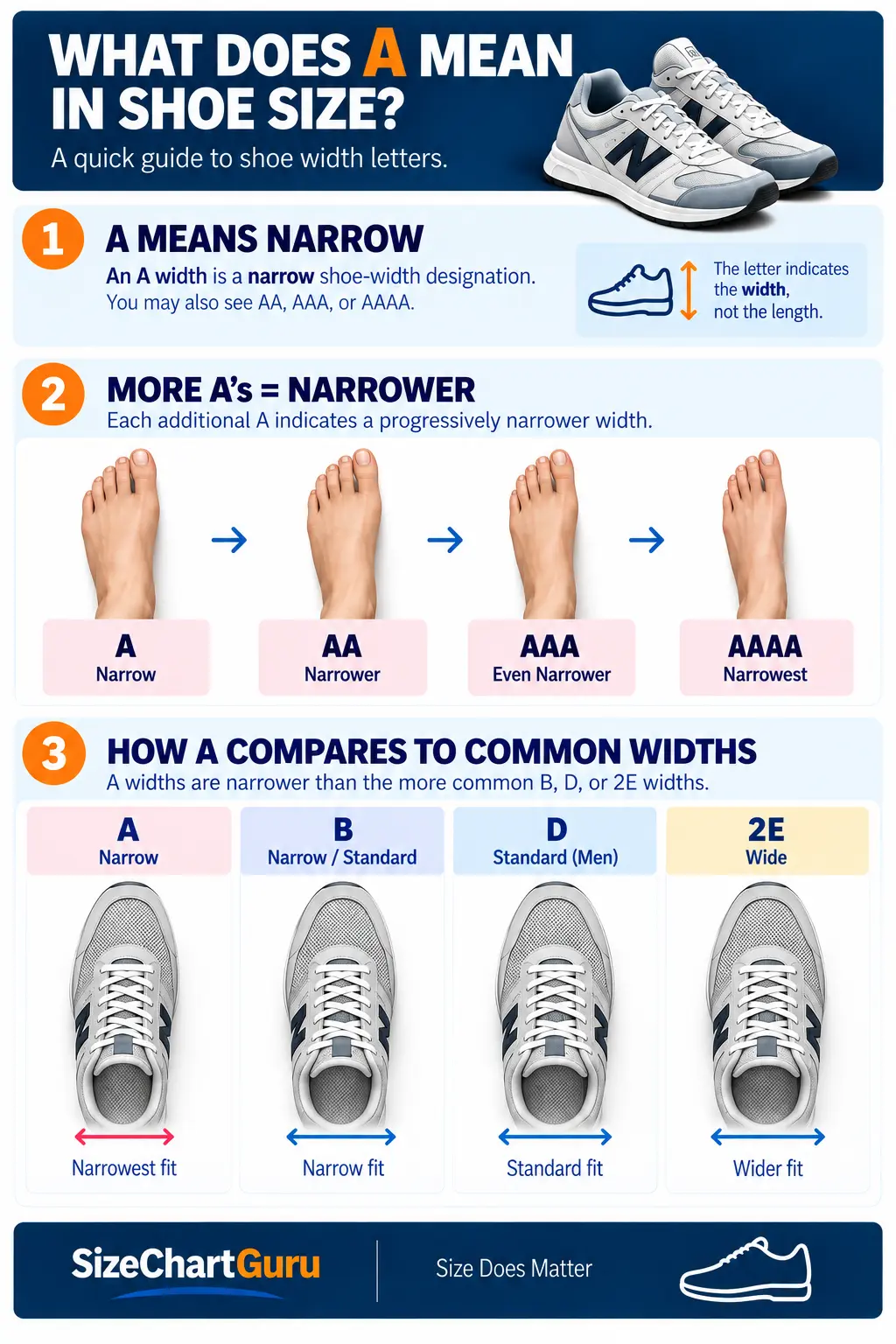
An A width is a narrow shoe-width designation. In traditional letter-based width systems, the sequence gets narrower as more A’s are added, so you may also see AA, AAA, or AAAA.
A simple way to read the progression is:
A → AA → AAA → AAAA
Each additional A indicates a progressively narrower width category. The exact terminology is not standardized, though, so one manufacturer may call A “narrow” while another may use it as part of a more detailed narrow-width scale.
You are also much less likely to see A widths in mainstream sneakers than more common designations such as B, D, or 2E.
Many athletic brands simplify their width offerings and do not produce every traditional letter width.
So if you see something like US 9A, the 9 is the length and A tells you that the shoe is made in a narrower width.
What Does B Mean in Shoe Size?
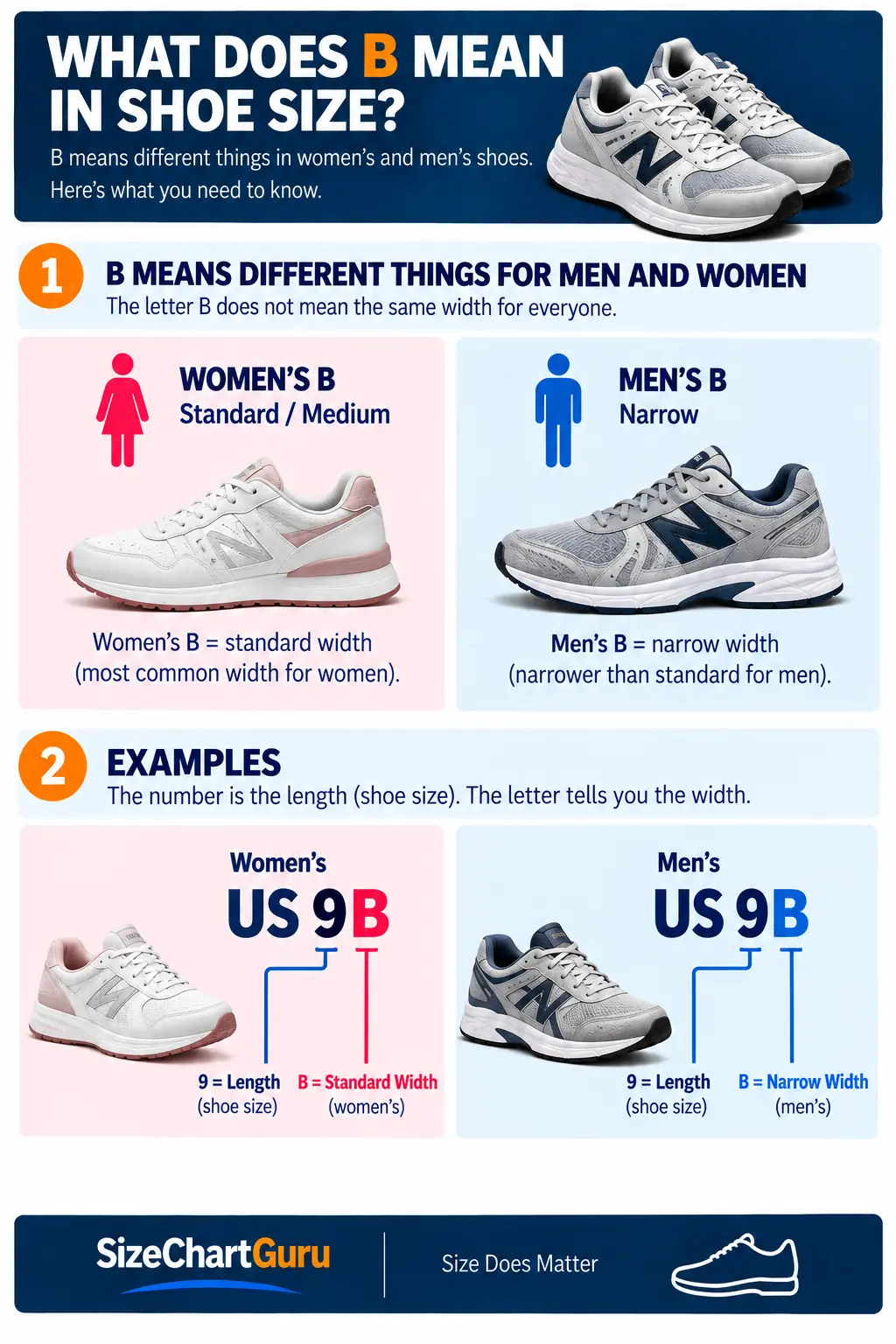
B means different things in women’s and men’s shoes:
- Women’s B: Standard / Medium
- Men’s B: Narrow
For example:
- Women’s US 9B: size 9 length + standard women’s width
- Men’s US 9B: size 9 length + narrow men’s width
So you should never read B by itself and assume it means “Medium.” You first need to know whether the shoe is using a women’s or men’s width scale.
What Does C Mean in Shoe Size?
A C width traditionally sits between B and D in the shoe-width lettering progression. In other words, it represents an intermediate width rather than one of the more commonly used standard categories.
C does not have one universal meaning such as “Medium.” Its exact use depends on the manufacturer’s width system.
Many mainstream athletic-shoe systems don’t offer C at all. For example, Brooks uses B, D, 2E and 4E for its men’s widths and 2A, B, D and 2E for women’s widths, skipping C entirely.
What Does D Mean in Shoe Size?
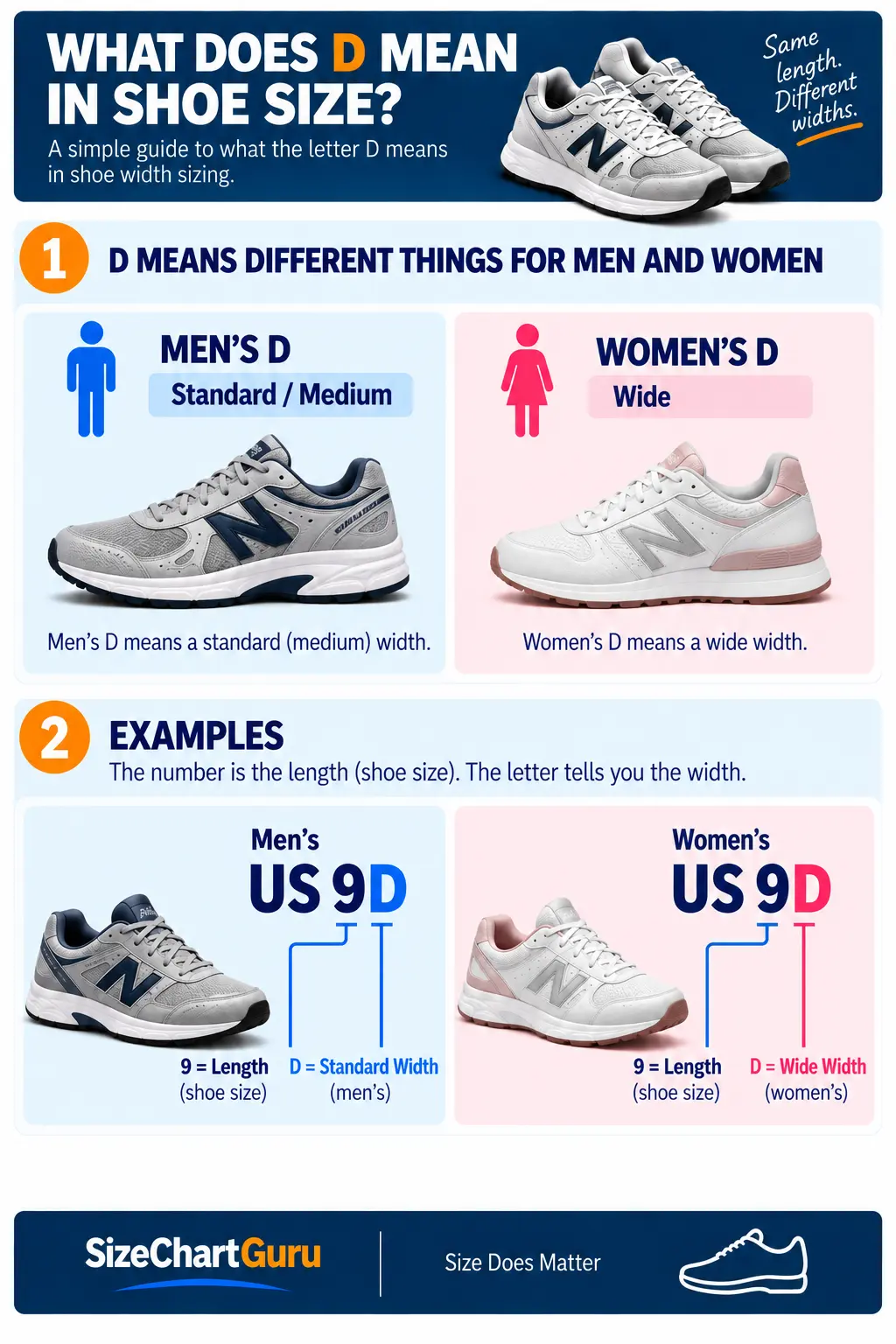
- Men’s D: Standard / Medium
- Women’s D: Wide
D is one of the most common shoe-width letters, but its meaning changes depending on whether you’re looking at men’s or women’s sizing.
- Men’s US 9D: size 9 length + standard/medium men’s width
- Women’s US 9D: size 9 length + wide women’s width
So seeing D on a size label doesn’t automatically mean the shoe is Wide.
What Does E Mean in Shoe Size?
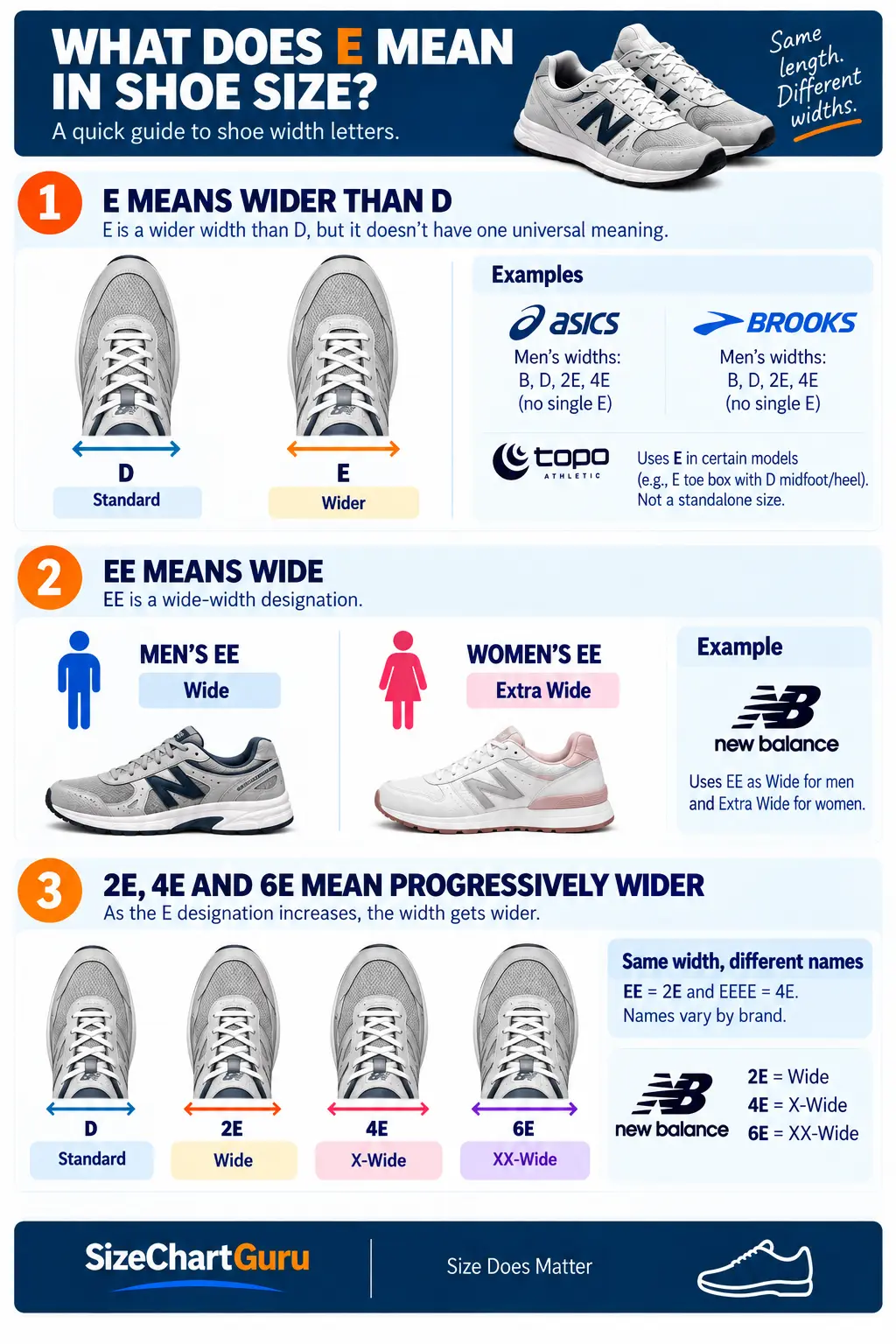
An E width sits wider than D in the traditional shoe-width progression, but a single E does not have one universal category that you can safely apply to every shoe.
That distinction matters because many modern athletic-shoe width systems don’t use a single E at all.
For example, Asics and Brooks go from D directly to 2E in their common men’s width scales: D is Standard/Medium and 2E is Wide.
Topo Athletic men’s Standard construction uses an E toe box with a D midfoot and heel, while its men’s Wide construction uses a 2E toe box with an E midfoot and heel.
In that system, E can describe different parts of the shoe rather than simply appearing as a standalone “Wide” size.
What Does EE Mean in Shoe Size?
EE is a wide-width designation.
In the width systems commonly used for athletic shoes:
- Men’s EE: Wide
- Women’s EE: Extra Wide
Asics and Brooks, for example, use this width category as Wide for men and Extra Wide for women. New Balance follows the same general pattern.
So if you see US 9EE or US 9 2E, the 9 is the shoe’s length size and EE/2E is the width designation.
What Do 2E, 4E and 6E Mean in Shoe Size?
As the E designation increases, the shoe-width category gets progressively wider.
E → EE / 2E → 4E / EEEE → 6E
EE and 2E are two ways of writing the same designation, just as EEEE and 4E are equivalent notations.
The higher the E designation, the wider the width category.
What changes between manufacturers is the name attached to each category. New Balance, for example, classifies men’s 2E as Wide, 4E as X-Wide and 6E as XX-Wide, while another manufacturer may use different terminology or may not offer all of these widths.
Of course, knowing what D, 2E or 4E means is only useful if you know your own measurements. If you haven’t measured recently, here’s how to measure your feet properly before comparing your foot to a sizing or width chart.
Robert Wadlow wore a remarkable US 37AA. See my guide to the biggest shoe size in the world to see how large his feet actually were and what the AA in 37AA means.
What Does a Shoe Size Like 9D, 9E or 9EE Mean?
When a shoe size includes both a number and a width letter, the number tells you the shoe length size, while the letter or letters tell you the width designation.
| Shoe Size | Length Size | Width | How to Read It |
|---|---|---|---|
| US 9D | 9 | D | Size 9 in a D width |
| US 9E | 9 | E | Size 9 in an E width |
| US 9EE | 9 | EE | Size 9 in an EE width |
| US 9 2E | 9 | 2E | Size 9 in a 2E width |
So 9D, 9E and 9EE are all size 9 in length. Moving to a higher width designation doesn’t make the shoe a longer size. It changes the width designation while the length size stays the same.
US 9D → US 9EE
The shoe is still a US 9. You’re changing the width, not moving to a bigger length size.
Does a Shoe Width Letter Have One Exact Measurement?
No. A shoe width letter does not correspond to one universal measurement in inches or millimeters.
You can see this clearly in manufacturers’ own charts. Hoka, for example, lists a men’s US 9 Regular (D) at 100 mm and the Wide (2E) at 108 mm. But move up to a men’s US 12 and those same categories become 106 mm for D and 114 mm for 2E.
The letters haven’t changed. The physical measurements have, because width scales with shoe size.
Women’s sizing shows the same thing. At US 9, Hoka lists 95 mm for Regular (B) and 101 mm for Wide (D).
At US 12, those figures increase to 101 mm and 107 mm.
That’s why I’d be careful with a chart that simply says “D = 4 inches” or “2E = 4.25 inches” without specifying the shoe size and sizing system.
My guide on how to tell if you have wide feet walks through the measurement side of it.
Why Does B Mean Standard for Women but Narrow for Men?
Because men’s and women’s shoe-width systems use different reference points. The letter B stays the same, but its position relative to the standard width changes depending on which sizing system you’re using.
In the commonly used women’s width scale, B is the standard or medium width. In men’s sizing, the standard reference point is typically D, which places B in the narrow category. Asics and Brooks both use this convention in their official width guides.
That’s why a B on a shoe label should always be interpreted in the context of men’s or women’s sizing, rather than as a width category on its own.
Why Does D Mean Standard for Men but Wide for Women?
Because men’s and women’s shoe-width systems use different reference points.
In the commonly used width scales:
- Men’s D: commonly Standard / Medium
- Women’s D: commonly Wide
This convention is used by major athletic-shoe brands including Asics and Brooks.
That doesn’t mean D represents the same physical width in men’s and women’s shoes. It’s a category within two different width systems.
Asics also notes that actual width differences are proportional to shoe size, reinforcing that these letters are width categories rather than fixed measurements.
What Do M, W, N and XW Mean in Shoe Size?
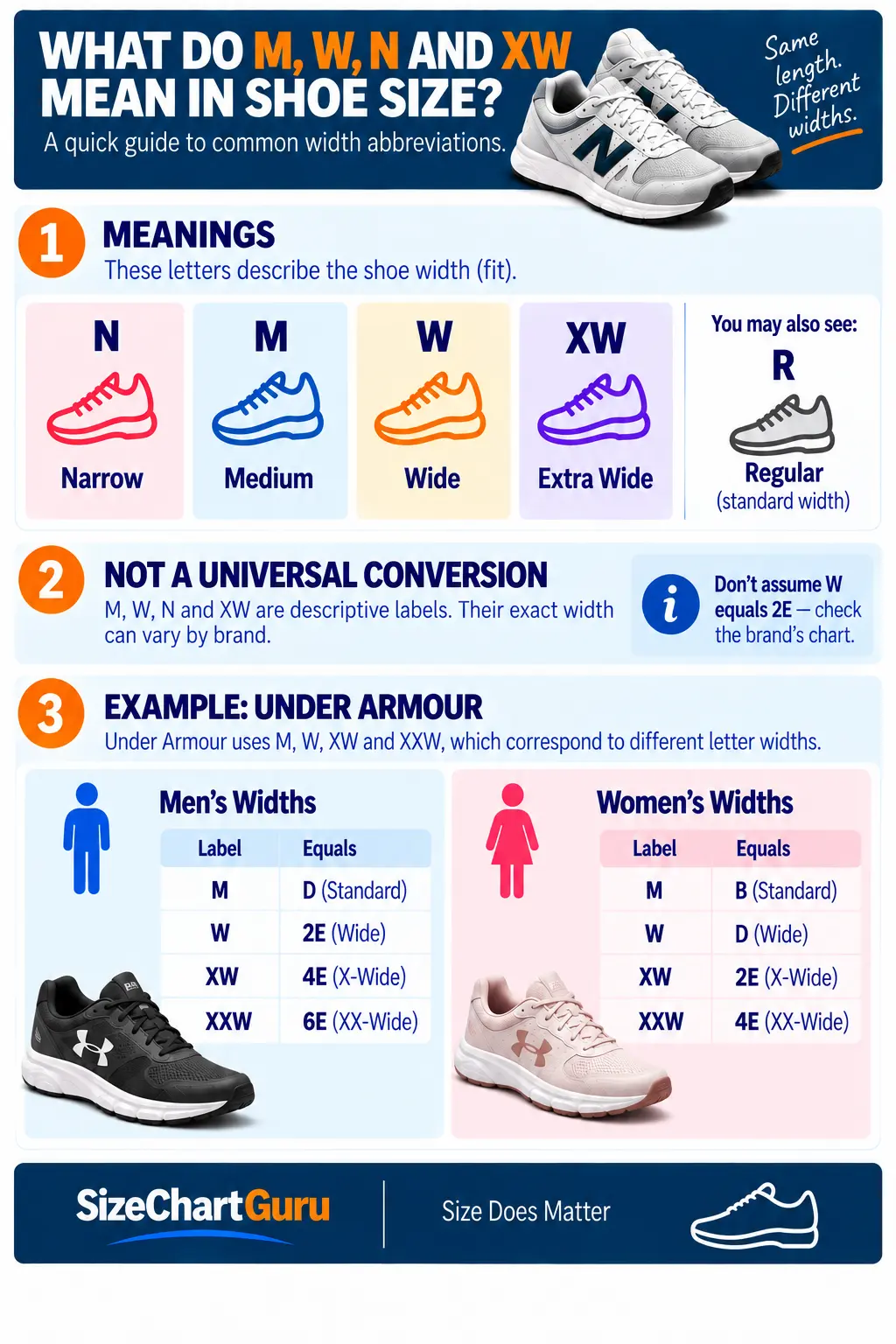
Some shoes use descriptive width abbreviations instead of, or alongside, traditional width letters such as B, D and 2E.
Generally:
- N: Narrow
- M: Medium
- W: Wide
- XW: Extra Wide
You may also see R: Regular, which is typically used to indicate the manufacturer’s regular or standard width.
N, M, W and XW are descriptive labels, not a universal width-conversion system. You shouldn’t assume, for example, that W always equals 2E.
Under Armour is a good example:
Men’s
- M: D
- W: 2E
- XW: 4E
- XXW: 6E
Women’s
- M: B
- W: D
- XW: 2E
- XXW: 4E
So a label such as W tells you the shoe is considered Wide within that manufacturer’s system. It doesn’t give you a universal letter-width conversion.
What Does C/D or D/B Mean in Shoe Size?
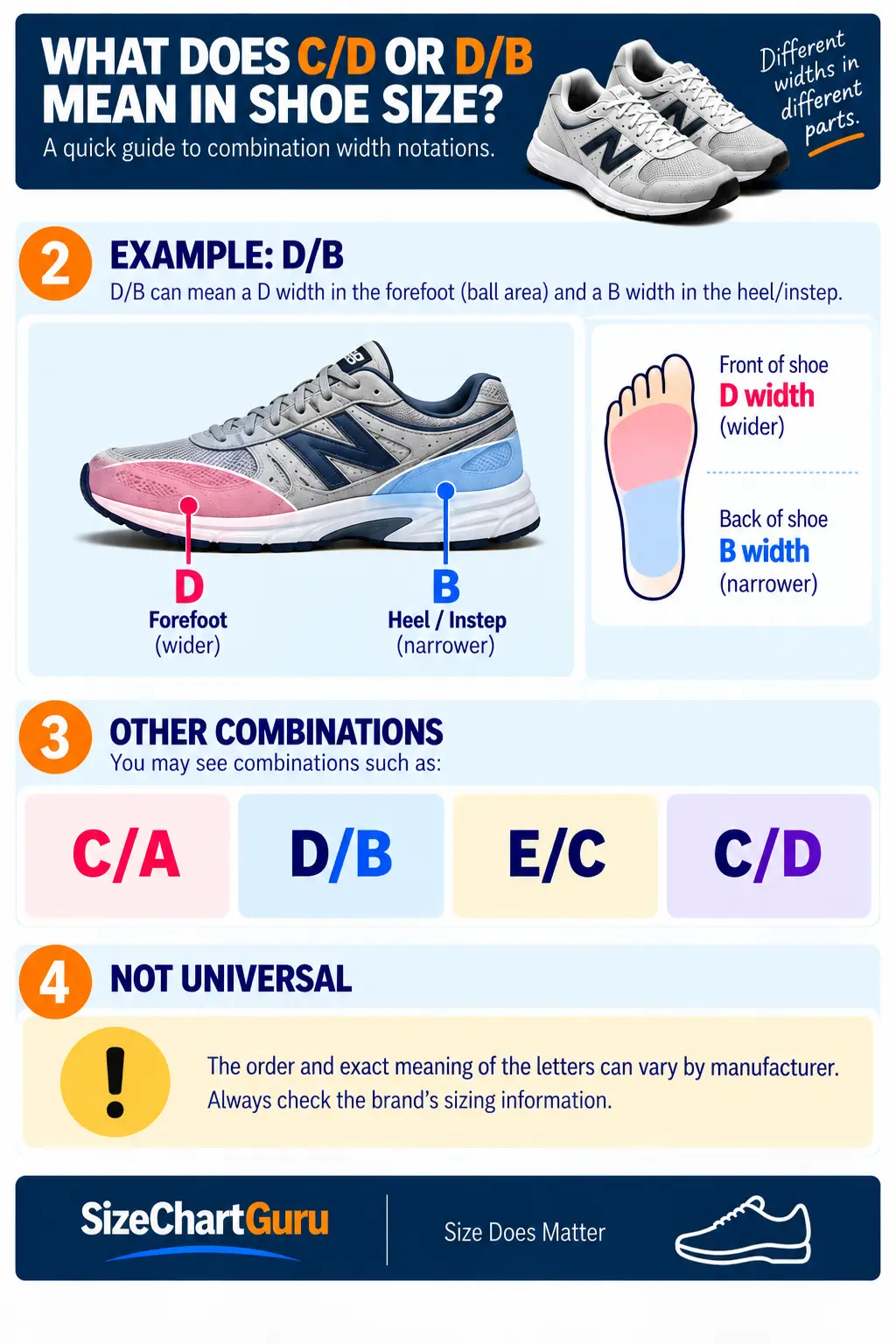
When two width letters appear together, they can indicate a combination width, meaning different parts of the shoe are built to different width specifications rather than using one width throughout.
For example, in a traditional combination-last notation, D/B can describe a shoe with a D-width forefoot or ball area and a narrower B-width heel/instep area.
You may encounter combinations such as:
C/A, D/B, E/C or C/D
The order and exact meaning of the two letters are not universal across every manufacturer. Different makers have used their own conventions for identifying the widths of the forefoot, heel, or instep.
What Does It Mean If My Shoe Has No Width Letter?
A shoe can still have a specific width even if no width letter is printed or shown in the product listing.
Manufacturers don’t necessarily display the standard or default width every time. Asics, for example, states that its shoe boxes and labels identify widths other than standard, meaning the standard width may be left unmarked.
So a shoe might simply be listed as:
US 9
rather than:
US 9D
But no width letter does not universally mean D. Asics itself uses D as the standard men’s width but B as the standard women’s width, and other manufacturers may follow their own labeling conventions.
The absence of a width letter therefore usually means you should look to the manufacturer’s default width for that particular shoe and sizing system, rather than assuming a specific letter.
Are Shoe Width Letters the Same Across Every Brand?
No. The same shoe-width letter does not guarantee the same physical dimensions or fit across every brand.
Manufacturers don’t even describe added width using the same measurement. Vans says its Wide Fit adds 5 mm to the bottom width and 10 mm to the ball girth compared with its regular construction.
Nike describes its Wide shoes as having about 1/4 inch (6.35 mm) more toe-box girth than Regular, while Extra Wide adds about 1/2 inch (12.7 mm).
Those aren’t directly interchangeable measurements. One brand is describing bottom width and ball girth, while another is describing toe-box girth.
That’s exactly why a width designation should be treated as a category within a manufacturer’s system rather than a universal physical measurement.
See my Sneaker Width Chart.
Are US and UK Shoe Width Letters the Same?
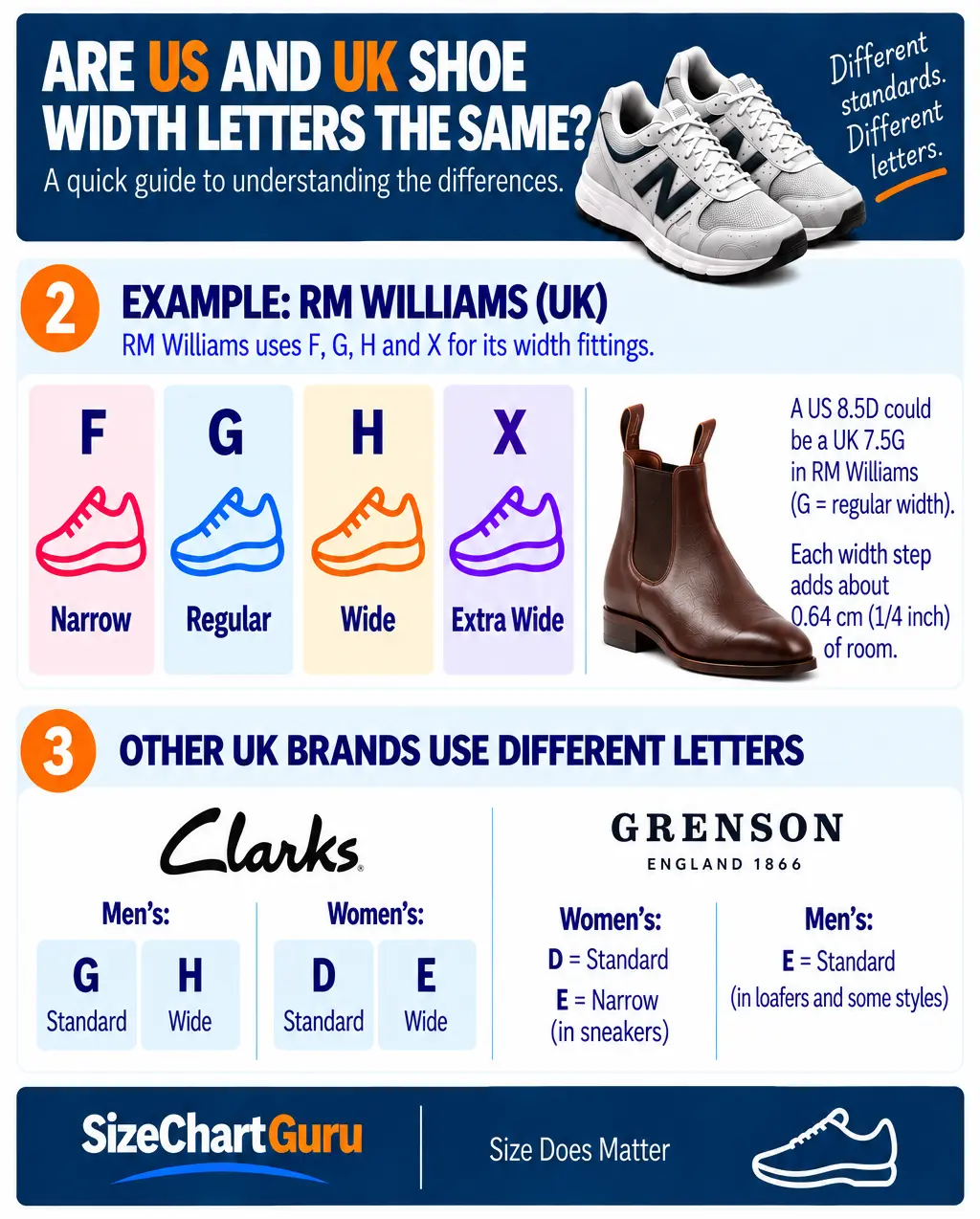
No. You shouldn’t interpret a US width letter using a UK width chart, or assume every UK manufacturer uses the letters the same way.
For example, RM Williams uses F for Narrow, G for Regular, H for Wide and X for Extra Wide. So someone who normally wears a US 8.5D could wear a UK 7.5G in RM Williams, with G representing the brand’s regular width.
RM Williams also changes the physical dimensions within the same length size as you move between width fittings.
Each step adds roughly 0.64 cm (1/4 inch) of room, so moving from G to H changes the width while the length size remains the same.
Other UK brands use the letters differently. Clarks, for example, uses:
Women’s:
- D: Standard
- E: Wide
Men’s
- G: Standard
- H: Wide
And then you have Grenson, where D is the standard women’s fitting, while E is used as a narrow fitting in its women’s sneaker range and some men’s styles. Grenson also considers E a standard fitting in its loafers, where a closer fit helps keep the shoe secure.
So even within UK footwear, E doesn’t automatically mean Wide, and G doesn’t automatically mean Standard. The letter only makes sense when you know which manufacturer’s width system you’re looking at.
That’s why I’d treat US, UK and brand-specific width letters as separate systems rather than trying to convert the letter by itself.
Does the Width Letter Tell You Exactly How a Shoe Will Fit?
No. A width letter alone doesn’t tell you exactly how a shoe will fit.
It doesn’t fully describe the shoe’s toe-box shape, internal volume, heel shape, or last and construction.
For those differences, see:
- Wide toe box vs. wide shoe: Sneaker Width Chart
- Width vs. volume: Sneaker Width Chart
Final Thoughts
Shoe width letters look straightforward until you start comparing B, D, E, EE, 2E, 4E, and all the other variations manufacturers use.
Hopefully, the labels on the shoe box make a little more sense now. A D isn’t automatically Wide, a B isn’t always Medium, and seeing a larger width designation doesn’t mean you’ve moved up in shoe length.
That’s really why I prefer to treat these letters as a starting point for understanding width, rather than an exact description of how a shoe will fit.
Seen a strange width code on a pair of shoes that I didn’t cover here? Leave it in the comments. Tell me the brand, shoe, and width code, and I’ll take a look.