
If you’re wondering whether you have wide feet, the best place to start is with an actual width measurement.
I measure a US 9 on a Brannock Device, with my width sitting around D to E. But that measurement doesn’t automatically mean I need Wide shoes.
Plenty of standard-width sneakers fit my slightly wider forefoot well, while others feel noticeably closer in the same size.
So if one pair squeezes your feet, I wouldn’t immediately conclude that you have wide feet.
The best way to tell is to combine your measurement with what keeps happening across different shoes. If the same width problem follows you from pair to pair, that’s a much stronger clue.

How to Tell if You Have Wide Feet
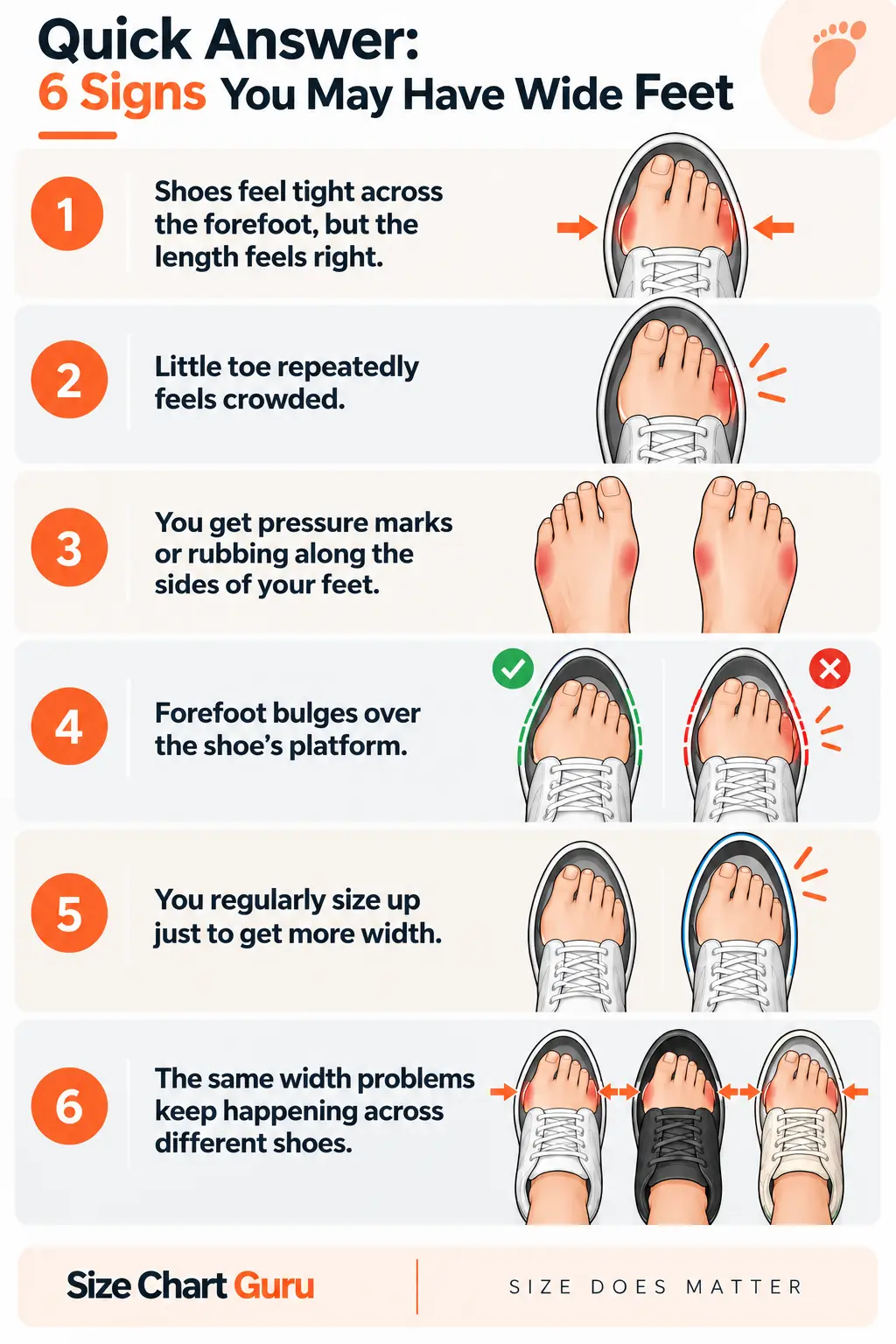
Quick Answer: 6 Signs You May Have Wide Feet
1. Your shoes feel tight across the forefoot, but the length feels right.
You have enough room in front of your toes, yet the sides of your forefoot still feel squeezed.
2. Your little toe repeatedly feels crowded.
Your little toe gets pushed inward, rubs against the side of the shoe, or feels compressed even when the shoe is long enough.
3. You get pressure marks or rubbing along the sides of your feet.
Repeated red marks, indentations, or rubbing around the forefoot can be a sign that the shoe isn’t giving you enough width.
4. Your forefoot bulges over the shoe’s platform.
When you’re standing, the widest part of your foot noticeably pushes over the edge of the sole instead of sitting comfortably over the platform.
5. You regularly size up just to get more width.
Going half a size up relieves the pressure, but then you’re left with more length than you actually need.
6. The same width problems keep happening across different shoes.
One tight shoe doesn’t prove you have wide feet. If the same forefoot pressure or crowding follows you across different brands and shoe shapes, that’s a much stronger clue.
The more of these patterns you notice across different shoes, the more worthwhile it is to measure your foot width rather than assuming one particular shoe is simply too narrow.
Now, before we go any further, here’s my sizing profile so you have some context for the personal fit examples I’ll use throughout this guide.
My Sizing Profile
- Brannock Size: US 9
- Width: 9D to 9E
- Foot Shape: Slightly wide through the forefoot
- Typical Nike Size: US 9
- Preferred Fit: Secure without squeezing my forefoot
One of the biggest clues for me is what happens when the length already feels right.
Before I knew where my own width fell, I noticed that my toes weren’t hitting the front, yet certain shoes still felt closer than I wanted around my forefoot.
Going longer wouldn’t have made much sense because I didn’t need extra space in front of my toes. I needed space in a different direction.
But I wouldn’t judge my foot width from that experience alone. What matters more is whether the same kind of problem keeps showing up.
One shoe can simply be narrow for your foot shape. If you notice several of the signs above across different brands and different shoe shapes, your foot becomes the common denominator.
My own experience isn’t that extreme. Plenty of standard-width shoes work well for my slightly wider forefoot, while other models feel noticeably closer around the front of my foot.
That’s why I wouldn’t label someone as having wide feet simply because they occasionally need more room. I’d be much more convinced if that need for extra width showed up again and again across different shoes.
If this keeps happening across different shoes, it’s time to measure.
🤔 Do Wide Feet Always Need Wide Shoes?
No. Even with my D–E measurement, most of my sneakers are still regular width.
My Nike Dunk Low is a US 9 in standard width, and I have enough room around my forefoot without needing to go wider.
The Air Jordan 1 is another shoe where my regular US 9 works well. I’ve had the same experience with the Asics Gel-1130 and GT-2160. Both work for me in a standard-width US 9.
That doesn’t make my width measurement irrelevant. I notice my slightly wider forefoot much more in shoes that give me less usable space around the front of my foot.
Two shoes labeled the same size and standard width can leave very different amounts of space around your foot.
For me, the measurement tells me something useful about my foot. The shoe still decides whether I actually need more width.
👟 Do I Have Wide Feet, or Is This Particular Shoe Just Too Narrow?
Before blaming your feet, look at what happens in the rest of your shoes.
I’d start with your rotation rather than the troublesome pair. If most of your standard-width shoes feel comfortable and only one or two models squeeze your forefoot, the shoe becomes the more likely explanation.
If one shoe suddenly feels much tighter than the rest of your rotation, I’d pay close attention to how that particular model is shaped.
That’s why I wouldn’t judge my foot width from the pair giving me trouble. I’d compare that shoe with the others I already wear comfortably and ask whether the same problem keeps showing up.
If one or two models feel noticeably tighter while your other standard-width shoes fit well, you’re probably seeing differences between shoes rather than discovering something new about your feet.
If the problem keeps following you from pair to pair, across different brands and different shoe shapes, then your foot width deserves more attention.
The more shoes you can compare, the easier it becomes to tell which of the two is the common denominator: your foot or the shoe.
Jeison Rodríguez’s feet measure more than 40 cm long, while Robert Wadlow wore an extraordinary US 37AA. See how they compare in my guide to the biggest shoe size in the world.
🦶 Can I Have a Wide Forefoot but a Narrow Heel?
Yes. Your foot doesn’t have to be equally wide from heel to toe.
You can have a broad forefoot while your heel is relatively narrow. You can also have more width around the middle of your foot without having an especially wide forefoot.
I have a slightly wide forefoot, so the front of the shoe is usually the area I pay the most attention to when I try on a new pair.
A shoe can feel perfectly secure around my heel and still sit much closer around the ball of my foot and little-toe side.
The opposite can happen too. A shoe may give your forefoot the space it needs but leave more room than you want around the back.
That’s why a squeezed forefoot and a loose heel aren’t necessarily contradictory. They’re happening at different parts of your foot.
So when you’re thinking about whether your feet are wide, pay attention to where you actually need the extra space.
See how your foot shape affects shoe sizing and why width may only be part of the problem.
↕️ Are Wide Feet and High-Volume Feet the Same Thing?
No. A wide foot and a high-volume foot aren’t necessarily the same thing.
Width mostly describes how much space your foot takes up from side to side, while volume is about how much three-dimensional space your foot occupies inside the shoe, including how much room it needs over the top.
Imagine two people whose feet measure the same width across the forefoot. One has a relatively low, flat profile, while the other has a much fuller foot with a higher instep.
Their width measurements might look similar, but the second person needs more space inside the shoe.
That’s why pressure isn’t always coming from the sides.
If the width around your foot seems fine but you consistently feel squeezed over the top of your foot, particularly around the instep, you may be dealing with a volume issue rather than a width issue.
I pay attention to this distinction with my own feet because a width measurement doesn’t describe everything about how a foot occupies a shoe.
When I’m trying a new pair, I want to know whether the closeness I’m feeling is actually coming from the sides or from above. Those are two different problems.
Found your width? Add Size Chart Guru as a Preferred Source on Google to find more of my sizing guides.
🔲 Is a Wide Toe Box the Same as a Wide Shoe?
No. A shoe can have a roomy toe box without actually being a Wide-width shoe.
The easiest way to understand the difference is to look at what each term describes.
A wide toe box refers to the shape and space around your toes. Some shoes stay relatively broad toward the front, giving your toes more room to spread, while others taper inward more aggressively, even if the shoe itself is sold in a standard width.
A Wide shoe, on the other hand, is a width option offered by the manufacturer. You might see the same model sold as Standard and Wide, sometimes with different width letters depending on the brand.
I’ve noticed this distinction with my own shoes. Some of my standard-width sneakers give my slightly wide forefoot plenty of usable space simply because of how they’re shaped.
I don’t need the word “Wide” on the box for the front of the shoe to feel accommodating.
That’s why I wouldn’t look at a sneaker with a roomy toe box and automatically call it a wide shoe. And I wouldn’t assume that every standard-width shoe gives your toes the same amount of space either.
Toe-box shape tells you about the room around your toes. The width designation tells you which width version of the shoe you’re buying.
🤏 How Can I Tell If My Shoes Are Too Narrow?
A shoe that’s too narrow usually tells you where the problem is. You just need to pay attention to what happens across the width of your foot rather than assuming any tight feeling means the whole shoe is too small.
The first thing I notice is persistent pressure along the sides of my forefoot. A shoe can sit close to my foot without bothering me, and I actually like a secure feel.
What gets my attention is when that closeness turns into squeezing that doesn’t go away as I walk.
My little toe is another good indicator. With my slightly wide forefoot, some shoes push noticeably harder against that side of my foot.
If my little toe feels compressed inward or is constantly pressing against the side of the upper, I know the available width isn’t working well for my foot.
I’d also check my feet after taking the shoes off. Repeated red marks or deep pressure lines along the sides of the forefoot can be another sign that the shoe is putting too much pressure on that area.
Numbness or tingling while wearing the shoes is another warning sign I wouldn’t ignore, especially if it goes away after taking them off.
If the same spots regularly rub or develop blisters, I’d pay attention to that too.
You can sometimes see the problem too.
Stand naturally in the shoes and look down at the widest part of your forefoot. If your foot is noticeably pushing the upper outward or spilling over the edge of the shoe’s platform, that’s another sign that the shoe may not be giving you enough width.
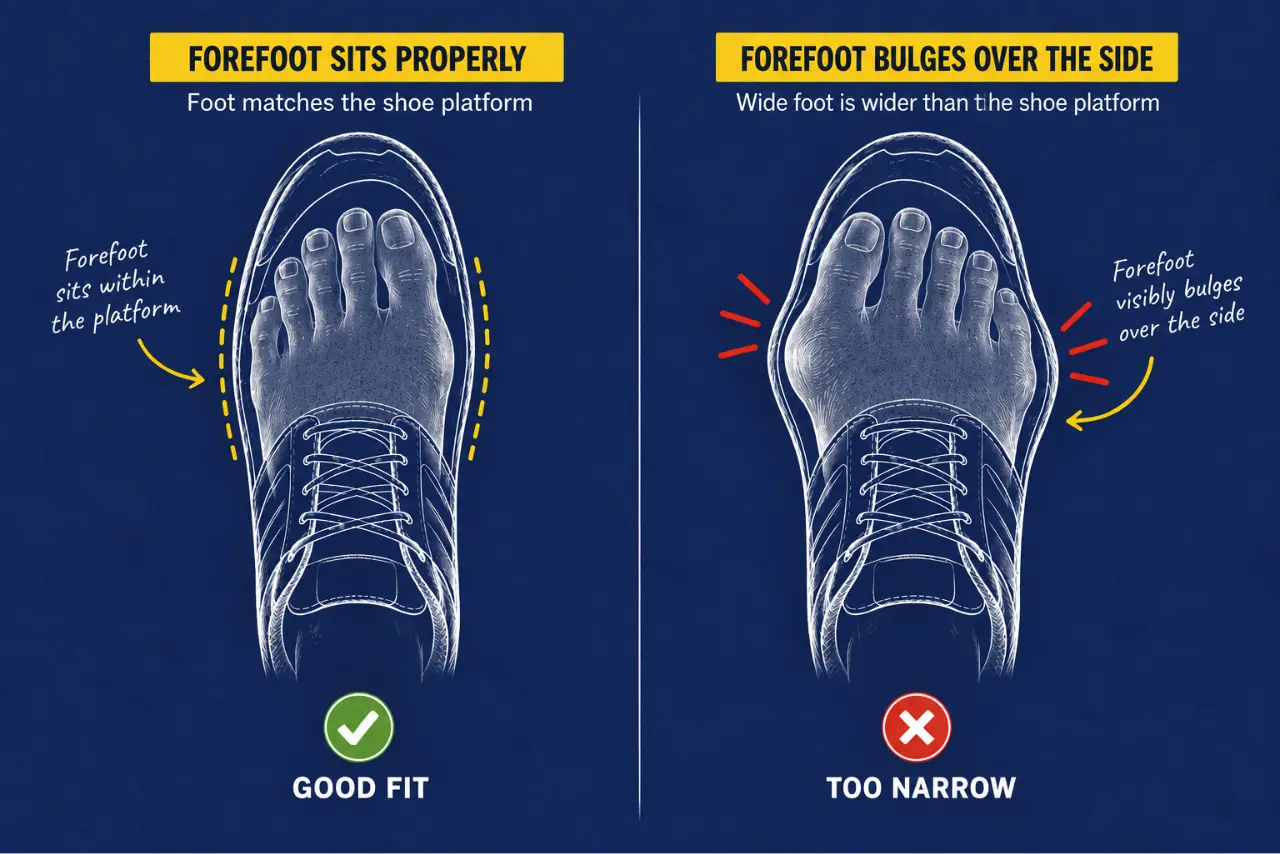
For me, the question is: Is the shoe holding my forefoot, or is it squeezing it?
Those can feel very different even when they look similar from the outside.
↔️ How Can I Tell If My Shoes Are Too Wide?
When a shoe is too wide, I notice movement where I don’t want it.
Your foot shouldn’t be sliding from side to side inside the shoe as you walk. If the length feels right but your foot keeps shifting laterally, there’s probably more width around it than you need.
Another clue is what happens when you tighten the laces. You shouldn’t have to pull them unusually tight just to stop your foot from moving around.
If you’re really cranking down on the laces and the shoe still doesn’t feel secure around your foot, the width may simply be too generous for you.
I prefer a secure fit, so extra room isn’t automatically a benefit for me.
The real test is what happens when you walk. A shoe can feel roomy while you’re standing still and still hold your foot well. If your foot keeps shifting from side to side once you’re moving, the shoe may be too wide.
👣 Should My Feet Touch the Sides of My Shoes?
Yes. Your feet can touch the sides of your shoes and still fit perfectly well.
I think this is an important distinction because I don’t expect to feel empty space all the way around my foot.
With my slightly wide forefoot, I can feel the sides of plenty of shoes in my regular US 9, and that alone doesn’t make me want more width.
What matters to me is how that contact feels.
If the upper rests against the sides of my foot without pushing inward, I consider that normal.
That’s very different from assuming you should be able to slide a finger between your foot and the side of the shoe. Unlike toe room, I don’t use a fixed gap as my target for width.
Your foot and the shoe are supposed to interact. Some contact is normal.
📏 How Should a Shoe Fit When the Width Is Right?
When the width is right, my foot can sit naturally inside the shoe without feeling squeezed or moving around more than I want it to.
I don’t expect empty space around my foot. I want the shoe to follow its shape closely enough to feel secure without changing the way my foot naturally sits.
My toes should be able to rest in their normal position, and the widest part of my forefoot shouldn’t feel like it’s fighting against the sides of the shoe.
Then I walk in them.
If I can move naturally without thinking about pressure from the sides or trying to control excess movement inside the shoe, the width is usually working for me.
That’s ultimately what I’m looking for: enough room for my foot to sit naturally, but not so much that I lose control of the shoe.
📏 How Do I Measure My Foot Width?
There are two easy ways to do this. If you have access to a Brannock Device, that’s the method I prefer because I can measure my foot length and width on the same device.
If you don’t have one, you can get a useful measurement at home with a piece of paper and a ruler or measuring tape.
Method 1: Measure Your Foot Width With a Brannock Device
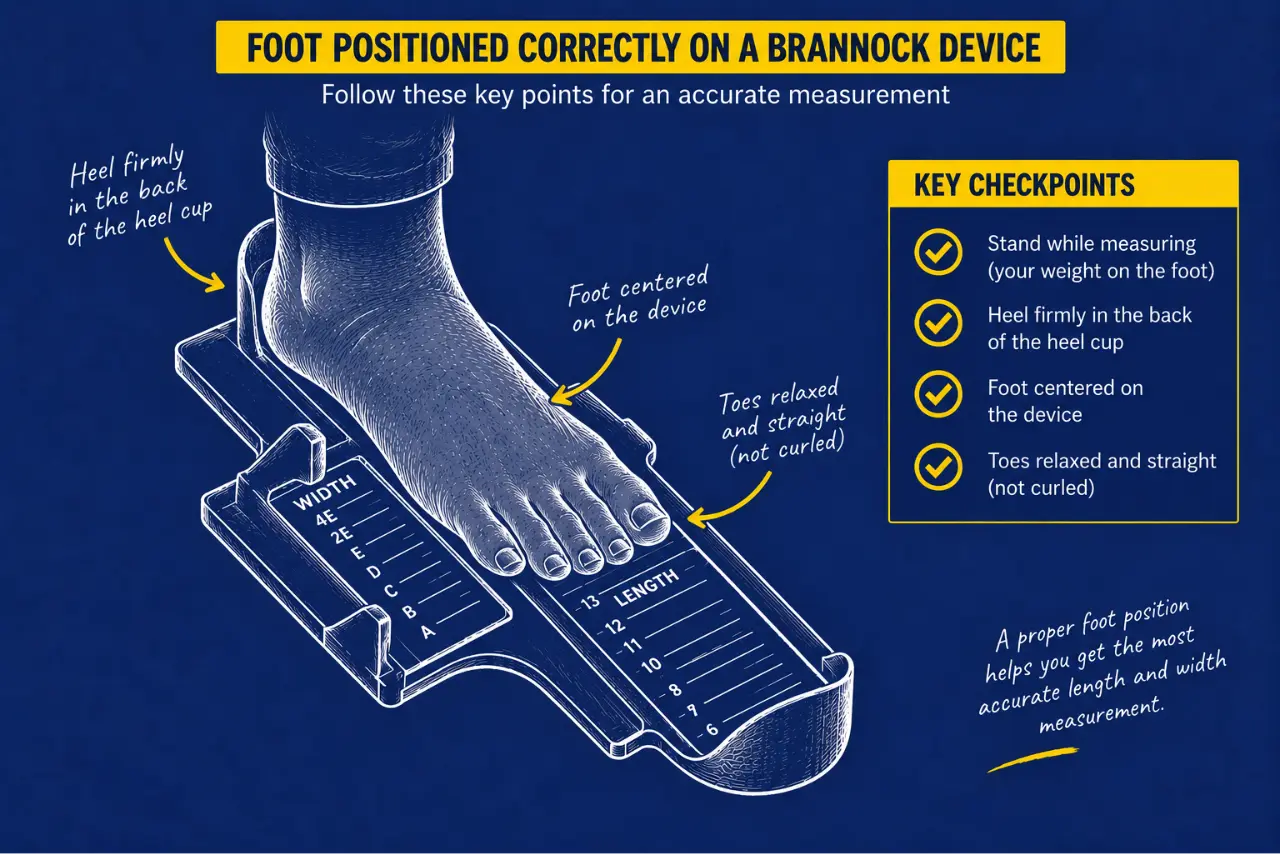
Put on the socks you normally wear with your shoes and place your heel firmly into the correct heel cup.
Stand with your weight evenly distributed across both feet so the foot you’re measuring can spread naturally.
Before reading the width, you need to determine your shoe size on the device.
First, look straight down over your longest toe to get your heel-to-toe length.
Then measure your arch length, also called heel-to-ball length. Place your thumb over the ball joint of your foot and slide the arch-length pointer forward until its curved edge matches the ball joint.
Compare the two readings. Brannock recommends generally using the larger of your heel-to-toe length and arch length as your shoe size.
For example:
- Heel-to-toe: US A0
- Arch length: US 10.5
- Size used to read width: US 10.5
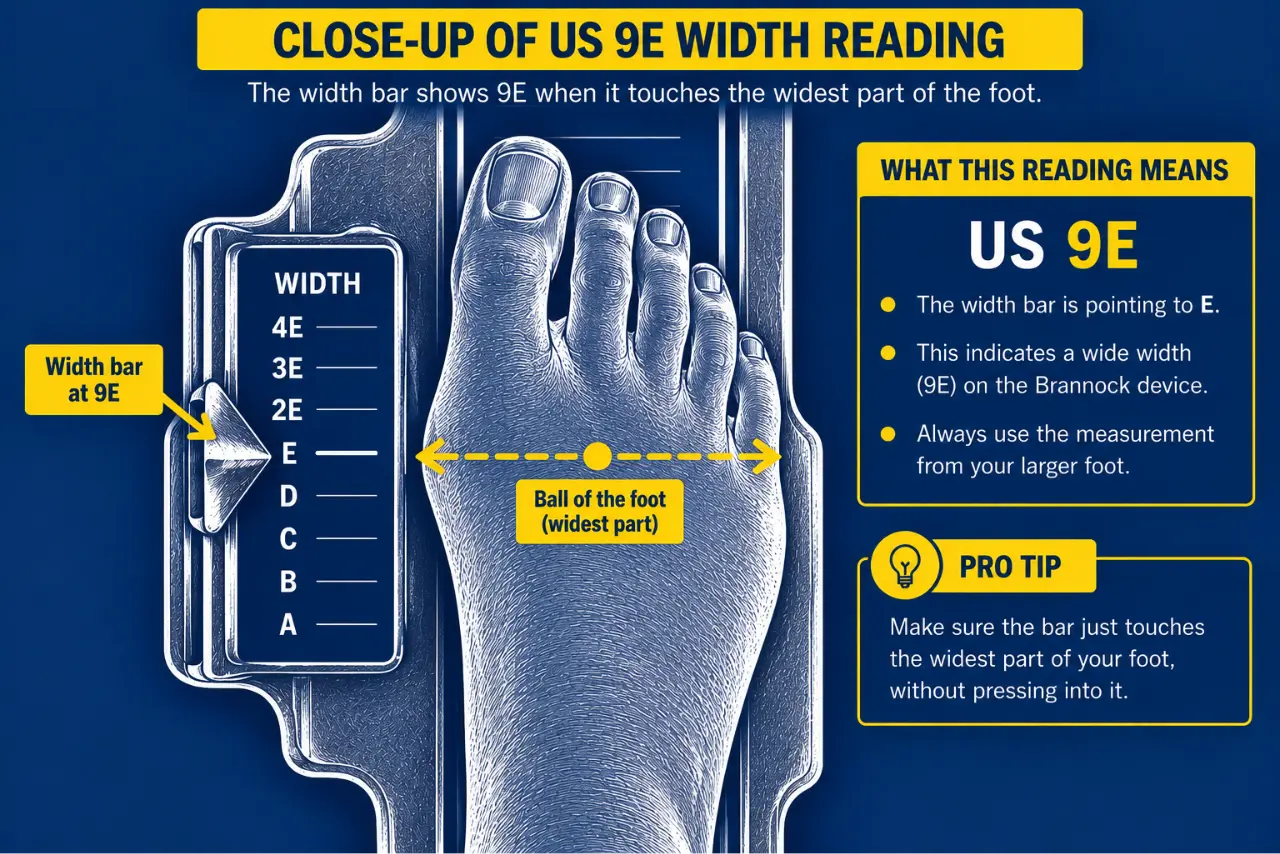
Once you’ve determined that size, slide the width bar firmly against the edge of your foot.
Now find your determined shoe size on the movable width bar and read the width indicated at that point.
For now, the important thing is that you determine your Brannock shoe size before reading the width.
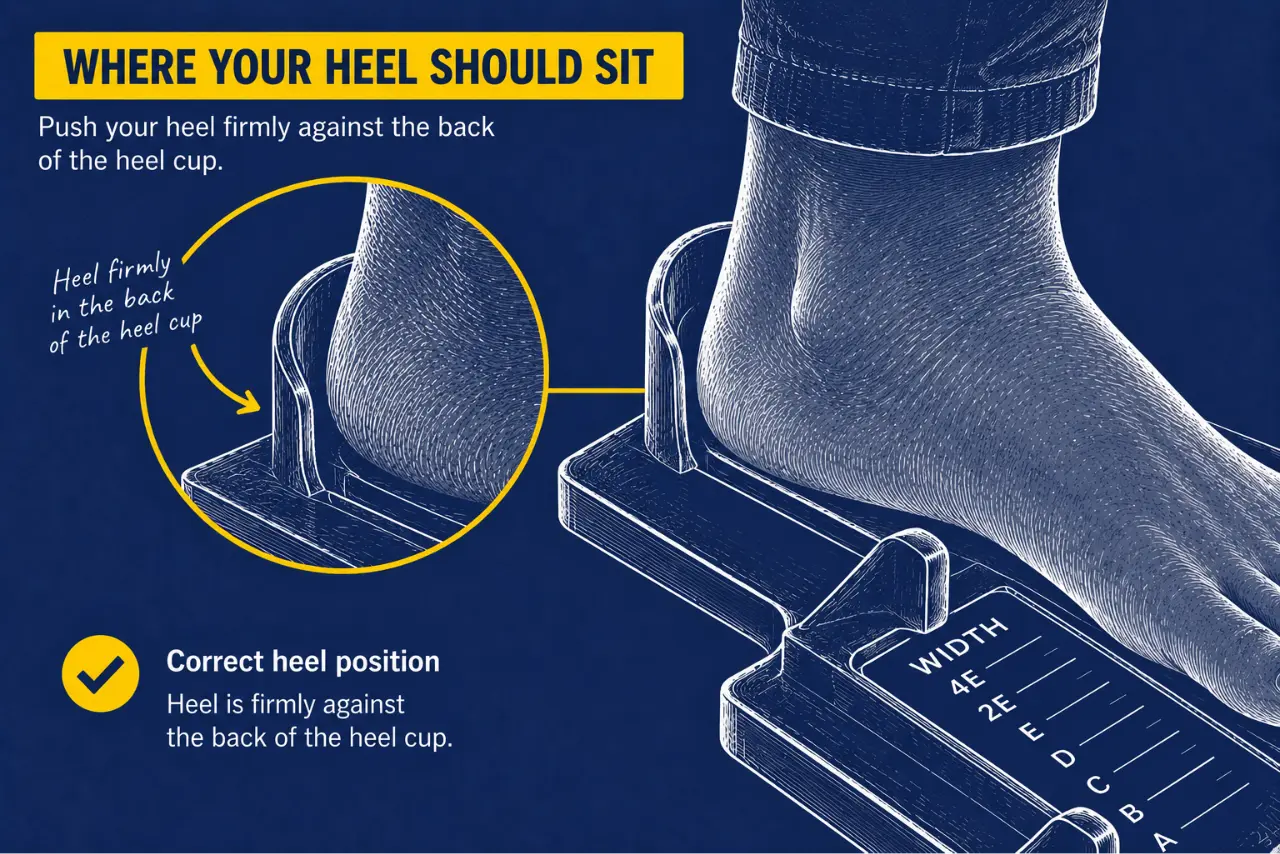
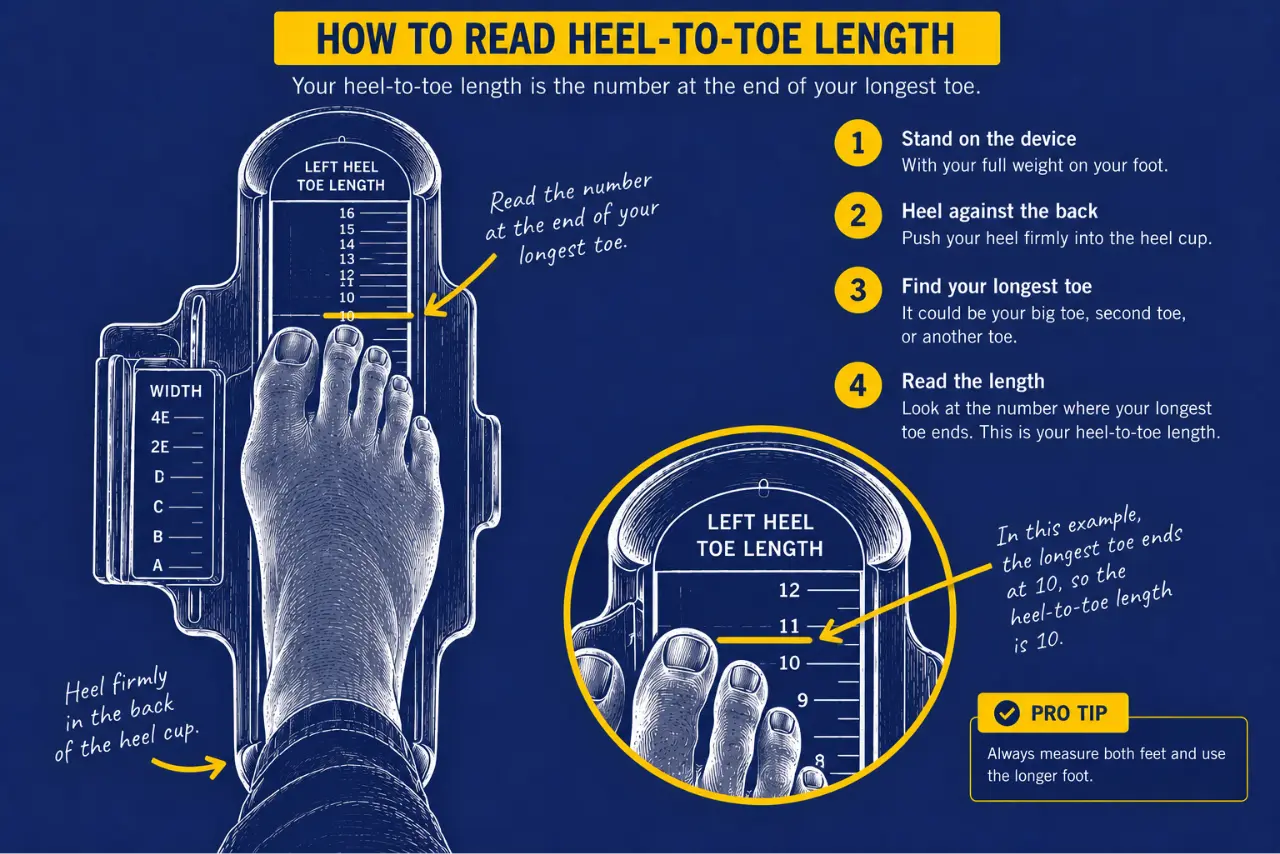
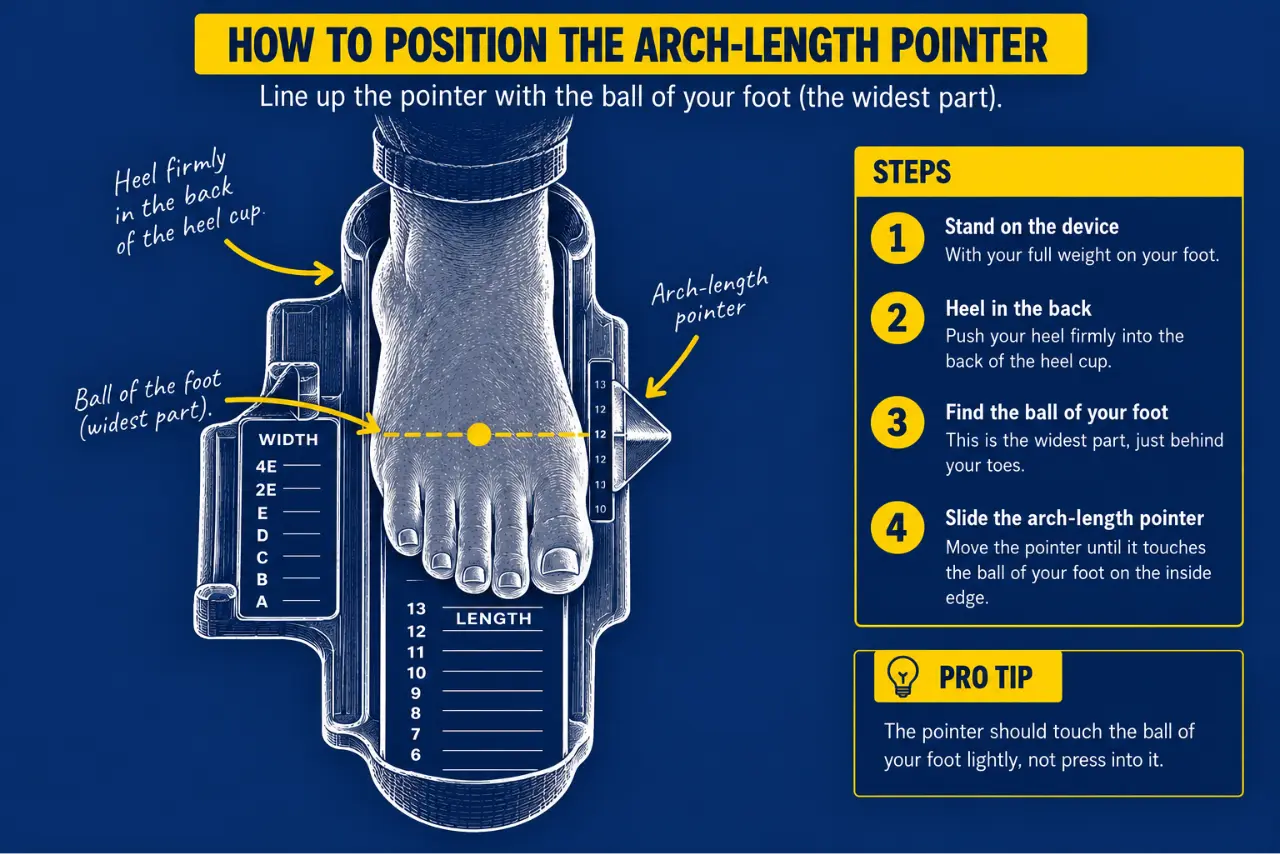
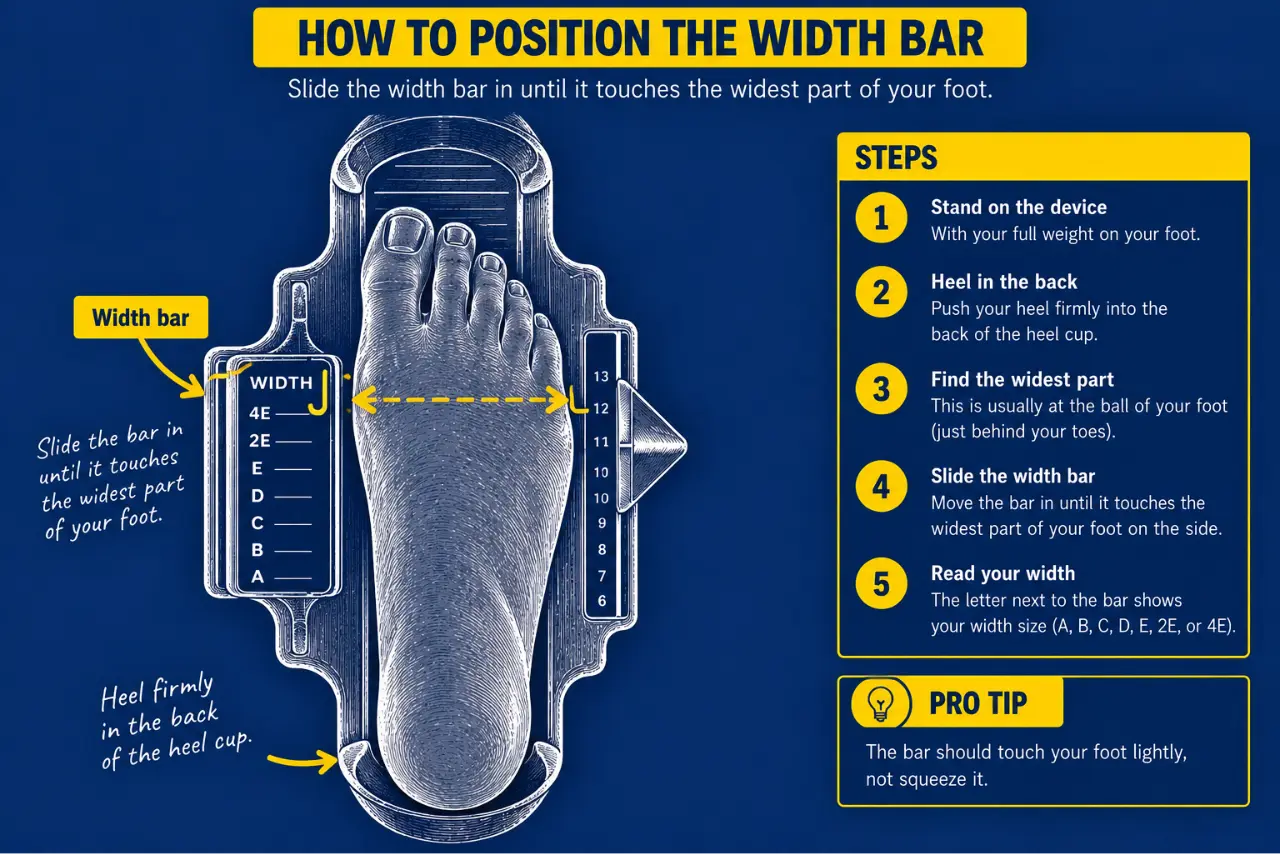
Method 2: Measure Your Foot Width at Home
If you don’t have a Brannock Device, you can still measure your foot at home.
If you want the full process for measuring both your foot length and width, follow my step-by-step guide on how to measure your feet at home.
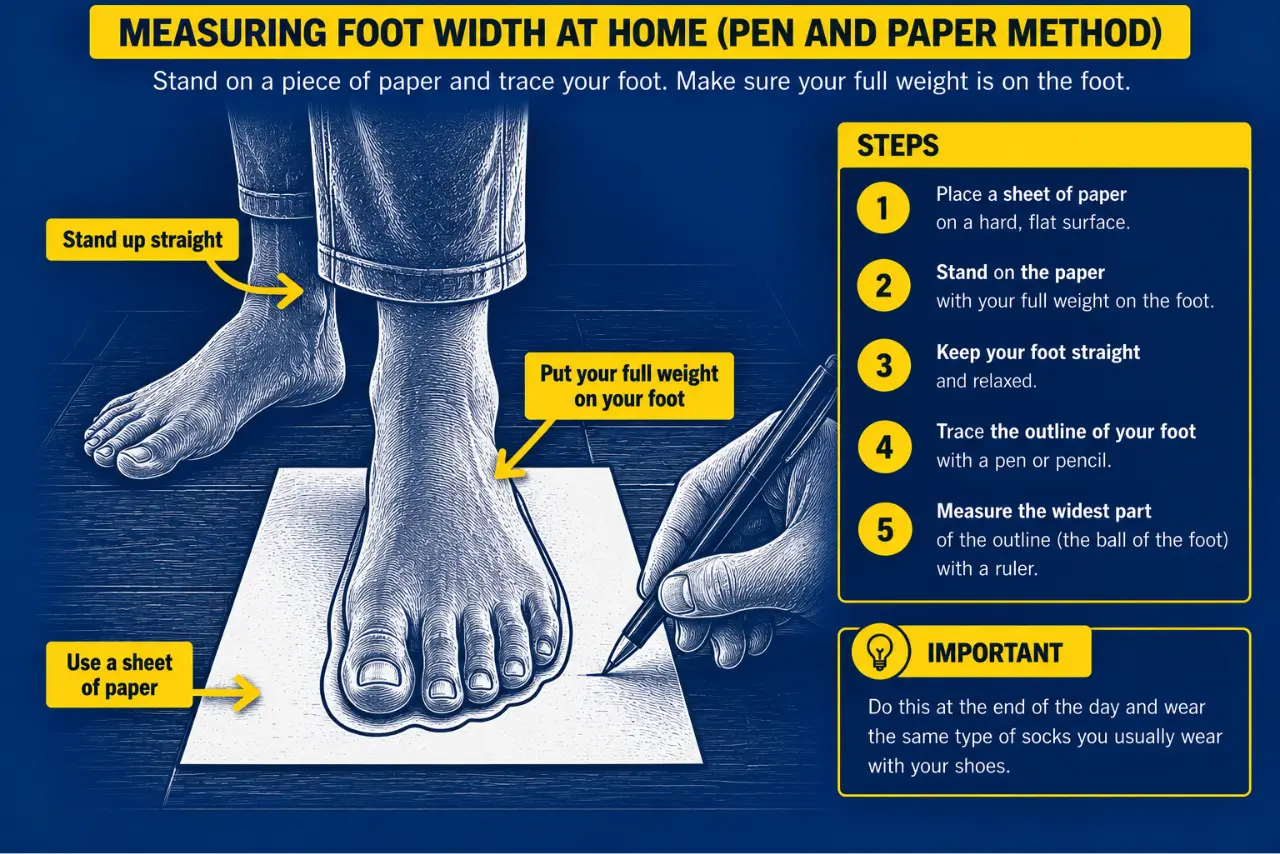
Put a piece of paper on a hard, flat floor and stand on it with your full weight on your foot. Trace around your foot while keeping the pencil as upright as possible.
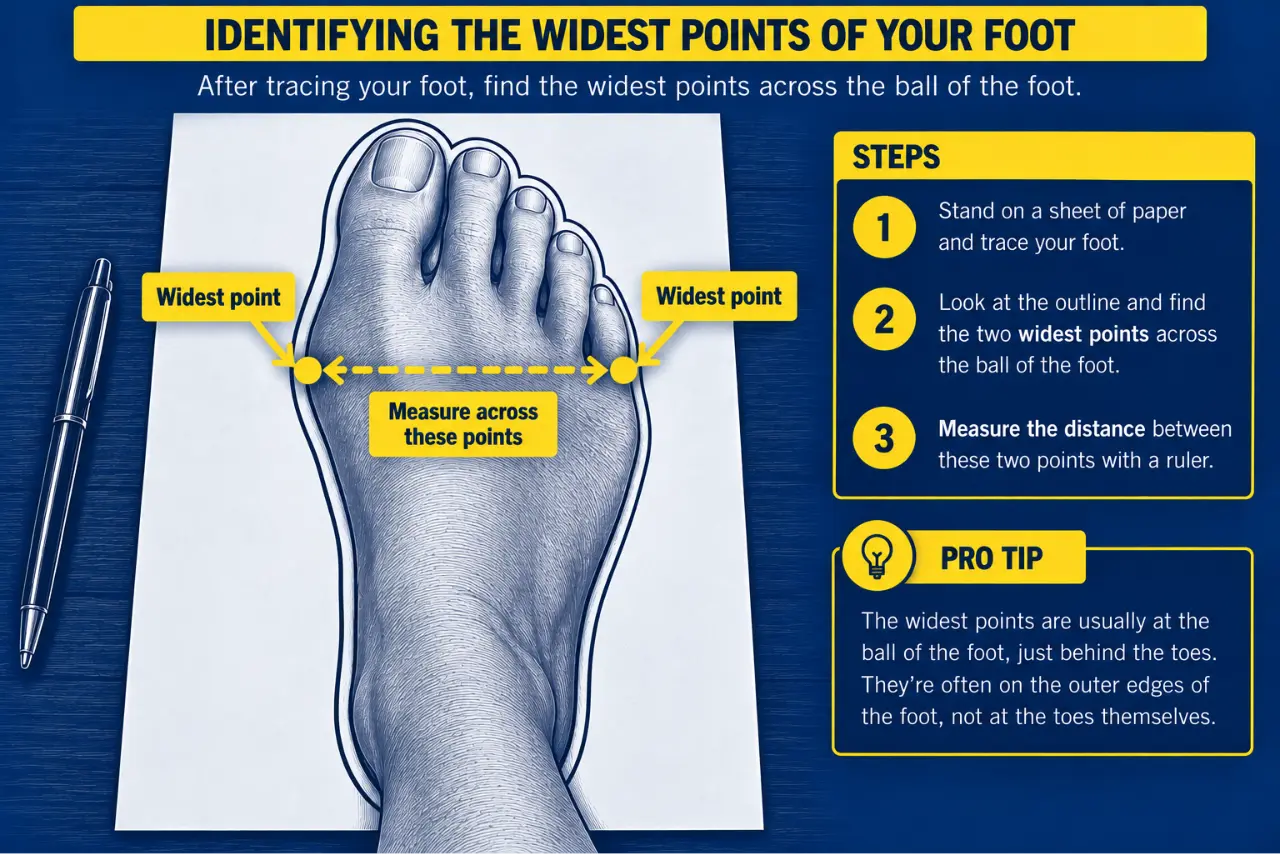
Once you’ve traced it, find the widest part of the forefoot. This will usually be around the ball of your foot.
Mark the two widest points and measure straight across between them with a ruler. Record that measurement in inches or centimeters.
For example, you might end up with:
Foot length: [X]
Foot width: [X]
Don’t worry about whether that number means narrow, standard, or wide yet.
Treat your home measurement as a reference point rather than a universal shoe-width size. You’ll still need to interpret it alongside your foot length and the width chart or sizing system you’re using.
My sneaker width guide explains standard, wide, and extra-wide widths and how those width labels work.
🦶 Why Should I Measure Both Feet?
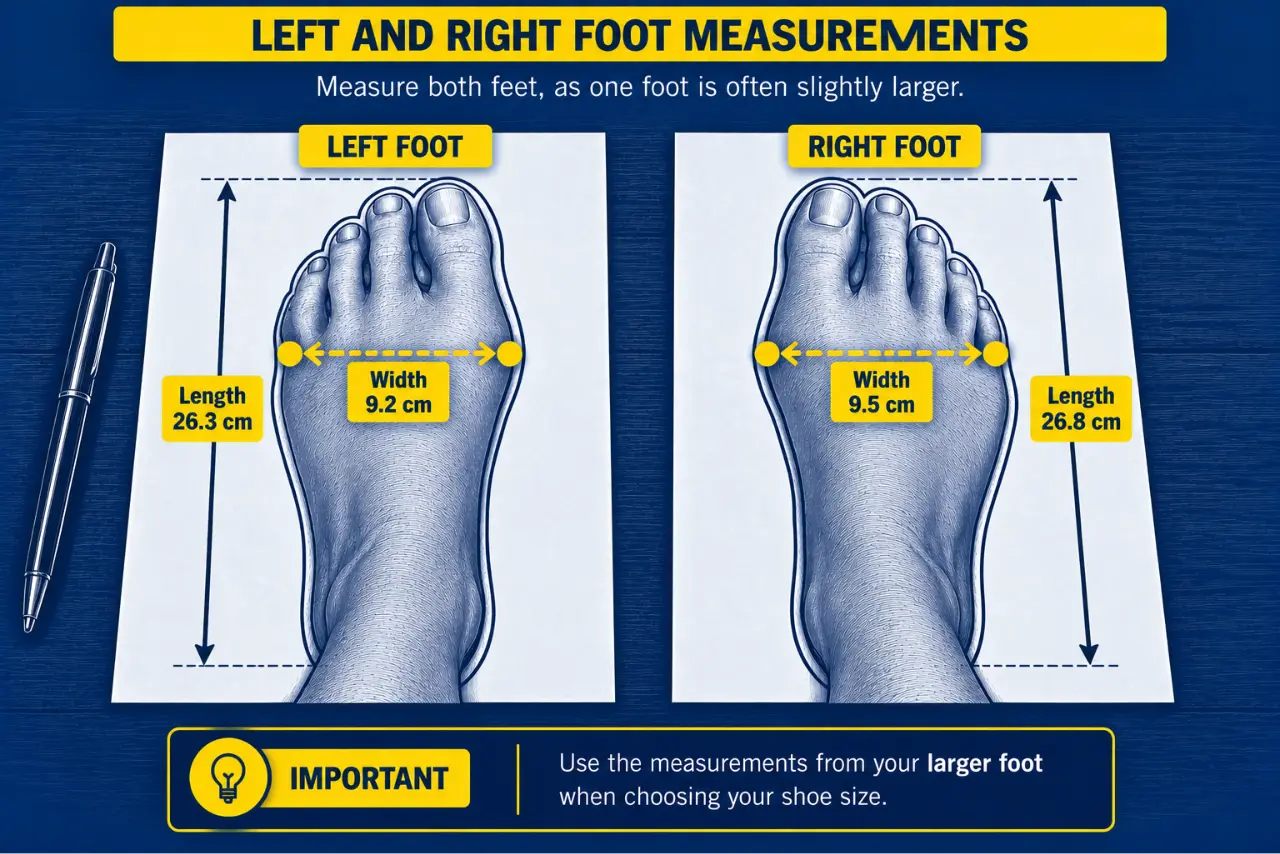
Because your feet don’t have to be identical.
One can be slightly longer, wider, or both. That’s true for me too, which is why I never assume a measurement from one foot automatically represents the other.
Measure both feet separately and write the results down:
Table here:
Left Foot Right Foot
Length ___ ___
Width ___ ___
If one foot is wider, that’s the foot I’d pay closer attention to when choosing shoes. Your shoes still need to accommodate it, even if the other foot is slightly narrower.
Don’t average the two widths. You don’t want to create a measurement that neither foot actually has.
⏰ When Should I Measure My Feet?
Try to measure your feet under conditions that resemble how you’ll actually wear your shoes.
I prefer measuring while standing, because my feet are bearing weight rather than sitting unloaded. I also wear the type of socks I’d normally use with the shoes I’m buying.
Time of day can matter too. Feet can be a little fuller later in the day after you’ve spent hours standing and walking, so an evening measurement can give you a better idea of the space your feet may need after they’ve been on the ground for a while.
And if you haven’t measured your feet in years, I’d measure them again rather than relying on an old number.
The goal isn’t to chase a perfectly precise measurement down to the last millimeter. It’s to measure your feet under realistic, repeatable conditions so the number is actually useful when we start interpreting it.
📐 What Does My Foot Width Measurement Mean?
Let’s say you followed the steps above and measured the widest part of your foot at 10.5 cm.
Does that mean you have wide feet?
Not necessarily. That number needs context.
A raw width measurement doesn’t tell you your shoe-width designation by itself. You need to interpret it alongside your foot length and the width system or chart you’re using.
So after measuring at home, keep both numbers together:
Foot length: ___ cm / inches
Foot width: ___ cm / inches
Once you know your US shoe size, use the tables below to compare your foot-width measurement with the approximate range for that size.
I’ve used ranges rather than exact cutoffs because shoe widths aren’t standardized across every brand and model. Think of these numbers as a practical reference point rather than a universal rule.
| US Size | Standard (B) | Wide (D) | Extra Wide (2E) |
|---|---|---|---|
| 5 | 3.1–3.2″ | 3.3–3.4″ | 3.4–3.5″ |
| 5.5 | 3.2–3.3″ | 3.3–3.4″ | 3.5–3.6″ |
| 6 | 3.2–3.3″ | 3.4–3.5″ | 3.5–3.6″ |
| 6.5 | 3.3–3.4″ | 3.5–3.6″ | 3.6–3.7″ |
| 7 | 3.4–3.5″ | 3.5–3.6″ | 3.7–3.8″ |
| 7.5 | 3.4–3.5″ | 3.6–3.7″ | 3.7–3.8″ |
| 8 | 3.5–3.6″ | 3.7–3.8″ | 3.8–3.9″ |
| 8.5 | 3.5–3.6″ | 3.7–3.8″ | 3.8–3.9″ |
| 9 | 3.6–3.7″ | 3.8–3.9″ | 3.9–4.0″ |
| 9.5 | 3.7–3.8″ | 3.8–3.9″ | 4.0–4.1″ |
| 10 | 3.7–3.8″ | 3.9–4.0″ | 4.0–4.1″ |
| 10.5 | 3.8–3.9″ | 4.0–4.1″ | 4.1–4.2″ |
| 11 | 3.9–4.0″ | 4.0–4.1″ | 4.1–4.2″ |
| 12 | 4.0–4.1″ | 4.1–4.2″ | 4.3–4.4″ |
| US Size | Standard (D) | Wide (2E) | Extra Wide (4E) |
|---|---|---|---|
| 6 | 3.4–3.5″ | 3.6–3.7″ | 3.7–3.8″ |
| 6.5 | 3.5–3.6″ | 3.7–3.8″ | 3.8–3.9″ |
| 7 | 3.7–3.8″ | 3.8–3.9″ | 4.0–4.1″ |
| 7.5 | 3.7–3.8″ | 3.9–4.0″ | 4.0–4.1″ |
| 8 | 3.8–3.9″ | 4.0–4.1″ | 4.1–4.2″ |
| 8.5 | 3.9–4.0″ | 4.0–4.1″ | 4.1–4.2″ |
| 9 | 3.9–4.0″ | 4.1–4.2″ | 4.2–4.3″ |
| 9.5 | 4.0–4.1″ | 4.1–4.2″ | 4.3–4.4″ |
| 10 | 4.0–4.1″ | 4.2–4.3″ | 4.3–4.4″ |
| 10.5 | 4.1–4.2″ | 4.3–4.4″ | 4.4–4.5″ |
| 11 | 4.2–4.3″ | 4.3–4.4″ | 4.5–4.6″ |
| 11.5 | 4.2–4.3″ | 4.4–4.5″ | 4.5–4.6″ |
| 12 | 4.3–4.4″ | 4.5–4.6″ | 4.6–4.7″ |
| 12.5 | 4.3–4.4″ | 4.4–4.5″ | 4.6–4.7″ |
| 13 | 4.4–4.5″ | 4.6–4.7″ | 4.7–4.8″ |
| 14 | 4.6–4.7″ | 4.7–4.8″ | 4.8–4.9″ |
If your measurement falls between two ranges, don’t force yourself into one category. You may simply sit between widths.
That’s where I fall myself. My Brannock measurement sits around D–E, which is one reason I treat width as a starting point rather than assuming I automatically need a Wide shoe.
My boot width guide explains the different width conventions and how to choose the right fit.
🔤 What Do Shoe Width Letters Mean?
Common examples include B, D, E, EE or 2E, and 4E. These are width designations manufacturers use to distinguish narrower and wider versions of a shoe.
Men’s and women’s width conventions differ, and brands don’t always label their widths in exactly the same way.
That’s why knowing that a shoe is a D or 2E is only useful if you understand the system behind those letters.
I’ve broken down what shoe width letters mean, including D, E, EE, 2E, 4E, and how men’s and women’s widths compare, in my complete shoe width guide.
⬆️ Should I Size Up If I Have Wide Feet?
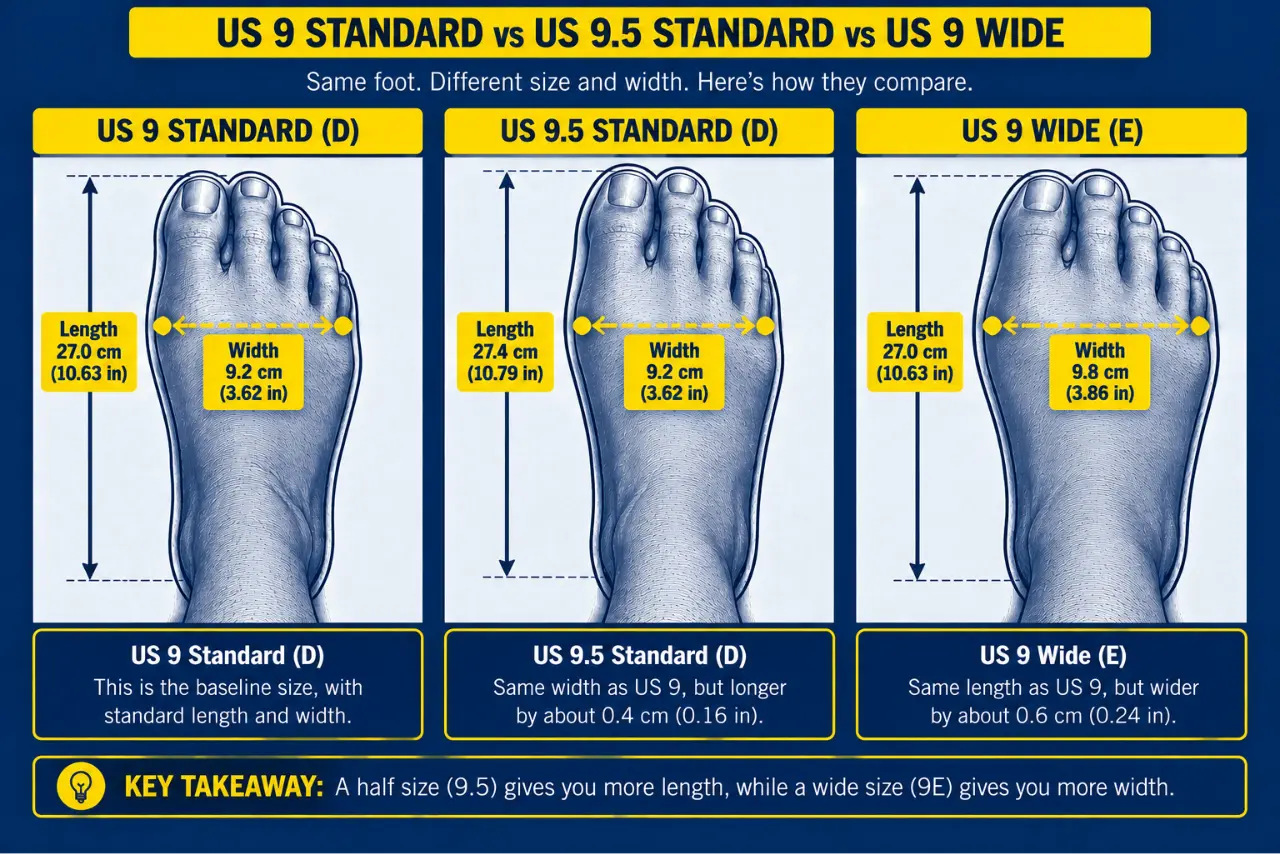
Not automatically. If the length of your shoe is already right, going up half a size just to get more width can create a new problem.
Let’s say your correct length is a US 9.
You try a US 9 Standard, and the length feels right, but the shoe puts too much pressure across the width of your foot.
Going to a US 9.5 Standard may give you a little more room, but you’re also buying a longer shoe. Now you may have extra space in front of your toes that you never needed in the first place.
That’s why I’d want to compare the US 9 Standard with the US 9 Wide before assuming that 9.5 is the answer.
You’re keeping the length that already works while changing the dimension that’s actually causing the problem.
I sometimes run into this decision with my own slightly wide forefoot. Certain shoes feel much closer across the front of my foot than others.
But I don’t want to automatically make the entire shoe longer every time I want a little more width.
That’s the question I’d ask before changing sizes:
- Do I actually need more length, or am I adding length just to escape width pressure?
🤏 What If I’m Between Standard and Wide?
Sometimes your foot doesn’t fall neatly into one width category. I’m a good example. At a US 9, I measure around D–E, so I’m sitting between a typical men’s standard D and the next step up in width.
In that situation, I wouldn’t decide based on the width letter alone. I’d try the same shoe in the same length, first in Standard and then in Wide.
For me, that would mean comparing:
- US 9 Standard vs US 9 Wide
Then I’d pay attention to the tradeoff between the two.
If the Standard version creates noticeable pressure but the Wide version lets my foot settle naturally without moving around, I’d choose Wide.
But if the Standard version feels comfortably close and the Wide version introduces unwanted side-to-side movement, I’d stay with Standard.
The decision can change from one model to another because I’m close enough to the boundary that either width may work.
🧭 Do I Need Wide Shoes? My Decision Guide
If you’re still not sure what needs to change, use this table to narrow down what your feet and shoes are telling you.
| What I notice | What I’d investigate |
|---|---|
| Correct length but persistent side pressure | Width |
| Toes hitting the front | Length |
| Forefoot feels tight but heel feels loose | Shoe shape |
| Pressure is mainly over the top of my foot | Volume |
| One particular model feels narrow | That shoe’s shape |
| Most standard-width shoes feel narrow | Foot width |
| Sizing up relieves the pressure but creates too much length | Same length in Wide |
| Standard and Wide both seem possible | Compare both at the same length |
The goal isn’t to label every uncomfortable shoe as a width problem. It’s to identify which part of the fit actually needs to change before you change anything.
🧪 How I Decide Whether I Need a Wide Shoe
My Brannock measurement gives me a starting point, not an automatic answer.
Because I know my forefoot runs slightly wide, that’s the area I pay the most attention to when I try a new shoe.
But I still start with my regular US 9 in standard width when that’s available.
Then I stop thinking about the letter on the Brannock Device and pay attention to the shoe.
Where does it feel close?
That’s usually the first thing I want to figure out. I don’t mind feeling the upper against my forefoot. I actually prefer my shoes to feel secure rather than overly roomy.
What I’m trying to separate is comfortable contact from actual pressure.
My Nike Dunk Low is a good example. My regular US 9 works well even with my slightly wider forefoot, so there’s nothing about my D–E measurement that makes me want to change the width.
I’ve had the same experience with shoes like the Asics Gel-1130.
Other shoes can feel much closer in the same size. When that happens, I don’t immediately decide that I need a Wide.
I pay attention to where that closeness is coming from…
- Is the shoe squeezing me from the sides?
- Is the pressure coming from higher over my foot?
- Or does this particular model simply wrap my foot differently from the shoes I’m used to?
That distinction matters more to me than the width label by itself.
Only after I’ve figured out what I’m actually feeling do I consider changing the width.
That’s probably the biggest lesson I’ve learned from being between D and E: my measurement tells me what my foot is like, but it doesn’t make the decision for every shoe I put on.
How to Tell if You Have Wide Feet FAQ
Can your feet get wider over time?
Yes. Foot shape can change over time, and your feet may become wider as you get older. Pregnancy can also change foot size and shape for some people.
That’s why I wouldn’t rely indefinitely on a measurement you took years ago. If shoes that used to fit comfortably consistently start feeling tighter, it may be worth measuring your feet again.
Yes. Your feet can become wider or change shape over time, so the width that worked for you years ago may not always be the best fit today.
Age-related changes can play a role, and pregnancy can also change foot dimensions for some people.
Are wide shoes longer than regular shoes?
Not necessarily. A Wide version is designed to give you more width, not simply function as a longer shoe. A US 9 Standard and US 9 Wide are different choices from a US 9 and US 9.5.
Do wide shoes run bigger?
They can feel bigger because there’s more space around your foot, but that doesn’t mean you bought a longer shoe size. How noticeable the difference feels depends on the model and how the manufacturer builds its different widths.
Can my shoe width change without my shoe length changing?
Yes. If the model comes in multiple widths, you can change from Standard to Wide while keeping the same numerical shoe size.
How often should I measure my foot width?
There’s no schedule I think everyone needs to follow. I’d remeasure if it’s been several years, your old size stops working as expected, or you notice that your shoes consistently feel different from how they used to.
Can bunions make my feet measure wider?
A bunion or bunionette can increase the width across the front of your foot, so your measurement may be wider at that point. That doesn’t necessarily mean the rest of your foot is equally wide.
When measuring at home, measure the widest part of your foot as it actually sits while you’re standing. When choosing shoes, pay attention to whether you need extra space specifically around that area rather than assuming you need more room everywhere.
💭 Final Thoughts: “I’m a Size 9” Doesn’t Tell the Whole Story
I’ve probably said “I’m a size 9” hundreds of times when talking about shoes. But the more shoes I’ve tried, the more I’ve realized how little that number actually tells you about my feet.
It tells you my length.
It doesn’t tell you how my forefoot is shaped, what happens around my heel, or how much space my foot takes up inside a shoe.
And even if you knew all of that, there’s still another half of the equation: the shoe itself.
Two sneakers marked US 9 Standard don’t necessarily put the same amount of space in the same places. One can follow my foot beautifully while another feels noticeably closer, even though the size printed on both boxes is identical.
That’s also why two people who both say “I’m a size 9” can put on the same sneaker and have completely different experiences.
The number is useful. It’s just not the whole shape of your foot.
💬 What About Your Feet?
Do you think you have wide feet? Do you measure wide, or are you somewhere between Standard and Wide like me?
Drop your shoe size, width measurement, and the shoes that give you trouble in the comments. If you’ve found a particular sneaker that works especially well for your foot shape, share that too.