
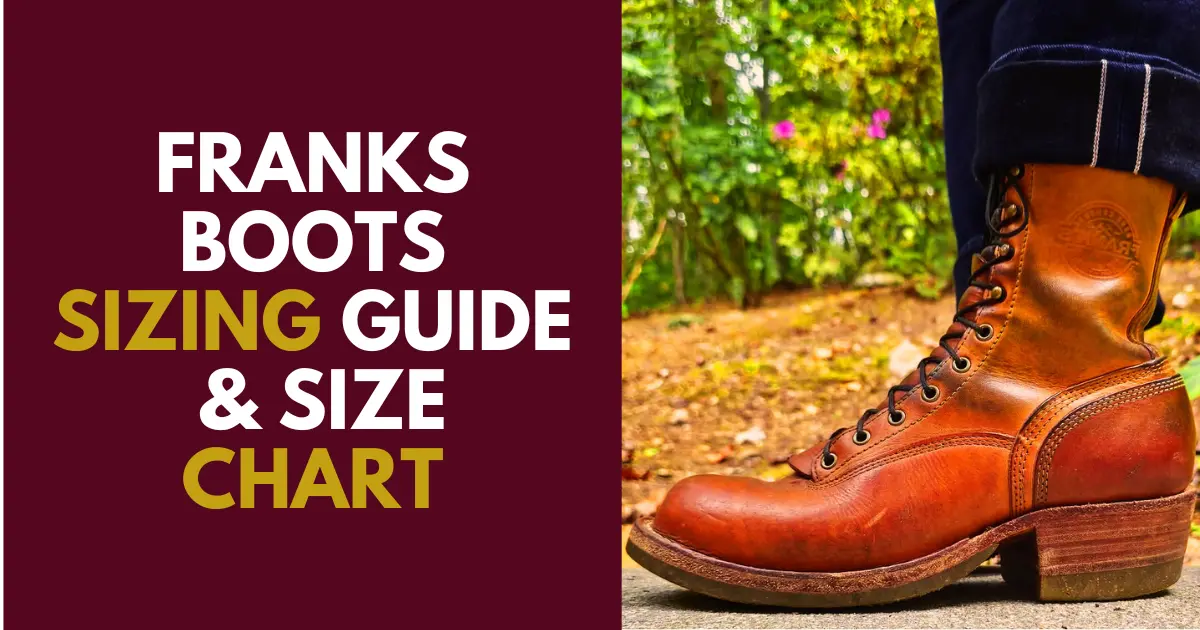
Right off the bat, you’re probably thinking Franks boots look like a White’s or maybe a Nicks. And honestly, you wouldn’t be wrong.
The Pacific Northwest bootmakers all share the same DNA. Many of them came from the same workshops, learned from the same mentors, and built their reputations on the same rugged, functional designs.
Franks is part of that story too, but it’s also a more personal one.
In this guide, I’ll walk you through Franks boots sizing, how their lasts differ, what to expect during the break in, and why their custom fitting process is both impressive and tricky at the same time.
If you’ve ever wondered how Franks compares to Nicks or White’s, or if you’re thinking about ordering your first pair, this article will help you figure out the right size and what kind of fit to expect.

Franks Boots Sizing
When you try Franks boots for the first time, you notice right away that these aren’t your average store-bought boots.
Everything about them feels serious, from the leather to the fit. Franks even asks you to download a fit sheet, take careful measurements, and send them in before you buy.
I did that, and it honestly changed how I think about boot sizing. It made me realize that “my usual size” doesn’t always cut it.
Different lasts can change everything.
For example, most people say that with the 55 last, you should go about half a size down from your Brannock size. But with the 1977 last, many go a full size down because it’s a high-volume last. You’ll be swimming in it if you don’t.
View this post on Instagram
Like what you found here? You can add Size Chart Guru to your Preferred Sources on Google for more sizing guides.
Related: For those of you who’ve worn Red Wings, Frank’s will feel different underfoot. That high arch in Frank’s really changes how the length and fit feel. Here’s a deeper look at Red Wing sizing if you’re curious.
Franks Boots Size Chart
You might be thinking, why do Frank’s boots seem to run a bit smaller? Well, it’s because of that high arch built into the boot.
It actually puts your foot in a nice, relaxed position, which can make it feel a little shorter. Without that arch support, your foot would naturally stretch out more.
| Franks | Brannock Sitting | US | UK |
|---|---|---|---|
| 5 | 5 | 4.5 | 3.5 |
| 5.5 | 5.5 | 5 | 4 |
| 6 | 6 | 5.5 | 4.5 |
| 6.5 | 6.5 | 6 | 5 |
| 7 | 7 | 6.5 | 5.5 |
| 7.5 | 7.5 | 7 | 6 |
| 8 | 8 | 7.5 | 6.5 |
| 8.5 | 8.5 | 8 | 7 |
| 9 | 9 | 8.5 | 7.5 |
| 9.5 | 9.5 | 9 | 8 |
| 10 | 10 | 9.5 | 8.5 |
| 10.5 | 10.5 | 10 | 9 |
| 11 | 11 | 10.5 | 9.5 |
| 11.5 | 11.5 | 11 | 10 |
| 12 | 12 | 11.5 | 10.5 |
| 12.5 | 12.5 | 12 | 11 |
| 13 | 13 | 12.5 | 11.5 |
| 13.5 | 13.5 | 13 | 12 |
| 14 | 14 | 13.5 | 12.5 |
| 14.5 | 14.5 | 14 | 13 |
| 15 | 15 | 14.5 | 13.5 |
| 15.5 | 15.5 | 15 | 14 |
| 16 | 16 | 15.5 | 14.5 |
Related: If you’ve tried John Lofgren boots, you’ll notice they share some DNA with Frank’s, especially in how the high arch affects fit. You can see my full thoughts in my John Lofgren boots sizing guide.
Franks Hybrid Highlander Sizing
When I tried the Franks Hybrid Highlander, I went with a size 8.5. For reference, my Brannock size is 9, and 8.5 is usually my go-to in most heritage boots. Still, I can tell you right away that Franks lasts run a bit large.
The 8.5 fits me fine. The waist feels perfect, my toes can splay comfortably, and I get no heel slip at all. But if I were to order again, I could probably go down to an 8E and still be okay.
The toe is fully structured, so there’s no way to cinch that down or cheat the volume with lacing.
After some back and forth with a friend who’s worn just about every Franks and Nicks model under the sun, he confirmed what many say online:
- Franks, Nick’s, and White’s sizing lines up almost identically.
- The feel between brands can differ a little, but the 55 last is the 55, and the HNW is the HNW.
He also told me something that clicked once I tried a few pairs. The 11067 last, AKA the 1977, fits differently. It has extra toe spring and more volume in the vamp, so you generally go down a full size instead of just a half.
I even asked Mario from Franks about how my Highlanders fit after sizing down, and he told me I was right on track.
He said if you wear an 8.5 in White’s Swashbucklers (on the 55 last), then you’d want an 8D in the Highland last.
Now here’s something Franks does that I think is genius: the sitting measurement….
Why Franks asks for a sitting measurement (and what that actually means)
Franks doesn’t ask you to sit down because they want to make life easier. They do it because many of their lasts include a built-in high arch feature.
That arch changes how your foot sits inside the boot. If you only measure while standing, your foot flattens and spreads. That can make your measured length look longer than what the Franks boot will actually feel like once it’s on.
So here’s the simple point: sitting measurements give a truer picture of your foot shape for boots with a pronounced arch.
The foot is at rest when you sit. The arch isn’t pushed down. The numbers you send Franks match the internal space they build around that arch. That reduces surprises when your boots arrive.
The sitting approach (Franks preferred)
- Sit with knees at 90 degrees and feet flat.
- Trace or mark heel and longest toe, and measure ball circumference for width.
- This shows the foot length and volume without the arch collapsing.
- Use these numbers for lasts with a high internal arch. That is what Franks wants.
The standing approach (the usual one)
- Stand with full weight on your feet and measure length and width.
- This shows how your foot stretches under load.
- It is useful for very flexible lasts or boots meant to be worn with thicker socks.
So, do the sitting measure first and send that to Franks. If you want extra confidence, take a quick standing measurement too and include it. Tell Franks if there’s much difference. They expect nuance and will guide you based on the last you chose.
Quick, actionable tip: if your sitting length is noticeably shorter than your standing length, that often means you have a high instep or arch.
Tell Franks. Ask them whether to follow the sitting number or to nudge length or width. They’re used to this and will help.
Related: I often get asked how Frank’s compare to Thursday shoes. Thursday uses a softer, more forgiving upper. Check out my Thursday sizing article to see what I mean.
What I Learned About Franks Sizing
After trying a few pairs and going through tons of user feedback, here’s what I picked up:
- On the 55 last, most people go half a size down from Brannock.
- On the 1977 last (that’s the one with the #4 toe), most go a full size down.
- Width-wise, Franks uses D as their standard.
- If you’ve got wider feet, you might want to go up one width (EE) while keeping the same size.
Someone once asked me, “If I’m a 9D in Franks 55 last, should I be a 9D in Nick’s HNW?” My answer was no, probably not.
You’ll likely want to size up half a size for the HNW. That tells you how similar these brands can feel yet still differ slightly.
From what I’ve seen, Nick’s 10.5E and Franks 10.5D on the 55 last feel almost identical. It could mean Nick’s runs a bit narrower, or maybe Franks D width is just a touch more forgiving. Either way, the difference isn’t huge.
If you’re like me, around a 9D Brannock, I’d try an 8.5D in the 55 last and an 8D on the 1977. That’s a good starting point. But everyone’s feet are different, so use your own measurements first.
See my breakdown of what D, E and EE mean in shoe size.
Related: You might wonder how Frank’s compare to Truman boots. Both brands are built tough, but the feel on your foot is different. See my Truman sizing guide to understand the contrasts.
Low Arch vs. High Arch Explained
View this post on Instagram
One of the first things people notice about Franks boots is the heel. It’s noticeably higher than most work boots, and the question always comes up: why so high?
Franks explains it perfectly. Their boots have about a 2-inch heel lift built using a three-piece system: the sole, the heel base, and the heel cap.
Together, this creates that signature high heel that shifts your body weight slightly forward.
Now, here’s what that actually does to your feet. When your weight moves forward, your arch lifts naturally. That lifted arch helps spread your body weight evenly across your heel, arch, ball, and toes.
In contrast, a low-heeled boot tends to keep more pressure on the heel and ball, leaving the arch underused and your posture slightly off.
According to them, the higher heel forces a more balanced stance, pushing your hips slightly forward and pulling your shoulders back. The result is better posture and less fatigue after a long day.
Once your feet settle into the heel cup, that “high heel” feeling disappears. The boot feels planted, stable, and surprisingly natural.
Many people say that by the end of the day, their legs, knees, and lower back actually feel better than when wearing flatter boots.
View this post on Instagram
Related: For those familiar with Viberg boots, the feel of Frank’s might surprise you. The high arch and toe spring shift how your foot sits. See my Viberg sizing guide for more details.
Franks Boots In-Stock Sizing Guide
Why Foot Drawings Can Go Wrong
One thing that a paper tracing doesn’t show is the full volume of your foot. It gives a flat outline, but it can’t capture the circumference or the height of your instep, which are important for fit.
That’s why Franks always asks for tape measurements up the foot, not just the outline. Even then, most customer drawings aren’t accurate. In fact, eight or nine out of ten come in off.
When that happens, the bootmakers at Franks rely on experience more than anything else. They look at your height, weight, foot shape, and the measurements you give them.
Then they use what they’ve learned from years of reading imperfect tracings to fill in the gaps. They’ve had plenty of mistakes, but they’ve also had a long list of successes. It’s part of what makes them so good at what they do.
Franks always say they can only build a boot as good as the drawing they get. Sometimes the drawing just isn’t usable, and they have to stop there.
But when a customer gets it right, the results can be amazing. They really can build a boot that fits like it was made in person.
Michelle from Franks often reminds customers of the small things that make a big difference: hold the pen straight up and down, never trace your own foot, and use a fine pen instead of a thick one.
That last part might sound minor, but it can change the tracing by as much as a quarter inch around your foot, which is more than enough to throw the fit off.
You don’t need much:
- a comfortable chair
- a tailor’s measuring tape
- a sheet of paper (two if your feet are larger than size 10.5)
- a pen
- your favorite boot socks.
- Oh, and you’ll need a helper. Doing this alone usually gives inaccurate results.
Start by putting on your socks and sitting down with your feet flat on the floor and your knees at a 90° angle.
- Place one foot in the center of the paper.
- Have your helper hold the pen vertically, not at an angle.
- Mark the tip of your longest toe and the back of your heel.
It might be your big toe, or your second toe might take the lead, depending on your foot shape. Then do the same for the other foot.
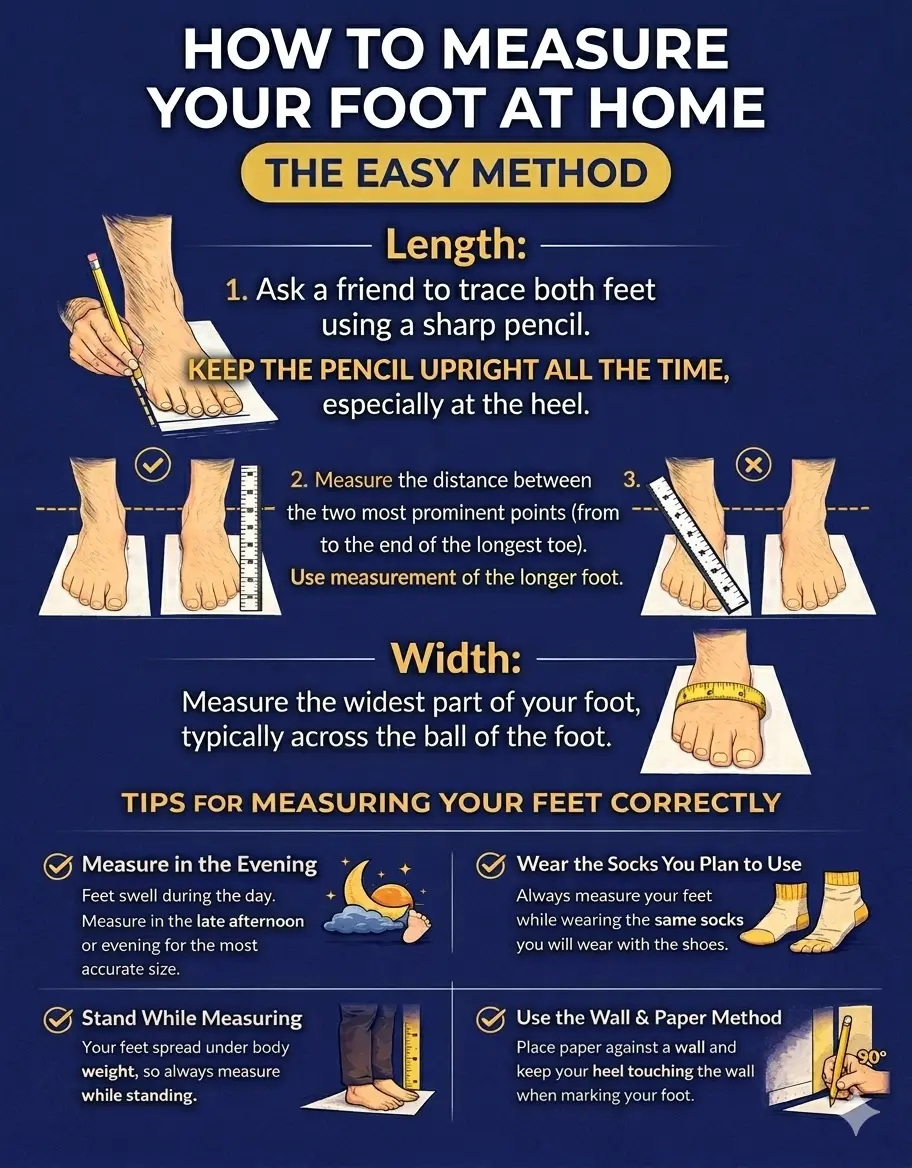
Next, grab your measuring tape and measure the distance between the two marks. Write it down. That’s your foot length.
Measuring Width
- Have your helper slide the measuring tape under the ball of your foot.
- Line it up with the big toe joint on the inside.
- Wrap it around to just behind your pinky toe joint.
- Keep it snug but not tight. That’s your ball width.
- Write it down and repeat with the other foot.
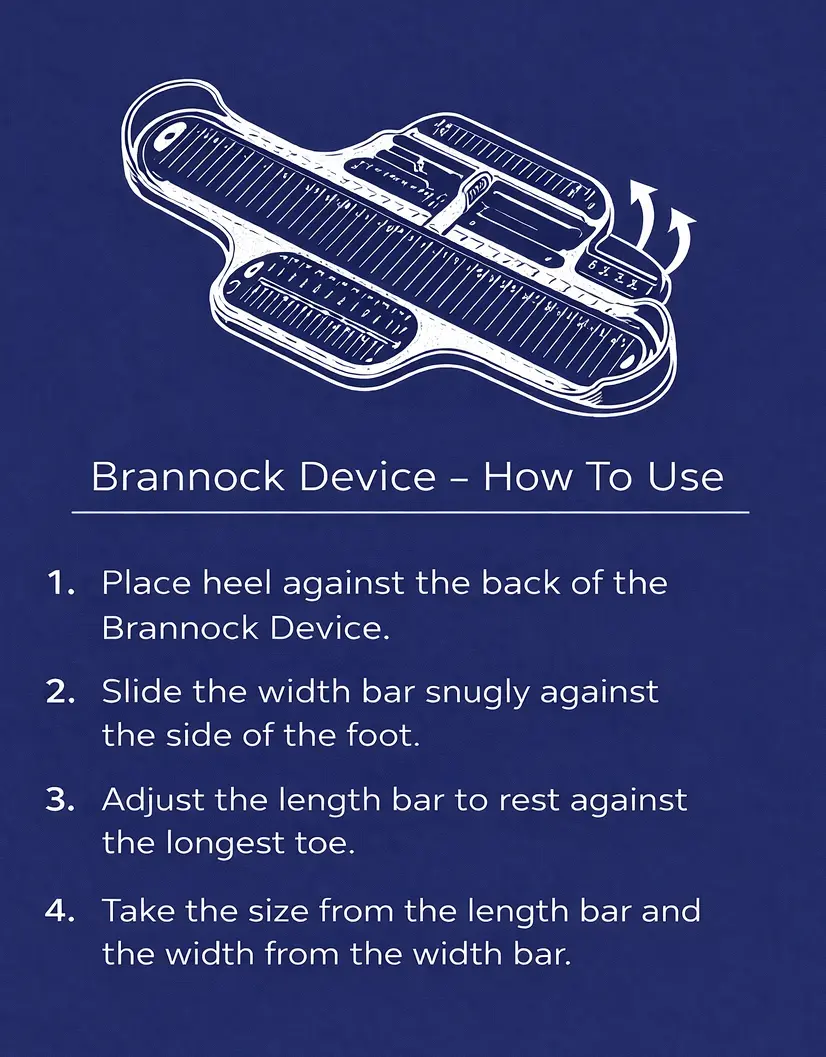
Or, you can use a Brannock device to measure your foot width:
Here’s Franks Boots width Chart:
| Franks Boots | US Standard | Width |
|---|---|---|
| A | AA | Narrow |
| B | A | Narrow |
| B | B | Narrow |
| C | C | Medium |
| D | D | Medium |
| E | E | Wide |
| EE | EE | Wide |
| EEE | EEE | X-Wide |
Finding Your Size
Once you’ve got your length and width, head over to franksboots.com. Tap the three bars in the top-left corner, then select “How to Find Your Stock Size.” Scroll down until you see the drop-downs for length and width.
Let’s say your measurements are 11 7/16 inches long and 10 ¾ inches wide. You’d choose 11 7/16” from the length list.
For width, a boot this long comes in a few options: 10 ½”, 10 ¾”, and 11”, which correspond roughly to E, EE, and F widths.
If your numbers fall between sizes or don’t show up exactly, don’t panic. Franks team can help you decide whether to go up or down in width. A quick call or email usually clears things up.
For example, an 11 7/16” length and 10 ¾” width usually works out to an 11EE on several lasts, like the 55, 4811, 5812, 5332, and 5163.
But if you’re ordering something built on the 1977 last, you’ll likely go with a 10½EE instead. That last just fits larger.
Always double-check the product description before ordering. Each boot listing mentions the last it’s built on, and that tiny detail can make a big difference.
If you ever get stuck, you can email orders@franksboots.com, call the shop at 509-309-2903, or even send them a quick message on Instagram (@franksbootcompany) or Facebook (facebook.com/franksboots).
Their crew knows their stuff. They build these boots by hand, after all, and they’ll guide you to the perfect fit.
Here’s Franks boot size chart:

Before You Hit “Buy”
Here’s what I’d keep in mind:
- Franks sizing depends a lot on the last, not just the number on the box.
- The sitting measurement makes a real difference. It keeps you from overestimating your length.
- Start half a size down for the 55 last.
- Go a full size down for the 1977 last.
- If you need more room, go up in width before changing the length.
And honestly, if you’re unsure, just reach out to Franks. They’re great about answering fit questions and would rather help you get it right than have you stuck with the wrong size.
View this post on Instagram
Franks Boots Last Guide
| Last | Toe Shape | Fit | Arch & Heel | Models | Fit Advice |
|---|---|---|---|---|---|
| 5812 Last (#1 Toe) | Pointed & narrow | Lowest profile of all lasts, sleek | High arch, standard heel height | Limited sizing options; not many models use it | Best for narrow feet or those who like a tight, dress-style toe box. Expect a snug fit. |
| 5332 Last (#2 Toe) | Slightly less pointed | Still low profile, but a touch more room than the 5812 | High arch | Used occasionally for specialty builds | Fits slightly narrow. Similar to the 5812 but a bit more forgiving in the toe area. |
| 55 Last (#3 Toe) | Rounded, classic PNW look | Medium profile, roomy | High arch & heel; same last used by Nicks and White’s | Front Range, Wilshire, Rainier | The benchmark PNW last. Go true to your Brannock or same size as your Nicks/White’s 55. Comfortable, versatile, breaks in beautifully. |
| 1977 Last (#4 Toe) | Broad, round toe | Highest profile; most volume & toe room | High arch, more toe spring | Often used on wider-fitting in-stock boots | Very comfortable & forgiving. Ideal for wide feet or long hours of wear. Many find it the easiest to break in. |
| HNW Last | Semi-rounded toe | Low arch & lower heel profile | Low arch/low heel, flatter fit | Common on Ground Pounder & Monkey Boot models | Best for those who prefer less arch support or a flatter stance. Great for all-day wear if you don’t like high arches. |
When you start looking at Franks Boots, one of the most confusing parts is the lasts. Each number means something different, and if you already know brands like White’s or Nicks, some of these will sound familiar.
Let’s start with the 55 last…
This one is what I’d call the heart of Pacific Northwest boots. Franks use the exact same 55 last that Nicks and White’s use.
Same shape, same dimensions, nothing different. It gives you that medium profile with a comfortable arch and enough room for your toes.
Models like the Front Range, Wilshire, and even the new Rainier use this last. The Rainier is interesting because it takes the 55 and pairs it with a crepe sole, which makes it feel softer underfoot while keeping that same supportive arch.
Then there’s the 1977 last, which is the broadest of all. It has the highest toe profile and a little more toe spring to it. I find it really comfortable, especially if you like a bit more room upfront.
The 5332 last is a step down in width and height. It’s less narrow than the 55 last but still has a low profile look.
The 5812 last takes that even further. It’s the most pointed and narrow shape that Franks use, with a very low profile. Both of these are more limited in sizing, so you’ll mostly find them on specific dress-style or specialty builds.
Finally, there’s the HNW last. It’s usually used for the Ground Pounder and Monkey Boot models. This one has a semi-rounded toe and a lower heel and arch compared to the 55 or 1977.
Franks describe it as their low-arch, low-heel option, and you can actually request it on any of their boots if you prefer a flatter, more casual feel.
If I had to sum them up, I’d say the 55 is the all-rounder, the 1977 gives you more space and height, and the HNW is what you’d pick if you want something more relaxed underfoot.
The 5812 and 5332 are the sleek ones, better for narrower feet or people who want a more refined look.
How to Break in Franks Boots
Franks boots are built with thick, full-grain leather and a supportive insole that takes time to shape to your foot.
Out of the box, they’ll feel stiff and unyielding, but that’s exactly how they’re supposed to feel. Once they settle, the leather molds around your arch and instep, and that’s when the comfort shows up.
Before you start, make sure the fit is right. You should have about a thumb’s width between your big toe and the front of the boot.
That space allows your toes to move forward slightly as the arch compresses and the boot begins to curl upward.
Lace them tightly and walk for a few minutes to let your feet relax. If you’re not sure about the fit, have someone check where your longest toe ends.
For the first day, Franks recommend a 50/50 mix of alcohol and water. Lace the boots snugly, spray them generously, and massage the liquid into the leather.
Then wear the boots for one to three hours. The alcohol helps soften the leather fibers without damaging them, which speeds up the initial flex.
If you feel some heel slip, tighten the laces a bit. Don’t apply any oils, greases, or waterproofing products at this stage. You want the leather to breathe and move freely as it starts to take shape.
From there, consistency is everything.
Try to wear them every day, even if it’s only for an hour or two. Gradually add more time as your feet and the boots adjust to each other.
Keep using the alcohol and water mix for a few days, but don’t soak them. A light mist is enough to keep the leather supple without oversaturating it.
The best advice I can give you is to wear them as much as possible. Every step you take helps the boot learn your shape.
After a week or two, you’ll feel the difference. The heel will lock in, the arch will start to support you naturally, and the stiff leather will turn into a glove-like fit.
Frank’s Brand Overview
Frank’s Boots has one of those stories that just sticks with you. It’s the kind that reminds you why small-batch craftsmanship still matters.
The company was founded by Frank Petrilli, who spent decades at Nicks Boots, helping shape some of the processes that made Nicks famous.
In fact, if you’ve ever filled out a Nicks fit sheet, Frank had a hand in designing that system back in the day.
After years at Nicks, Frank started feeling boxed in by the factory pace. He preferred the slower, more personal side of bootmaking.
So he left Nicks in 2016, right after the company changed ownership, and decided to start something of his own.
Six months later, he opened Frank’s Boots in Spokane, Washington, in the very same building he had worked in for over 20 years.
Frank didn’t do it alone. He and his wife, Michelle, built the brand from scratch, traveling across the country to collect old bootmaking equipment, hiring a small team of four or five artisans, and setting up shop with one goal in mind: to make honest, handcrafted boots without the factory feel.
Michelle now handles most of the social media and customer communication, and she’s known for chatting directly with customers about custom builds, repairs, or even resole stories years later.
What I love about Franks is how personal they are. They’re not chasing massive sales or trying to outgrow their roots.
They focus on craftsmanship, relationships, and doing right by the people who wear their boots. You can feel that when you call them.
Their lineup carries the same Pacific Northwest DNA as Nicks and White’s. The 55 last and others in the Franks catalog share the same heritage fit as their Nicks and White’s counterparts, but with Franks own twist on comfort and finish.
In a region crowded with legends like White’s, Wesco, JK, and Nicks, Franks still manages to stand out. They offer deep customization, even accommodating customers with different-sized feet or unique fitting challenges.
Their creative streak shows in special projects like the custom Batman or Joker boots, and unique models like the Ryker AT.
To me, Franks Boots feels like a family shop that never forgot its roots. They’ve got the skill and pedigree of the big names, but the heart of a small-town craftsman, and that’s exactly why so many boot lovers keep going back.
Final Thoughts
If you already own a pair of Nicks or White’s, you’ll feel right at home with Frank’s.
Franks boots sizing is familiar, the craftsmanship feels every bit as solid, and the fit just makes sense if you know what to expect from a Pacific Northwest boot.
What stands out to me, though, is how personal everything feels with Frank’s. You can literally talk to them, get real advice, and even send in your foot tracing to have something built just for you.
If you’re new to this kind of boot, don’t rush the break in. These are serious, heavy-duty boots that mold to your feet over time, and when they do, the comfort is worth every step.
I’ll say this: Frank’s might not have the big brand name of White’s or Nicks yet, but they’ve got the same heart, the same DNA, and maybe even more soul.
If you want a boot built by people who actually care about what goes on your feet, Frank’s is worth your attention.
That’s my experience with Frank’s boots, but I’d love to hear what you think. Have you tried any of their lasts or gone through their fit sheet process?
Did you size down or stay true to your Brannock?
Drop a comment below and share how your Franks fit and feel after break in.