

I’m really excited to finally talk about John Lofgren sizing because this brand has been on my radar for a while, but I never gave it the deep dive it deserves.
I recently got my hands on some of their boots and sneakers, wore them around for a bit, took notes, and then spent hours digging through forums and fit discussions to really understand how these boots fit.
The more I learned, the more I respected what John Lofgren stands for.
In this guide, I’ll walk you through everything I found about John Lofgren sizing and size chart details.
We’ll look at:
- How different models fit
- How they compare to other well-known brands
- What size you should actually order if you’re thinking of getting a pair.
If you’ve ever been unsure whether to go true to size or down half a size, I’ve got you covered.

John Lofgren Sizing
The key to good boot sizing is how your foot sits inside the boot. Length isn’t the only thing you need to worry about.
If your foot feels stable and well supported, a bit of extra room in front of your toes is completely fine. That space helps with comfort and prevents your toes from hitting the end when you walk.
Now, how do John Lofgren boots generally fit, you ask?
After trying a few of their models and reading just about everything I could find online, I can say John Lofgren boots usually run a half size large compared to your Brannock size, though the exact fit can depend on the last and the model.
The Engineer boots, for instance, feel slightly roomier in the instep and toe box, while the Combat boots have more structure through the arch and heel.
If you’re coming from brands like Viberg or White’s, you might notice that Lofgren boots feel a bit more refined.
The fit is snug in the right places but not overly tight. Once you break them in, your foot feels locked in and supported, which is what you want from a high-end heritage boot.
If you read my section about the Engineer boots below, you’re going to know how challenging they can be to get on at first.
But once they’re on, the fit is phenomenal.
The Combat boots don’t fit a full size large like some people claim. It’s really that sweet half-size down that gets the best result.
So, if you’re unsure where to start, I’d recommend going a half size smaller than your Brannock measurement for most John Lofgren boots.
Now that you’ve got a sense of how John Lofgren boots generally fit, let’s take a closer look at how the Engineers, Combat Boots, the Donkey Punchers, and Champion Sneakers fit…
If you regularly use my sizing guides, you can make Size Chart Guru a Preferred Source on Google.
Related: While Lofgren leans more on traditional Japanese craftsmanship, Dievier takes a slightly different approach in how their boots fit. I talked more about it in my Dievier boots sizing article.
John Lofgren Size Chart
| US | UK |
|---|---|
| 6 | 5.5 |
| 6.5 | 6 |
| 7 | 6.5 |
| 7.5 | 7 |
| 8 | 7.5 |
| 8.5 | 8 |
| 9 | 8.5 |
| 9.5 | 9 |
| 10 | 9.5 |
| 10.5 | 10 |
| 11 | 10.5 |
| 11.5 | 11 |
| 12 | 11.5 |
John Lofgren Engineer Boots Sizing
View this post on Instagram
Here’s everything I have about the Engineer boots sizing…
A Hard Boot to Get Right
Engineer boots are tough to nail. I could probably count on both hands the number of brands that make them right. You have the big names like Red Wing and Wesco who do great work, but even then, proportions can be tricky.
Some pairs look too bulky and end up more like work boots. Others go too far the other way and end up too slim, like a Chelsea boot pretending to be a work boot.
Getting the balance between rugged and sleek is harder than it looks, but John Lofgren absolutely nailed it.
Honestly, I think John Lofgren makes the best-looking engineer boots on the market. Period. And the crazy part is, they fit and feel incredible once you break them in and get past the pass-through (I’ll explain everything below).
Now, if you’ve spent any time on boot forums, you’ve definitely seen the argument: Do John Lofgren boots run big or small?
First Impressions and Sizing Basics
Out of the box, these were some of the most beautiful boots I’ve ever handled. I wear a 9D Brannock and typically go down to an 8.5D in most U.S. boot brands like Thursday and Truman.
That’s exactly what worked for me in the Lofgrens, too.
The general rule is: John Lofgren boots do run large, so go half a size down from your Brannock measurement.
That’s what John Lofgren recommends, and I agree. I tried both 8D and 8.5D, and the 8 was just too tight, especially through the instep.
The 8.5D gave me a snug, locked-in fit without any heel lift. There’s no extra space sloshing around, but also no pinching.
The toe box hits that perfect balance between sleek and roomy. It’s not bulbous, not cramped, just clean and natural.
Now for the real issue…
The Famous “Pass-Through” Struggle
Now, here’s where things get interesting…
If you’ve ever tried on engineer boots before, you already know what I mean by pass-through. It’s that tight squeeze when your foot goes down the shaft and has to pop into place on the footbed.
Well, with the Lofgrens, that pass-through can feel like a battle, especially if you have a high instep like I do.
I spent about 20 minutes trying to get my foot in the first time. I tried sitting, standing, and switching socks, but nothing seemed to work.
At that point, I thought they just didn’t fit and even emailed Standard & Strange about returning them.
Luckily, they suggested I get a long shoehorn and cover my feet with grocery bags to help them slide in.
It sounded ridiculous, but it actually worked. I looked like a dope sitting there with plastic bags on my feet, but once they were on, I felt like a million bucks.
That horsehide lining grips your socks like sandpaper in the beginning. It’s almost like a soft nubuck. Over time, it smooths out, but breaking them in takes patience.
Breaking In: The Pain and the Payoff
I won’t lie. These boots made me work for it. The first few days were rough. The heel counter is stiff, and the shaft feels narrow.
It took me a good twenty minutes to pull them on every morning. But once they’re on, man, they feel incredible.
Horsehide doesn’t stretch like cowhide, so don’t expect it to magically soften overnight. It molds to your foot slowly, but once it does, the fit becomes second skin. The comfort is hard to describe.
After the first week or two, slipping them on became easier. And once they were fully broken in, I stopped thinking about fit completely. No heel slip, no blisters, no movement inside the boot. Just a solid, secure fit every time.
Fit Details and the Lofgren 110 Last
The John Lofgren Engineer Boots are built on the 110 last, which runs a touch large and is considered a medium width (D). The toe is slightly squared-off with a subtle bump that gives the boot its distinctive shape.
If you’ve got a standard-width foot, you’ll be fine going half a size down from Brannock. But if your feet are wide, you might run into some issues. The 110 last is not forgiving in width. That was my main struggle. The length was perfect, but the width felt too tight for me.
For reference, the Truman 20 last is noticeably more generous in the toe area. If you wear Trumans and they already feel snug, you might want to size up half a size in the Lofgrens.
For low-volume feet, the Lofgren Engineers can actually feel a bit roomy across the vamp and instep. In that case, you can use the adjustable buckles to dial in the fit and get a more secure feel.
Sizing Comparison: Viberg, Red Wing, and Others
If you’re wondering how these stack up against other brands. Compared to:
- Red Wing Iron Ranger: The sizing is very similar. Whatever works for you in the Iron Ranger will likely work here.
- Viberg: Go half a size up from your Viberg size. Lofgrens fit slightly smaller overall.
- Truman: Stay with the same size.
- Thursday: I wear 8.5 in both, and the fit feels consistent.
So, if you’re a 9D on the Brannock, start with an 8.5D in John Lofgren. If you’re used to Viberg or Clinch sizing, you might find the shaft narrower and the pass-through tighter. That’s just part of the sleek silhouette.
Now that engineer boots are getting more attention, a lot of people end up running into the same problems I did.
Getting them on can be a real fight, especially at first. So, if you’re struggling, here’s what helped me stretch mine just enough to make life easier…
Related: If you’re curious how these compare to something more refined and dressy, check out my Beckett Simonon sizing guide.
How to Stretch John Lofgren Engineer Boots
Getting the Engineers on them is something you have to factor into your day. If you’ve got half an hour before work and twenty minutes of that is taken up just putting your boots on, well, that’s not ideal. That’s usually the point where most people give up.
You can start with the old plastic bag trick. Slip a couple of thin grocery bags over your feet before sliding them in. It sounds ridiculous, but it helps your foot glide past that tight shaft and through the narrow instep.
Use a long shoehorn, too. That combination works better than brute force. It still takes time, though.
The good news is that once the boots are actually on, they fit beautifully. They feel solid, the heel stays locked in place, and even though I expected some heel slip, especially since you can’t tighten them like lace-up boots, I hardly felt any at all.
Once you get used to the laceless feel, it’s actually very freeing. There’s nothing pressing down over your instep, no tight eyelets or leather layers across the top of your foot, so the movement feels smooth and natural.
Over time, I stretched out the pass-through just enough. It used to take me twenty minutes to get my foot in; now it takes maybe five.
The more I wore them, the easier it got. The horsehide doesn’t stretch as easily as cowhide, but it does relax with wear.
And yes, I would have loved for them to fit perfectly right out of the box, especially at that price. But that’s the reality with ready-made boots. They’re not bespoke; they’re built for the average foot shape.
The goal is to fit as many people as possible within each size range.
Now, I’ve talked before about different ways to stretch tighter shoes safely without ruining the leather, so if you’re curious, check out my dress shoe stretching guide.
John Lofgren Combat Boots Sizing
If you’ve already read what I said about the John Lofgren Engineer boots above, then some of this will sound familiar. The same logic applies here, just with a few small differences.
Lofgren recommends going half a size down from your Brannock size, and that’s exactly what I’d tell you, too.
These run a little large, not a full size large like Vibergs, but enough that your true Brannock size will probably feel a bit roomy.
For reference, my Brannock size is 9D, and I went with 8.5D. That half-size down gave me a snug, balanced fit that still leaves enough toe room.
The Fit and Feel
The main thing that stood out to me with these combat boots is the toe box volume. It feels noticeably higher and roomier than the Engineer Boots.
I could walk around comfortably right out of the box, but the toe box did feel a bit too spacious. If the volume was slightly lower, they’d be just about perfect for me.
That said, I still wouldn’t go a full size down. As I mentioned earlier with the Engineers, the Lofgren lasts don’t have much give lengthwise.
A full size down would probably crush my toes once the leather starts to mold. Half a size down strikes the right balance.
Breaking In and Comfort
These are much easier to break in than the Engineers. The lace-up design lets you fine-tune the fit, and the tongue adds extra flexibility. The leather feels thick and structured, but it softens nicely with wear.
There’s still that signature Lofgren density underfoot. It’s a solid boot, not something you forget you’re wearing, but once the leather loosens up a bit, it becomes one of those pairs you can wear all day without thinking about them.
Sizing Comparison
If you’ve tried other brands, here’s roughly how they compare:
- Viberg Combat Boots:
Go half a size up from your Viberg size. Remember, Viberg uses UK sizing, which runs one full size smaller.
- John Lofgren Engineer Boots:
Sizing is basically the same. If the Engineers fit you well at half a size down, stick with that here. The only difference is the toe box volume, where the Combat Boots feel roomier up front.
- Red Wing Iron Ranger:
Same rule. Whatever you wear in Iron Rangers should translate perfectly to these.
Related: I’d say Crown Northampton plays in the same league when it comes to craftsmanship, though the fit is a bit different. You can see how they compare in my Crown Northampton sizing guide.
John Lofgren Donkey Punchers Sizing
View this post on Instagram
The John Lofgren Donkey Punchers are built on the updated 2023 version of Lofgren’s 120 last, and I have to say, this last feels a little more refined than before.
It keeps that rugged, hard-working character you expect from a Donkey Puncher, but the proportions are more balanced, especially around the toe box and instep.
In terms of sizing, these run slightly large, so the brand recommends going half a size down from your standard sneaker or Brannock size.
Again, I wear a 9 Brannock, and in most U.S. heritage boots, I go 8.5, which worked just as well here.
Comparing with Other Lofgren Models
View this post on Instagram
As I mentioned earlier about the Combat Boots, they run a touch bigger than these. The Donkey Punchers do not fit quite as large as the Combat Boot built on the same 120 last.
In other words, if you wear a size 8 in the Lofgren Combat Boot, you’ll likely want an 8.5 in the Donkey Puncher.
The updated last feels a bit more controlled. The volume across the instep and forefoot is slightly reduced, which gives a snugger fit without feeling tight.
It’s still roomy enough to wear with medium-weight socks, but not so generous that you get heel lift or movement.
Fit Notes and Feel
Once broken in, the Donkey Punchers feel solid underfoot. The heel holds your foot securely, and there’s a bit less space over the arch compared to older Lofgren lasts.
If you have high insteps, you might feel some resistance at first, but the leather softens nicely after a few wears.
I’d also say this model feels more planted compared to the Engineers or Champions. It’s definitely more of a “workhorse” boot in the way it grips your foot and delivers that heavy-duty comfort.
John Lofgren Champion Sneakers Sizing
View this post on Instagram
If you’ve already read what I said about the Combat and Engineer boots, this one follows the same logic.
John Lofgren recommends keeping the same size you wear in their boots, and I completely agree with that.
I wear a size 8.5 in the Lofgren Engineer Boots, and these sneakers in 8.5 fit perfectly. I can wear them with thin socks, medium socks, or even barefoot, and they all work fine. The fit does not feel too snug but not too loose either.
Fit and Comparison
If you have the Grant Stone Coast Sneaker, the overall length is basically identical. The only thing that might throw you off is that the John Lofgren Champion sneakers look slightly narrower, but keep in mind you’re comparing a leather upper (Lofgren) against a canvas upper (Grant Stone).
Leather holds its structure, while canvas has a lot more give and movement. So even if the Lofgrens look narrower at first, they don’t actually feel tight once you start wearing them.
For reference, I wear 8.5 in the Grant Stone Leo last boots, 9 in the Coast sneakers, and 8.5 in the John Lofgren Champions. So the pattern is pretty consistent: go half a size down from your Brannock, and you’ll be spot on.
How They Feel on Foot
What I like most about the Champion Sneakers is that they keep that same solid Lofgren build quality but in a much lighter, more casual form. They still feel supportive underfoot, and they have that heritage boot vibe even though they’re sneakers.
The leather softens beautifully with wear, so even though they feel structured at first, they don’t stay stiff for long.
If you’re between sizes, I’d say lean toward the smaller one, especially if you plan to wear them sockless or with thin socks.
By the way, if you like heritage-style sneakers, Thursday also makes a solid pair. I broke down how their sneakers fit in my Thursday sneaker sizing guide, so check that out if you’re curious.
John Lofgren Last Guide
View this post on Instagram
If you’re wondering which last your pair is built on, here’s a simple breakdown of John Lofgren’s main lasts and the boots that use them…
D Width Lasts
| Last | Models |
|---|---|
| 110 Width D | Wabash Engineer |
| Steadfast Chukka | |
| Chelsea | |
| Medallion Brogue Chelsea | |
| 130 Width D | Mohawk Moccasin |
| 150 Width D | Glover Brogues |
| 170 Width D | Duke Roper |
| 210 Width D | El Captain |
| 220 Width D | Fieldmaster |
| 250 Width D | Montgomery |
| 260 Width D | Chapman |
| Munson Width D | M-43 Service Shoes |
E Width Lasts
| Last | Models |
|---|---|
| 140 Width E | Monkey |
| Military Desert | |
| USN Low Quarter | |
| Sahara | |
| 120 Width E | Donkey Puncher |
| Donkey Puncher 8" | |
| Combat | |
| Ludlow | |
| Steel Gang | |
| Steel Gang SW |
My guide to shoe width codes and letters explains how D, E, EE and the other width designations work.
How to Measure Your Feet for John Lofgren Boots
With brands like John Lofgren, half a size can make all the difference between a perfect fit and a week of frustration trying to break them in.
Get Measured by a Professional (If You Can)

If you have access to a proper shoe store that uses a Brannock device, go for it. The device will tell you your exact length, width, and arch length.

When you try on heritage boots like Lofgren, those details matter. A small difference in instep height or arch position can completely change how the boot feels.
Professionals can also check if you’ve got a high instep or a low-volume foot, which helps a ton when you’re trying to decide between sizes.
So if you can, get measured by someone who knows what they’re doing. It’ll save you from the return hassle.
Measuring at Home (With a Brannock Device)
If you already have a Brannock device at home, or can borrow one, use it the same way they do in stores:
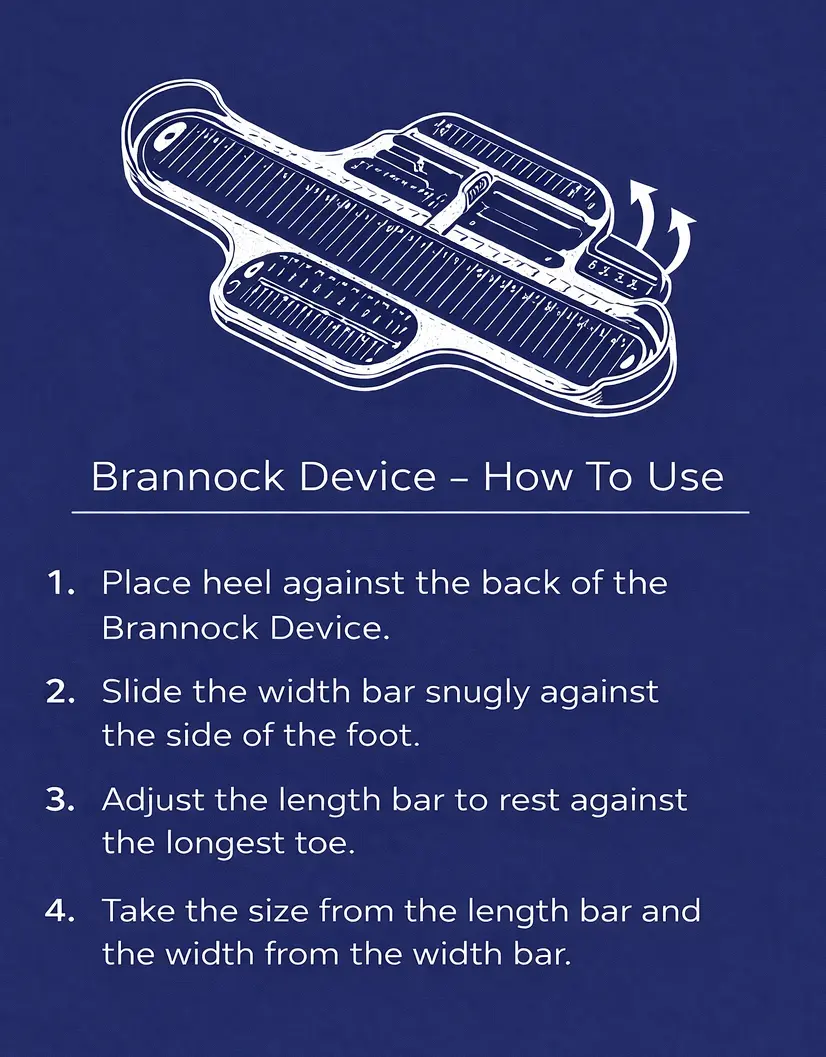
- Stand up straight with your weight evenly on both feet.
- Measure both feet (they’re rarely identical).
- Go with the larger foot as your reference.
Remember, John Lofgren boots are built on fairly structured lasts like the 110 and 120, so even a small measurement difference can affect how your foot slides through the shaft or sits in the toe box.
The Pen and Paper Method
Here’s an easy way to do it at home:

- Place a piece of paper on a hard floor and tape it down.
- Stand on it wearing the type of socks you’d normally wear with your boots.
- Use a pen or pencil to trace around your foot, keeping it vertical (not angled under your arch).
- Measure the length from the heel to the longest toe and the width at the widest point.
- Do both feet, and again, go with the bigger one.
Compare your measurements to John Lofgren’s size chart below. If your numbers fall between two sizes, think about how snug you like your fit.
For a roomier feel or thicker socks, go up half a size. If you prefer a tight, structured fit and your instep allows it, you can size down half a size.

A Few Sizing Tips to Keep in Mind
- Measure at the end of the day.
Your feet swell slightly as the day goes on, so you’ll get a more realistic number.
- Stand, don’t sit.
You want your full weight on your feet for an accurate reading.
- Consider sock thickness.
Lofgren boots are sturdy and structured, the kind that can feel tight with thick socks.
- If in doubt, ask the retailer.
Shops like Standard & Strange or Self Edge know these boots inside out.
So before you jump into your next Lofgren order, take a few minutes to measure properly. You’ll avoid the frustration of wrestling your foot into a too-tight shaft or sliding around in a loose heel cup, both of which I’ve definitely experienced.
Brand Overview
From Quadrophenia to Craftsmanship
John Lofgren started his brand after being inspired by the film Quadrophenia, a movie that perfectly captures the rebellious energy and clean style of the 1940s and 1950s.
That movie lit a spark. It was about the clothes, music, attitude, individuality, and pride in what you wear.
Lofgren took that spirit and turned it into a brand that celebrates timeless design and craftsmanship rather than fleeting trends.
Made in Japan, Without Compromise
All John Lofgren boots are made entirely in Japan, and that alone says a lot. Every stitch, every component, every piece of leather is chosen with care.
The soles, the hardware, the finishing, everything comes together with obsessive attention to detail.
You can feel that sense of pride in each pair. These boots are built for people who value the process just as much as the product.
Ethics at the Core
What really sets Lofgren apart is how seriously they take their values. They source everything ethically, and there’s no gray area in how their products are made.
The workers are treated fairly, the materials are responsibly obtained, and there’s full transparency behind every step.
As someone who’s spent time comparing different heritage brands, I can tell you that not everyone walks the talk, but John Lofgren actually does.
They put their money where their mouth is, and it shows in both the quality and the integrity of their boots.
Final Thoughts
After wearing and digging deep into John Lofgren sizing, I get why people are so passionate about this brand.
Once you get the size right, these boots feel like they were made for your feet. They’re built with precision, the materials are top-notch, and you can tell there’s a lot of heart behind the craftsmanship.
If you’re still on the fence about what size to pick, don’t stress too much. Like most heritage boots, there’s a bit of a learning curve at first, but once they settle in, you’ll be glad you took the time to figure it out.
At the end of the day, John Lofgren isn’t just another brand chasing the heritage trend. They’re one of the few doing it right, and once you’ve broken in your pair, you’ll understand why so many people swear by them.
Viberg is the premium version of the Pacific Northwest brands, and John Lofgren is like ultra premium.
And if you’ve tried John Lofgren boots yourself, I’d really like to hear what size worked for you. Did you go down half a size, or did you find them true to size?
Drop your thoughts in the comments. I always enjoy comparing notes with other boot nerds.