
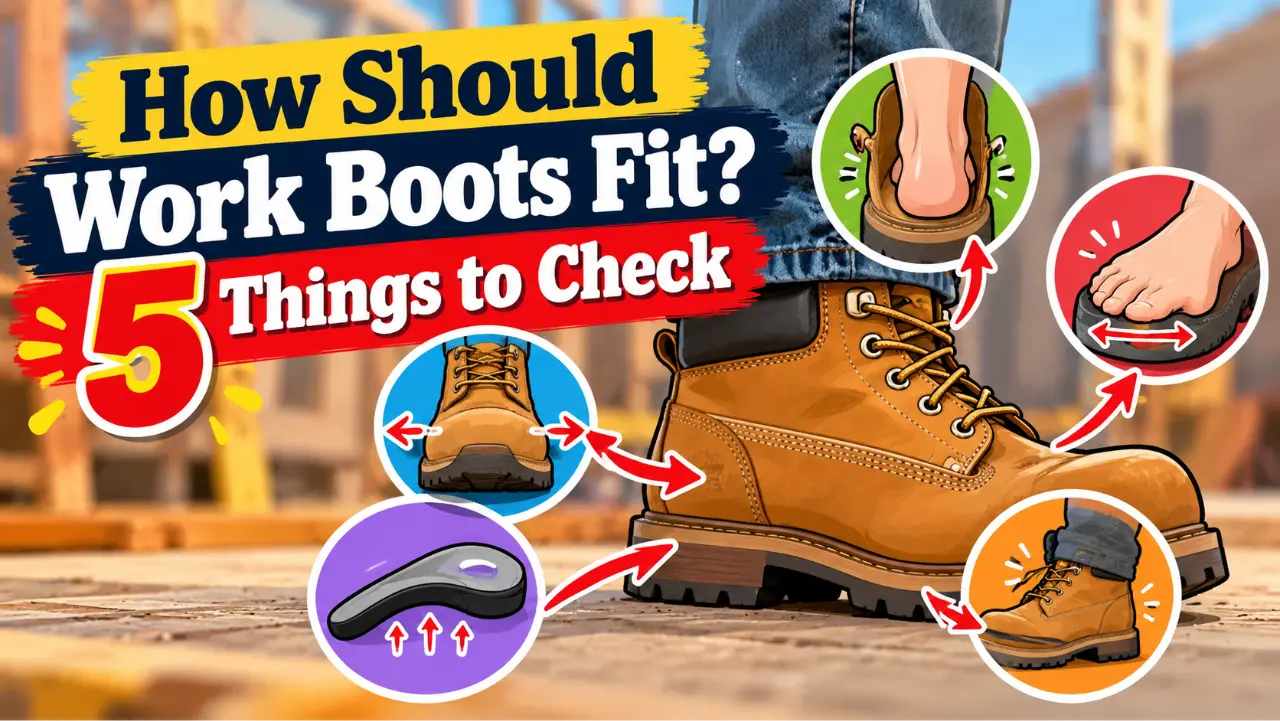
People wear boots for all sorts of things. Some are made for hiking or winter activities, others for casual everyday wear, and then you’ve got work boots, which have a pretty different job to do.
There’s quite a bit to check when you’re buying work boots. You’ve got the length, width, heel fit, and arch support to think about, and that’s before getting into all the safety features.
So, how should work boots actually fit?
You want a secure fit around your heel and across the middle of your foot, but leave some room for your toes. And if something is already hurting when you try the boots on, I wouldn’t buy them expecting a few weeks of wear to fix it.
How Should Work Boots Fit
1. Your Heels Should Stay in Place
A little heel movement in new work boots isn’t necessarily a problem. Leather boots can be pretty stiff when they’re new, and the heel area sometimes takes a while to settle.
But if your heel is lifting out of the boot with every step, I’d be concerned.
I’ve seen people assume that any heel slip means their boots are too big. That’s not always the case. The heel counter might just need some breaking in. Or perhaps that particular boot has a heel shape that doesn’t suit your foot.
Lace them up properly and take a walk around the store. See how much your heel actually lifts.
Still getting a lot of movement? I’d try another size, although sometimes switching to a different boot works better.
You can get away with a little movement in some new boots. What you don’t want is the back of the boot rubbing your skin raw halfway through a shift.
If you’re looking at Red Wing boots, I’ve also got a Red Wing sizing guide that goes through their different widths and how sizing can vary between models.
2. Your Toes Shouldn’t Be Pressed Against the Front
You need some space in front of your toes. About a thumb’s width is a decent starting point, although the exact amount depends on the shape of the boot.
The Canadian Centre for Occupational Health and Safety recommends about 12.5mm of space in front of your toes when fitting safety boots.
Don’t just check your big toe, either. Some people have a second toe that’s longer.
Steel-toe boots are worth being particularly careful with. If the cap is pressing against your toes, there’s no point waiting for it to stretch. Steel doesn’t stretch, and neither does a composite safety cap.
Try walking downhill or stepping down from a raised surface if the store has somewhere you can do that safely. Your foot will move forward a little, and you’ll find out pretty quickly if your toes are hitting the front.
You should also be able to wiggle your toes a little. They don’t need loads of extra space, just enough that they aren’t cramped together.
Thorogood is another brand worth checking, especially if you’re shopping for work boots. I’ve covered their sizing and width options in my Thorogood sizing guide.
3. The Sides Shouldn’t Hurt
The ball of your foot is worth checking first. If the boot is too narrow, you’ll often feel it there, particularly around the little toe.
A little snugness is fine. But if your little toe is getting crushed against the side, I’d try the same size in a wider width before going up half a size.
Some leather boots stretch and loosen a little across the sides after you’ve worn them for a while. I wouldn’t rely on that if the boots are already painful, though.
And don’t automatically go up half a size to get more width.
You might solve the pressure on the sides, but now you’ve got extra length you didn’t need. Your heel could start slipping, too.
Interestingly, a study of 208 underground coal miners found that many were wearing boots considerably longer than their feet. The researchers suggested that some miners may have been choosing longer boots because the correct length didn’t give them enough width.
See if the same boot comes in a wider fitting first. A lot of work boot brands sell D and EE widths, and some go wider than that.
Wolverine has quite a few different boot styles, so I’d check their sizing guide before assuming your usual size will fit every model.
4. The Arch Shouldn’t Dig Into Your Foot
Arch support is a bit of a personal thing.
Some people like a fairly firm footbed. Others can’t stand that feeling of something pushing up under the middle of their foot.
If you’re trying on boots and the arch feels uncomfortable straight away, I wouldn’t ignore it.
A lot of work boots have removable insoles, so you’re not necessarily stuck with whatever comes in the box. You could try a different footbed if the original one bothers you. Watch the thickness, though. Some aftermarket insoles take up quite a bit of room, and you might start feeling pressure over your instep.
Already using orthotics? Bring them to the store. You want to know how the boots fit with those inside, not just the factory footbeds.
5. Your Feet Shouldn’t Move Around Inside the Boots
Don’t judge the fit while you’re sitting down. Get up and walk around in them.
Try crouching in the boots, too. That’s when you might notice the leather pressing into the top of your foot, even though everything felt fine standing up.
Your foot shouldn’t be sliding forward every time you walk. And if you’re having to really crank down on the laces to hold everything in place, I’d question whether that boot fits your foot properly.
Do Work Boots Need Breaking In?
A bit stiff, yes. Painfully tight, no.
New leather boots can be pretty stiff around the ankles. You might also feel the leather resisting a little when you bend your foot.
That’s not unusual, especially with heavier work boots. What I wouldn’t put up with is actual pain or numbness.
If your toes are cramped or the sides of your feet hurt while you’re just standing there, I’d be looking at another size or width.
And bring your work socks when you go shopping. If you normally wear thick wool socks, that’s what you should be wearing when you try the boots on. They can make a surprisingly big difference to the fit.
I’d also try shopping later in the day if possible. Your feet may be a little bigger after you’ve been standing and walking for hours.
One last thing: don’t let anyone talk you into buying painfully tight boots because the leather will supposedly stretch. A little stiffness is one thing, but if you’ve tried a few sizes and the boots still hurt, I’d move on to another model. There’s no shortage of work boots out there.