A while back, I assumed my shoe size was simple. I wear a size 9, so I figured that was it. Same number, different models, no big deal.
Then I started paying closer attention to how certain pairs actually felt on foot.
In a lot of Made in USA New Balance models like the 993 and most of the 990 series including the V3, V4, V5, and V6, I consistently go half a size down.
If I stay true to size in those, they feel long and slightly sloppy, especially in the forefoot. Dropping half a size gives me a more secure fit without cramping my toes.
But in many Made in Asia or UK models like the 2002R, 991, 1500, 1906R, and 860 V2, I usually stay true to size.
If I try to go down in those, the fit starts to feel tight and less forgiving, especially through the toe box and midfoot.
Same brand. Same labeled size. Completely different fit experience.
That was the moment it really clicked for me that shoe size does not equal shoe fit.
The number on the box is only part of the story. Foot shape, last design, materials, and construction all change how a shoe feels on your foot.
This guide will show you how your foot shape affects sizing decisions, so you stop going in blind and start choosing the right size on purpose.
How Foot Shape Affects Shoe Sizing
The 5 Core Foot Measurements That Actually Matter
Before you start thinking in terms of “foot types,” it helps to understand the measurable structure of your feet.
These measurable details give you a foundation for knowing why different shoes feel different even if the size number is the same.
A. Foot Length
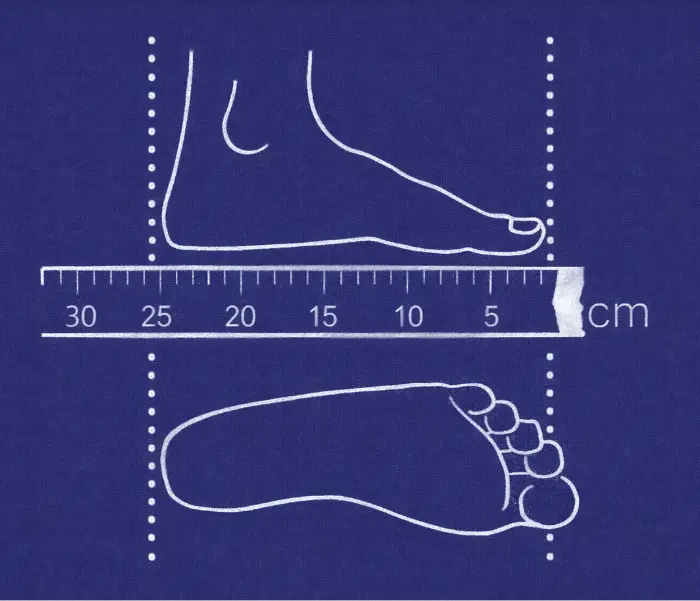
Foot length is the distance from the back of your heel to the tip of your longest toe. This is the number most people think of when they talk about shoe size.
The most accurate way to measure it is to stand on a flat surface with your weight on the foot and measure from heel to the longest toe.
This is the primary measurement used in most shoe sizing systems worldwide.
You also need to note that the longest toe isn’t always the big toe. In many people, the second toe is actually longer, and if you only measure to the big toe, you can end up with shoes that don’t have enough room for your true longest toe.
B. Foot Width
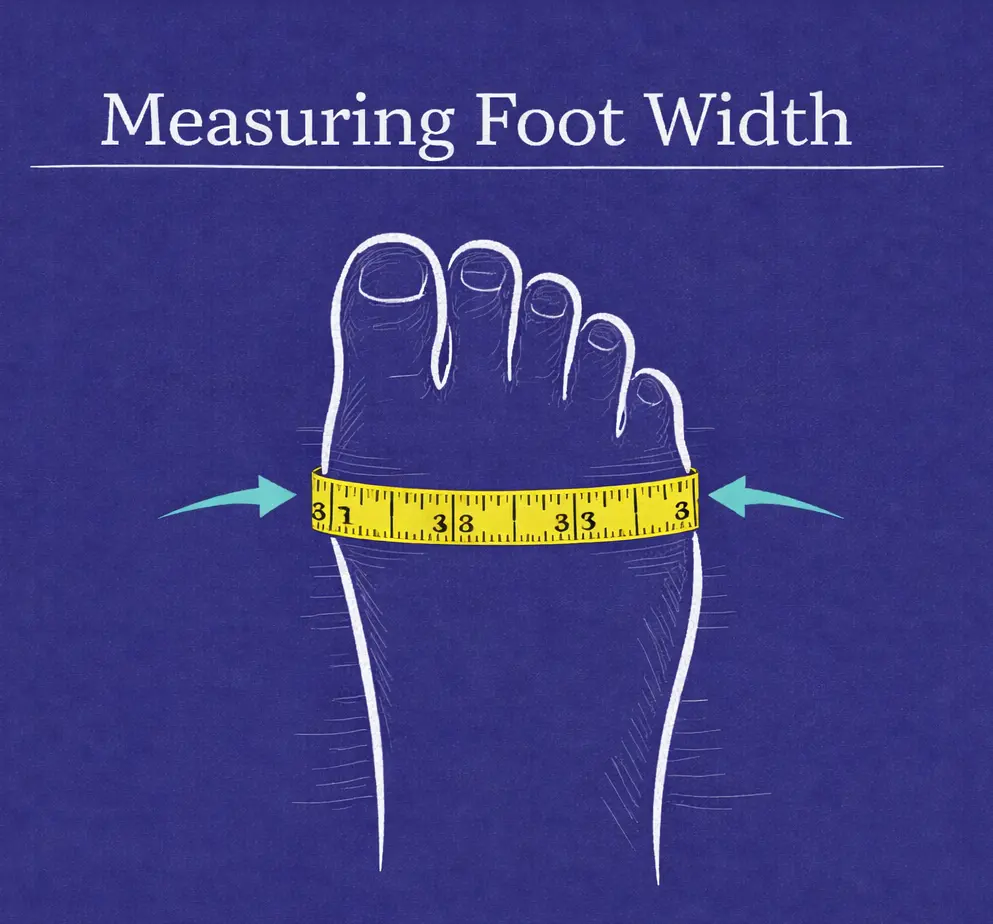
Foot width is the measurement across the widest part of the forefoot, usually around the ball area just behind your toes.
This is often recorded in standardized systems as a letter like B, D, or E, where B or D is “standard” and E or above is wider.
Width letters alone don’t tell the whole story because they are linked to specific measurement scales that vary across regions and brands.
They also don’t account for volume, or how tall or full your foot is, which can affect whether a shoe feels tight even if the width number looks correct.
C. Arch Height
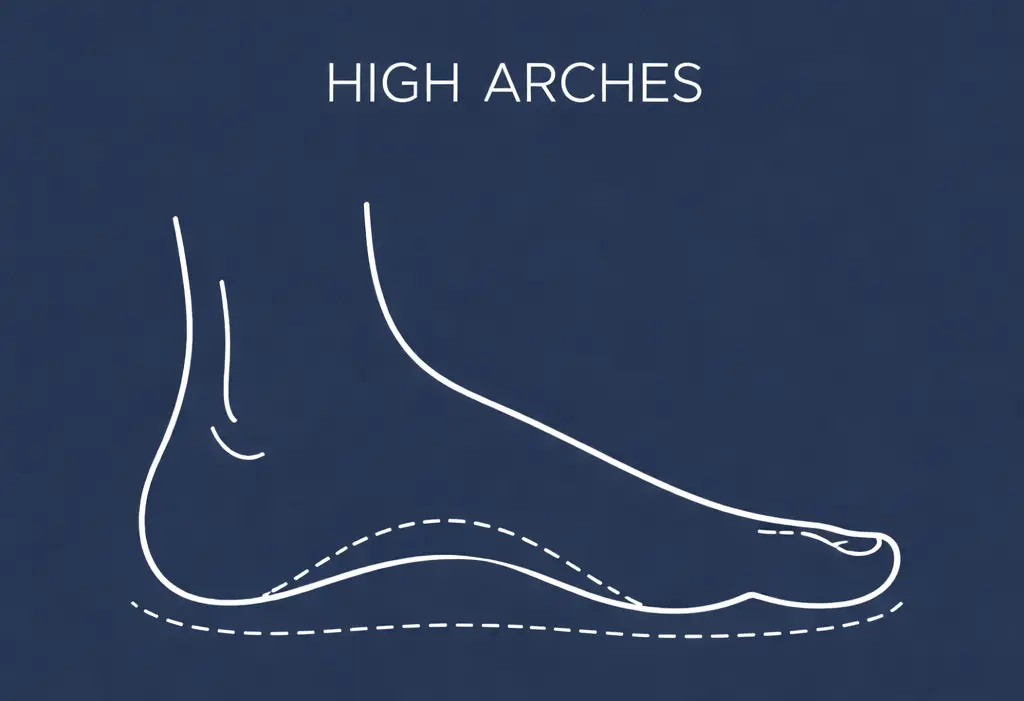
Arch height refers to how high the arch of your foot is between the heel and the ball.
People with high arches have more space under the midfoot, and people with flat feet have less. This height changes how much volume your foot takes up inside a shoe.
A high arch doesn’t change your length or width measurement, but it does affect how the foot fits into the volume inside a shoe.
Shoes with low volume or minimal arch support may feel tight across the midfoot for higher arch feet, even at the correct length and width.
D. Instep Height
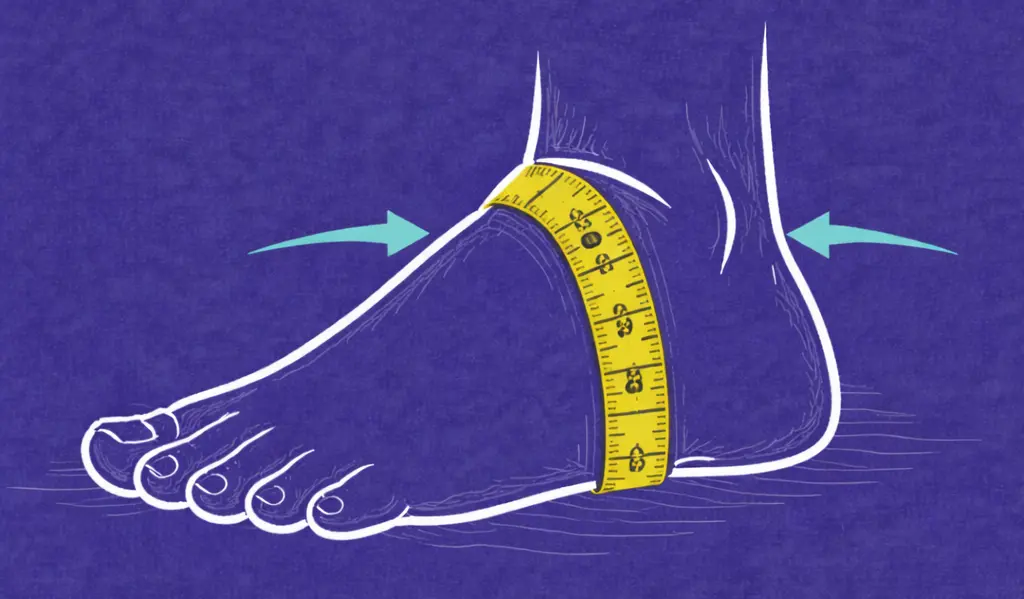
Instep height is the distance from the ground up over the top of your foot, around where your laces are. This is often called foot volume in professional fitting tools.
A high instep can make shoes feel tight over the laces and along the top of the foot, especially in styles with little adjustability like slip-ons or certain dress shoes. Footwear with more lacing adjustability or more internal volume through the vamp design tends to accommodate higher insteps better.
E. Heel Width
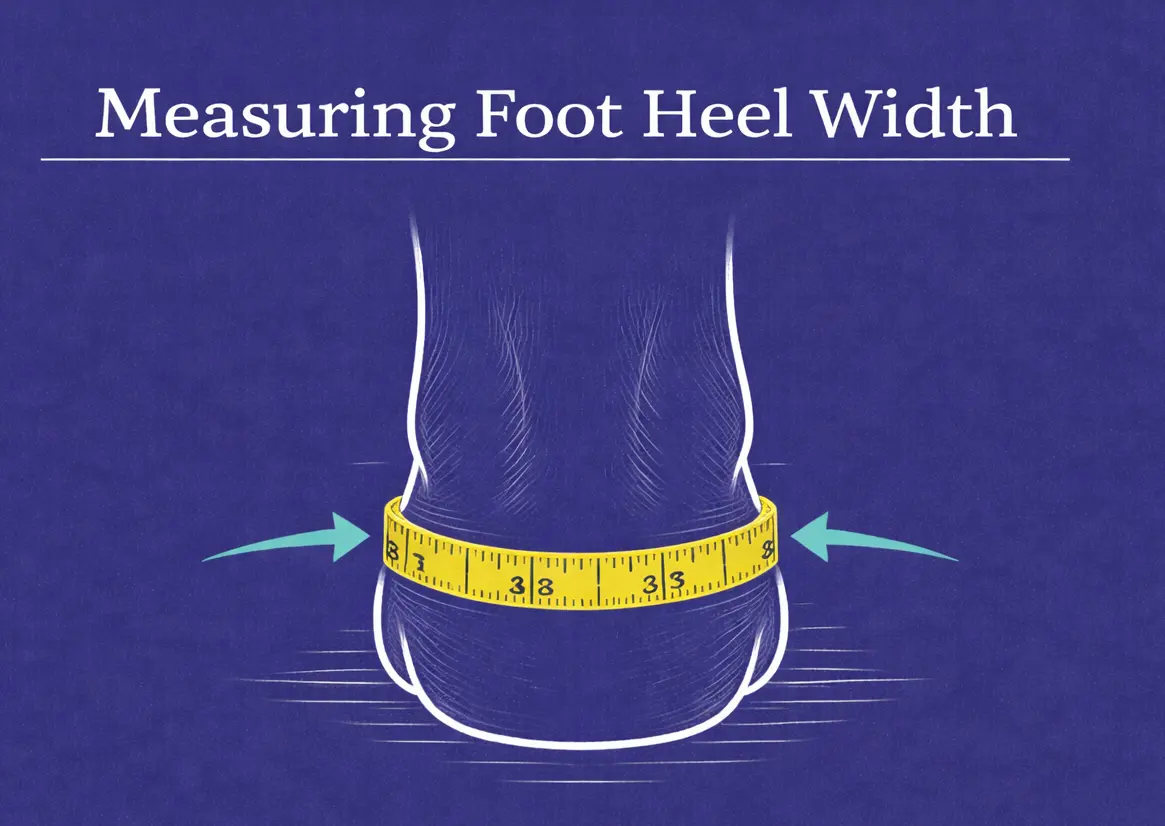
Heel width is how wide your heel is where it sits in the back of the shoe. If your heel is narrower or wider than the shoe’s heel cup, you can experience heel slip or rubbing even when the rest of the shoe fits correctly.
Heel slip happens when there isn’t enough grip or structure in the heel cup for your specific heel width.
Conversely, if the heel cup is too tight, it can create rubbing and discomfort at the back of the foot.
This measurement isn’t always included in size charts, but many professional fitters pay close attention to it because it affects stability and comfort.
Toe Shape and Its Effect on Sizing
Toe shape is rarely discussed in sizing guides, but it directly affects how a shoe fits in the forefoot.
The classifications below are descriptive categories commonly used in footwear and podiatry discussions. They are not medical diagnoses, but they help explain fit patterns.
John H. McDonald from the University of Delaware notes that variations in toe length and alignment are normal anatomical differences.
A. Egyptian Foot Shape
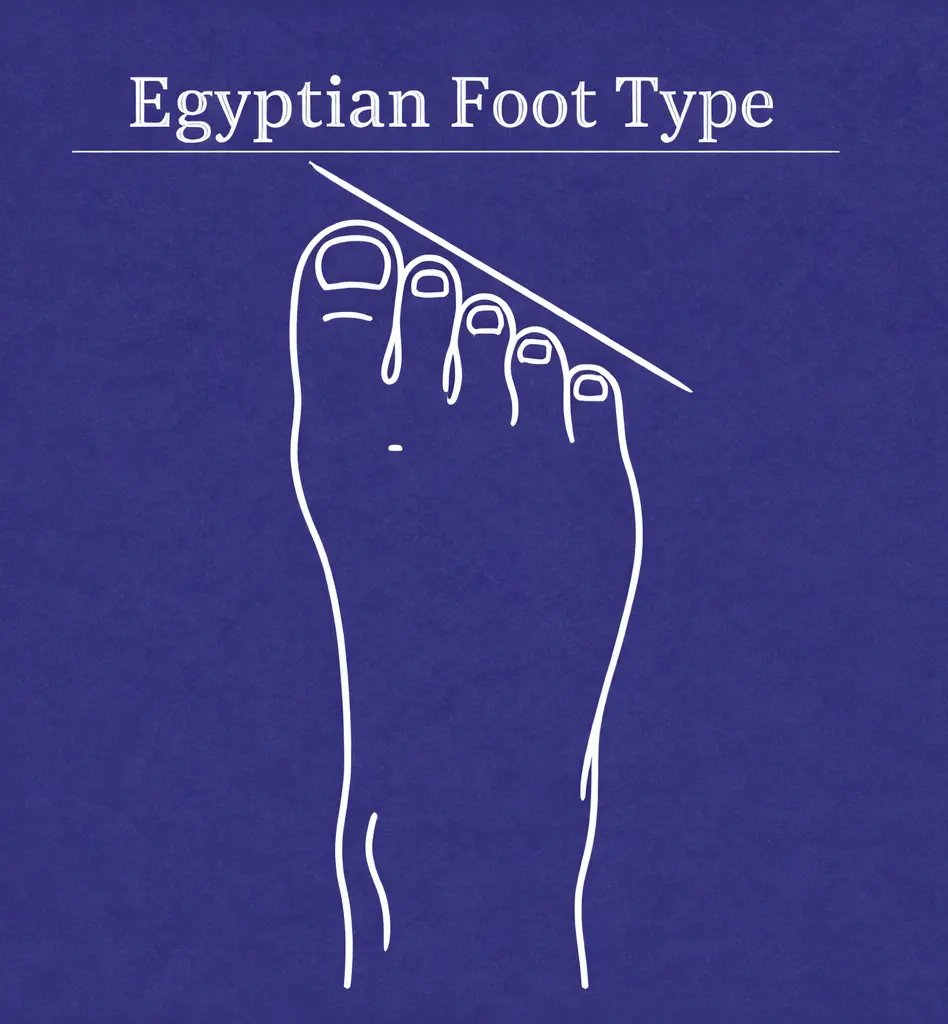
In this pattern, the big toe is the longest and the other toes slope downward in length.
Because the front of the foot tapers naturally, many people with this shape fit comfortably in shoes with a slightly tapered toe box.
Forward space is still necessary, but the taper of the shoe often mirrors the taper of the foot.
Toe box pressure is less likely at the second toe compared to other shapes, but insufficient length can still cause repetitive impact at the front of the shoe.
B. Greek Foot Shape
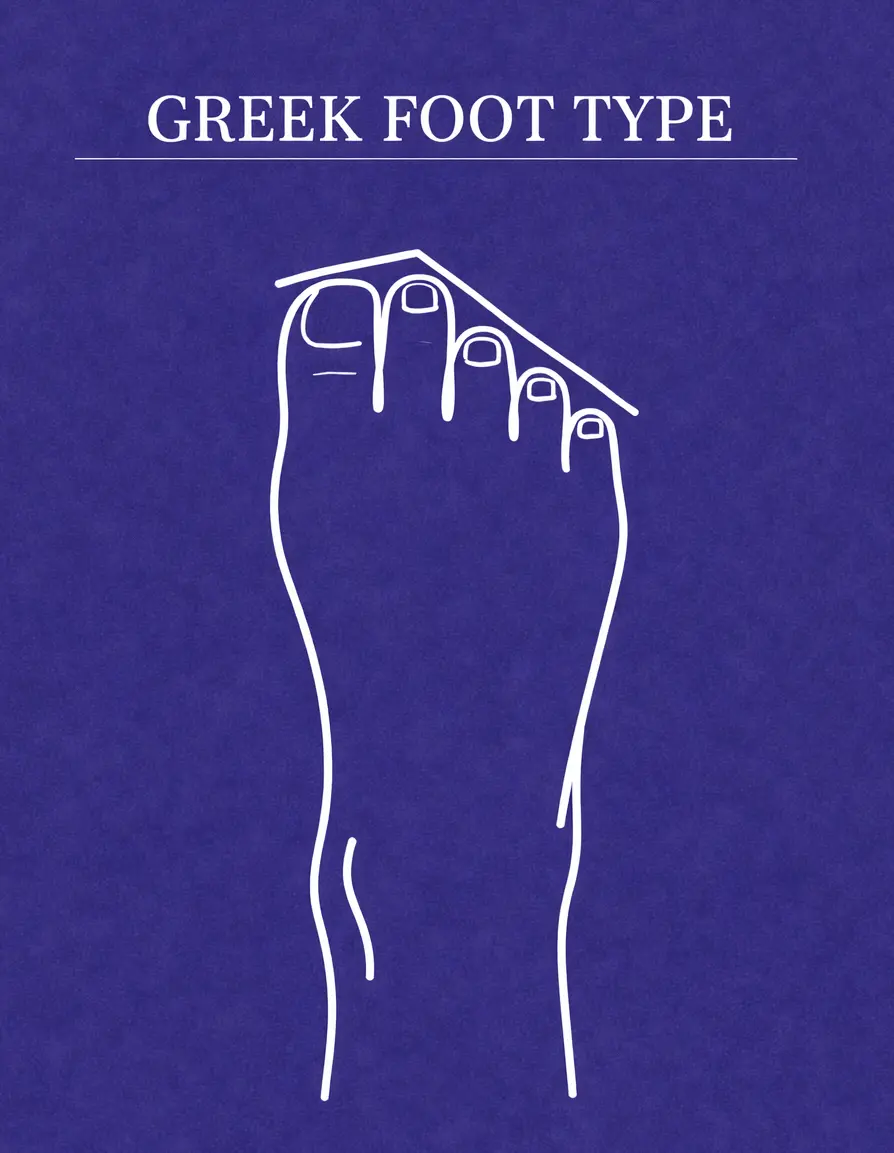
In this pattern, the second toe is longer than the big toe.
This changes how length should be evaluated because the true longest point of the foot is not the hallux.
If sizing decisions are based only on the big toe, the second toe may repeatedly contact the front of the shoe.
Repeated pressure or impact to the longest toe increases the risk of nail trauma and bruising, which SportsMedToday confirms can occur from repetitive friction or impact inside footwear.
Because of this forward extension, individuals with a Greek toe pattern often require slightly more internal length.
In some cases, that may mean going up half a size, but in others it may mean choosing a model with a longer internal last rather than simply increasing size.
C. Square Foot Shape
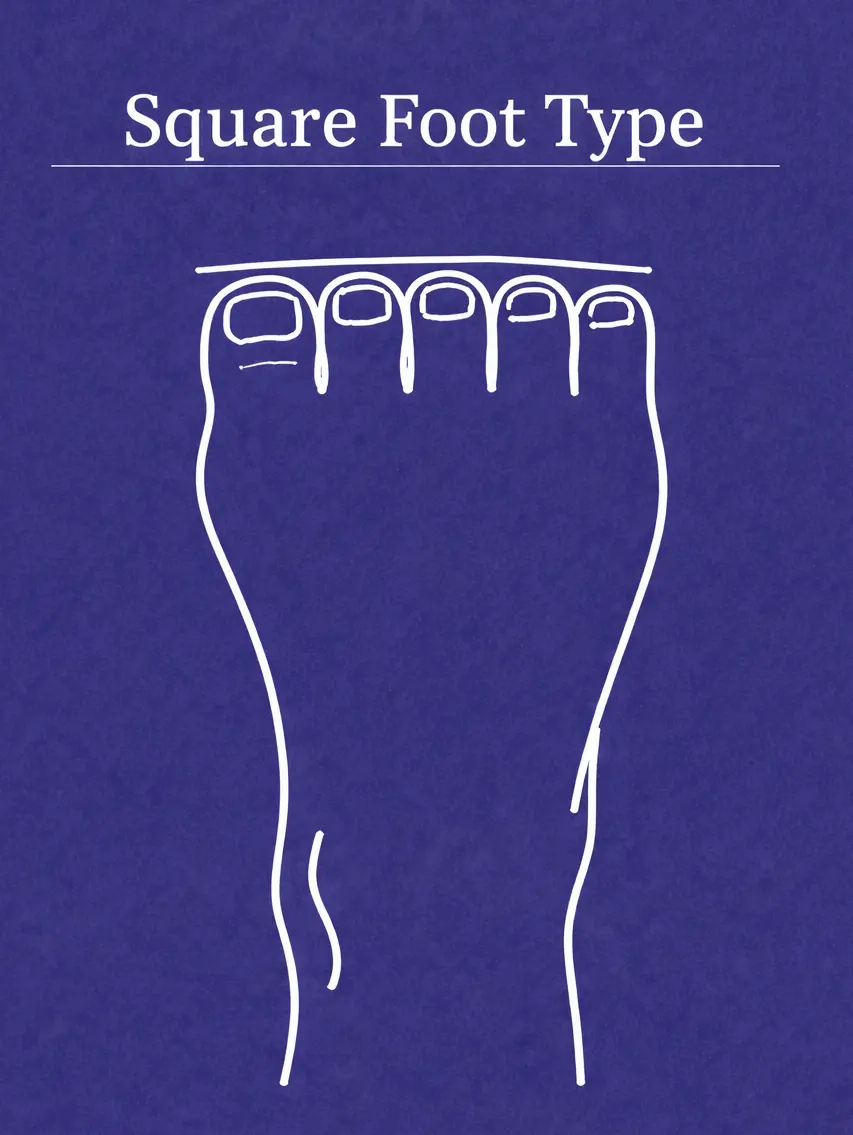
In a square pattern, the first three toes are similar in length.
This creates a broader, flatter forefoot profile. Tapered sneakers can compress the outer toes even if overall length is correct.
Forefoot compression is associated with discomfort and can contribute to conditions like bunion irritation when shoes are too narrow, according to the American Academy of Orthopaedic Surgeons.
In this case, increasing size does not always solve the issue. A wider toe box design is often more effective than simply adding length, since the pressure is lateral rather than forward.
D. Roman Foot Shape
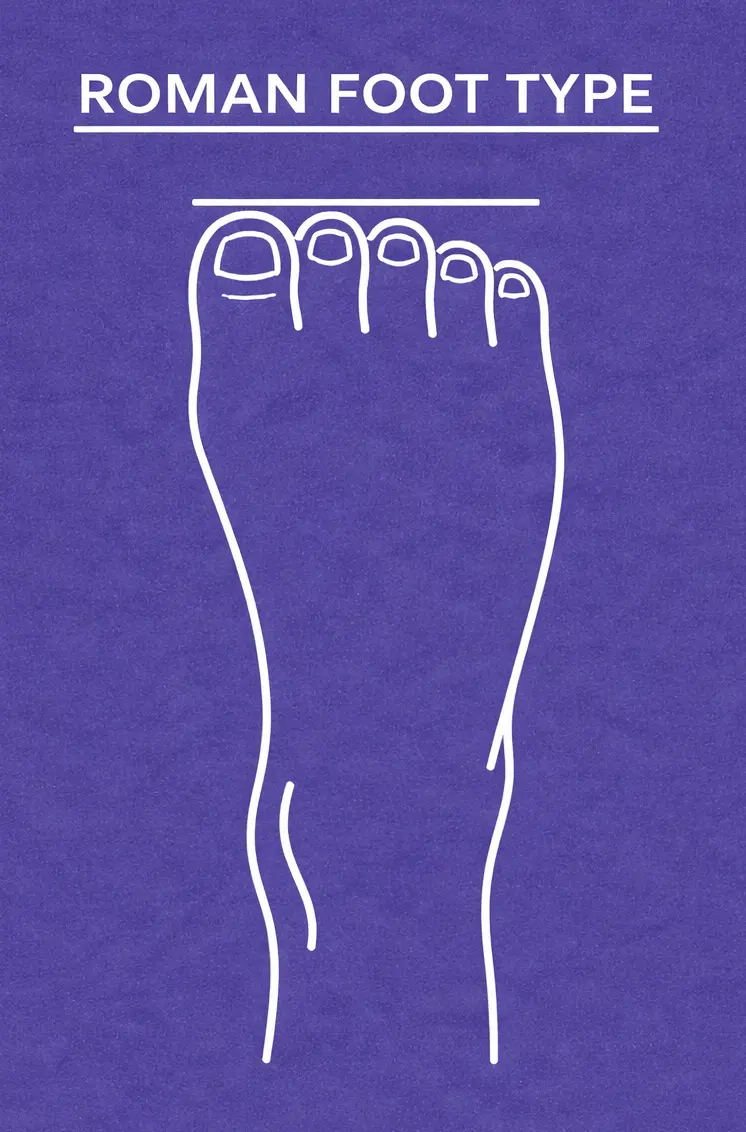
In a Roman pattern, the first three toes are nearly equal in length but the overall forefoot is more rounded rather than flat.
This shape can still struggle in sharply tapered toe boxes but may not require as much additional width as a square pattern.
Fit issues typically show up as even pressure across the front of the shoe rather than isolated pressure on one toe.
If discomfort occurs, evaluating toe box shape is usually more effective than automatically increasing size.
How Toe Shape Changes Sizing Decisions
Toe shape affects where pressure develops inside the shoe.
Forward pressure on the longest toe increases risk of nail trauma. Lateral compression increases risk of soft tissue irritation and deformity progression in susceptible individuals.
If discomfort is primarily at the front of the longest toe, additional internal length may be needed. If discomfort is along the sides of the forefoot, a different toe box shape or width is usually more appropriate than increasing size.
Understanding toe shape allows you to decide whether you need more length, more width, or a different silhouette entirely. That distinction is critical before moving on to broader foot type categories.
Foot Width vs Foot Volume
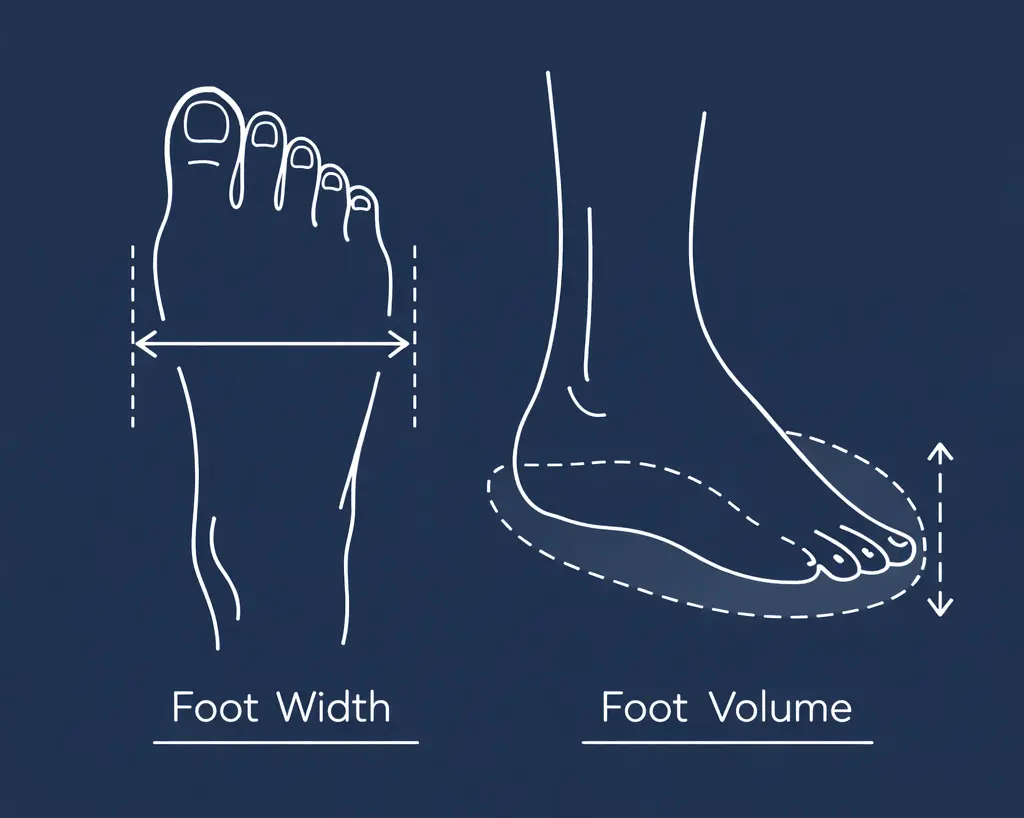
Foot width and foot volume are not the same thing, even though many sizing guides treat them as if they are interchangeable.
Understanding the difference changes how you interpret fit problems.
Foot width refers to the measurement across the widest part of the forefoot, typically at the ball of the foot.
This is the measurement captured by tools like the Brannock Device, which measures heel-to-toe length, arch length, and ball width.
The Brannock Device Company explains that width sizing is determined at the ball of the foot and corresponds to letter designations such as B, D, E, and 2E, depending on the sizing system.
A wide foot, in technical terms, means the forefoot measurement at the ball is greater than the standard width for that length.
Foot volume, by contrast, refers to how much three dimensional space the foot occupies inside the shoe.
Volume includes vertical height from the sole to the top of the foot, especially across the instep and midfoot.
Pedorthic education sources describe volume as the combination of width, girth, and instep height that determines how much internal space a shoe must provide.
Instep and girth measurements affect overall fit and cannot be captured by width letters alone.
This means you can have:
A narrow but high-volume foot.
In this case, the ball width measures standard or even narrow, but the instep height is high. The person may feel pressure over the laces even when the width letter is correct.
A wide but low-volume foot.
Here, the forefoot measures wide at the ball, but the foot is relatively flat and low in height. The person may need width accommodation but not necessarily more vertical space.
These two structures size differently…
A narrow but high-volume foot may require shoes with greater depth or more adjustable uppers rather than wider sizing.
A wide but low-volume foot may need width-specific models but not necessarily additional length.
Research notes that improper fit across the forefoot or midfoot can contribute to pressure-related discomfort and structural irritation.
If width and volume are not separated conceptually, people often solve the wrong problem. They size up to relieve instep pressure when the real issue is vertical volume.
Or they choose extra-wide models when the discomfort is caused by overall depth rather than ball width.
Distinguishing width from volume is foundational because it explains why two people who both wear a D width can experience completely different fit issues in the same shoe.
Arch Type and Its Effect on Sizing
Arch height affects how the foot interacts with the ground and how it occupies space inside a shoe. Arch structure is commonly described as low, neutral, or high.
Flat Feet
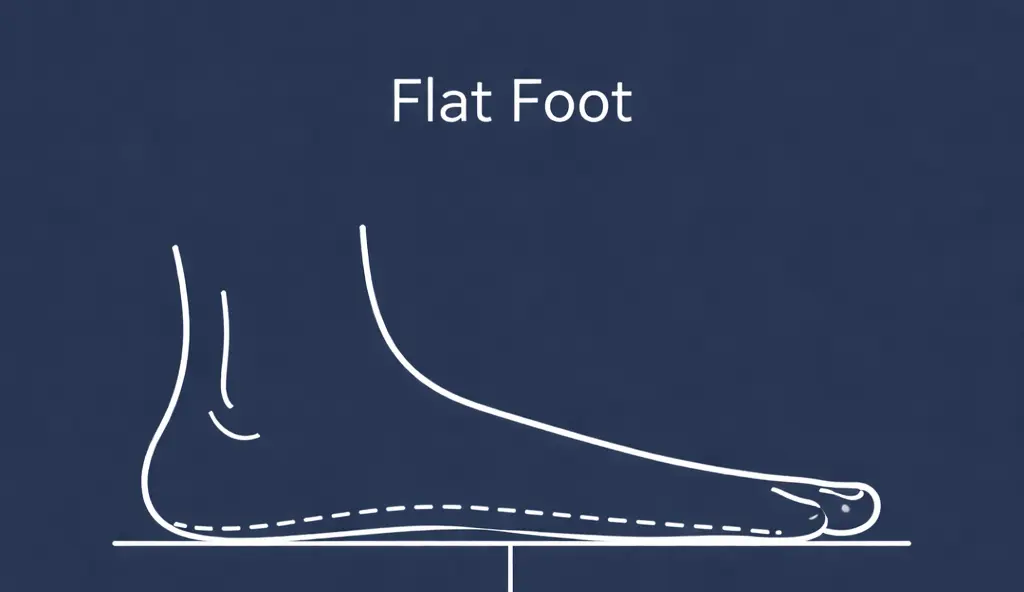
Flat feet, also referred to as low arches, tend to flatten further under body weight.
When the arch lowers during standing, the foot can lengthen and widen slightly due to load bearing.
The American Academy of Orthopaedic Surgeons notes that flattening of the arch can increase strain across the foot and alter weight distribution.
Because the arch collapses under load, individuals with flat feet often experience more forefoot splay while standing.
This can translate to a need for additional width in some shoes.
In certain cases, if the foot lengthens measurably under weight, a half size increase may provide better toe clearance, although this depends on the specific shoe last and material structure.
Flat feet can also influence midfoot tightness…
A shoe with a narrow midfoot platform or aggressive arch contour may feel restrictive if it does not accommodate the broader contact area of a flatter arch.
Lacing adjustments can help relieve dorsal pressure, but structural midfoot narrowness cannot always be solved by loosening laces alone.
Insole swaps are common in this group…
Supportive insoles are often used to provide arch structure. However, adding a thicker orthotic reduces internal volume, which may make a previously comfortable shoe feel tighter across the instep.
High Arches
High arches, sometimes referred to as pes cavus, create a different fit pattern.
High arches are describes as a condition where the midfoot is raised higher than typical, which changes weight distribution across the heel and forefoot.
Because the arch is elevated, the midfoot occupies more vertical space inside the shoe.
Even if length and width measurements are correct, individuals with high arches often report pressure across the top of the foot. This is not always a width issue but rather a volume issue.
Midfoot tightness in this case typically presents as lace pressure or discomfort along the top of the foot.
Adjusting lacing patterns can reduce localized pressure, but if the shoe has low internal depth, the sensation of tightness may persist despite correct sizing.
High arches generally do not spread as much under weight as flat feet, so additional width is not always necessary.
But the increased vertical structure can make shoes feel tight even when the length is appropriate.
Insole swaps also affect high arch feet differently…
Some individuals use cushioning insoles to increase shock absorption, since high arches are associated with reduced natural shock dispersion.
Adding thicker insoles reduces internal depth and may increase instep pressure unless the shoe has sufficient volume.
How Arch Type Influences Fit Decisions
Arch type influences how much the foot spreads under load, how much vertical space it occupies, and how pressure is distributed across the midfoot.
Flat feet are more likely to require width accommodation and careful attention to load-related length changes.
High arches are more likely to require adequate internal depth and thoughtful lacing adjustment.
Understanding arch structure helps explain why a shoe can feel tight in the midfoot even when length and ball width measurements appear correct.
Instep Height and Its Effect on Fit
Instep height refers to the vertical height of the foot from the sole up to the top of the midfoot, roughly where the laces cross.
This measurement is rarely included in standard size charts, but it significantly affects how a shoe feels across the top of the foot.
Footwear fitting standards recognize that overall foot volume includes vertical dimensions such as instep height.
Width letters measure the forefoot at the ball, but they do not account for how tall the foot is from bottom to top.
A person can measure standard width at the ball and still have a high instep that changes how the shoe fits.
Lace Bite and Tongue Pressure
When instep height is above average, the upper of the shoe can press down against the top of the foot even if length and width are correct.
This often presents as pressure under the tongue or discomfort when the laces are tightened.
Lace bite is commonly described in sports medicine as irritation or pain across the top of the foot caused by repetitive lace pressure or stiff uppers.
A common pattern appears here…
If you loosen the laces to reduce pressure, heel lockdown may suffer. If you tighten the laces to secure the heel, pressure across the instep increases.
This is a structural fit issue, not simply a sizing mistake.
Why Some People Size Up Despite Correct Length
In some cases, people with high insteps choose to go up half a size. The added internal volume in a larger size can reduce vertical compression across the midfoot.
However, increasing length to solve a volume problem can create excess space in the toe box, which may affect stability.
This is why sizing up is sometimes a workaround rather than a perfect solution. The underlying issue is vertical space, not foot length.
Material choice also matters…
Flexible mesh or knit uppers typically accommodate higher insteps more easily than rigid leather or heavily reinforced constructions.
I cannot confirm that most brands intentionally design for low insteps, as design specifications vary by manufacturer and model.
However, footwear lasts are generally built around population averages, which means individuals with significantly higher insteps may fall outside the central fit range.
Instep height often explains why someone can measure correctly for length and width yet still feel that a shoe is too tight. Without considering vertical volume, the fit assessment remains incomplete.
Heel Shape and Lockdown
Heel shape plays a significant role in overall fit, especially in how secure the shoe feels during walking or running.
While length and forefoot width receive most of the attention, the rearfoot structure often determines whether a shoe feels stable or loose.
Narrow Heels
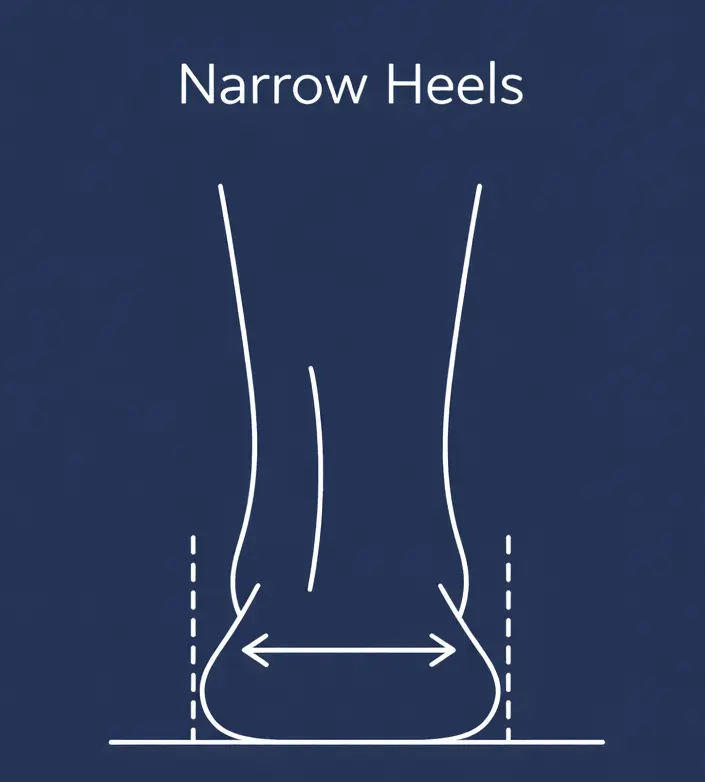
A narrow heel means the calcaneus region occupies less horizontal space inside the heel counter of the shoe.
If the shoe’s heel cup is built on a standard or wider last, a narrow heel may not fully engage the internal structure. Proper heel fit is important for stability and reducing friction at the back of the foot.
Excess movement can contribute to irritation and blister formation.
When heel slip occurs despite correct length, one possible reason is a mismatch between heel width and heel cup shape.
In these cases, tightening laces or using specific lacing techniques may improve lockdown. However, if the heel counter itself is too wide relative to the foot, adjustments may be limited.
Some individuals attempt to fix heel slip by going down half a size. A shorter shoe may hold the heel more firmly due to reduced internal length and slightly tighter overall volume.
But reducing size to solve a rearfoot issue can create new problems in the forefoot, especially if toe clearance becomes insufficient.
Wide Heels
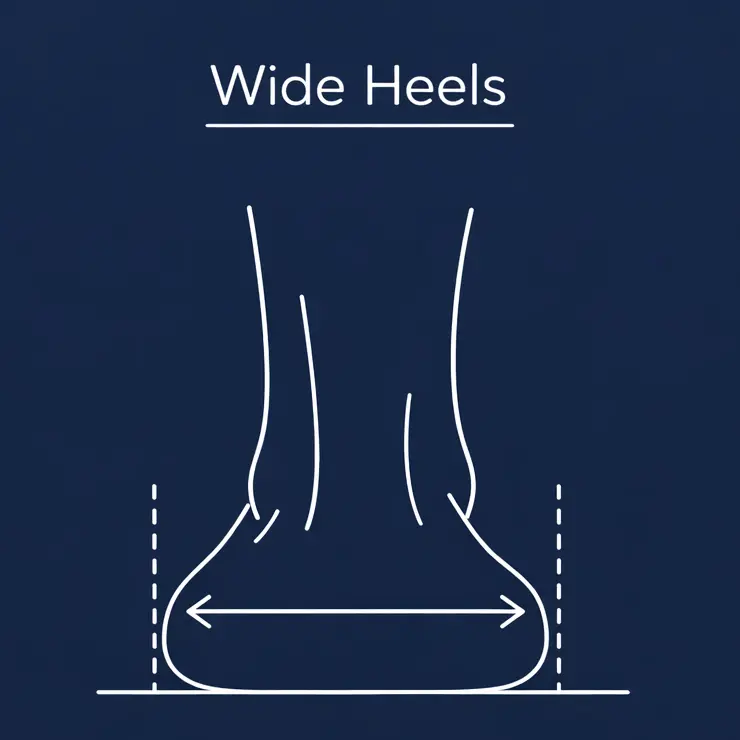
A wide heel occupies more horizontal space in the rearfoot. If the heel counter of the shoe is narrow or aggressively sculpted, this can create pressure or rubbing at the back and sides of the heel.
In this situation, heel discomfort is not caused by excess movement but by compression.
Increasing length does not always solve this, because heel width is not directly proportional to shoe length. Instead, models built on wider lasts or with more forgiving heel counters may be more appropriate.
Causes of Heel Slip
Heel slip can occur for multiple reasons:
- Heel to shoe mismatch, where the heel cup is wider than the foot.
- Excess internal length, allowing the foot to slide forward and lift at the rear.
- Insufficient midfoot lockdown, which allows forward movement inside the shoe.
Footwear fit guidance from podiatric associations emphasizes that heel movement should be minimal during walking, as excessive motion increases friction and reduces stability.
It is important to distinguish between minor initial lift and structural slip.
Some heel movement is normal in certain shoe constructions, particularly before materials soften. Persistent slipping during regular walking, however, usually indicates a fit mismatch.
The Trade-Off Between Heel Security and Toe Space
Going down half a size may improve heel security by reducing internal length and tightening overall volume. However, this approach can reduce toe clearance and increase pressure at the front of the shoe.
This illustrates a broader principle in sizing decisions: solving one fit issue can create another.
Heel shape, forefoot width, instep height, and overall length interact as a system. Adjusting size to correct a rearfoot issue without evaluating toe box space can introduce risk of toe compression or nail trauma.
Understanding heel shape and lockdown dynamics adds another layer of complexity to fit assessment. It reinforces that sizing decisions should consider the entire structure of the foot, not just a single measurement.
Foot Splay and Dynamic Shape Change
Foot shape is not static. The structure of the foot changes under load, and this dynamic change directly affects sizing decisions.
How Feet Widen When Standing
When you stand, body weight compresses the arches and soft tissue structures of the foot. This causes measurable increases in both length and width.
Research has shown that foot dimensions increase under weight-bearing compared to non weight-bearing conditions, including both arch lowering and forefoot widening.
This widening under load is commonly referred to as foot splay. The arch lowers slightly, the forefoot spreads, and the overall contact area increases.
Because of this, a foot measured while seated will not reflect its full functional dimensions during walking or running.
Why Measuring Seated Can Lead to Incorrect Sizing
Professional fitting standards recommend measuring the foot while standing because weight bearing produces more accurate length and width readings.
The Brannock Device fitting instructions specify that the foot should be measured while standing with full weight distributed evenly.
If someone measures their foot while seated, the arch is less compressed and the forefoot is narrower. This can result in choosing a size that feels correct initially but becomes tight once the foot expands during regular use.
This dynamic change explains why some people report that shoes feel fine in the store but tight after walking for extended periods.
Why Runners Often Need Extra Toe Space
During running, forces through the foot are significantly higher than during walking.
Ground reaction forces during running can reach two to three times body weight.
Under these repeated loading cycles, the foot experiences both longitudinal elongation and transverse widening. Combined with forward momentum inside the shoe, this increases pressure at the toes.
For this reason, many running shoe fitting guidelines recommend leaving additional space in front of the longest toe compared to casual footwear.
Specialty running retailers commonly advise approximately a thumb’s width of space between the longest toe and the front of the shoe, though specific recommendations may vary by brand and source.
The need for extra toe space is not arbitrary. It accounts for dynamic foot expansion, repetitive forward movement, and swelling that can occur during longer runs.
Why This Matters for Sizing
Foot splay explains why static measurements alone do not fully determine fit. A shoe that feels correct when trying it on briefly may become restrictive once the foot expands under sustained load.
For individuals who run regularly, dynamic expansion should be factored into sizing decisions. Without accounting for this, toe box pressure, nail trauma, and forefoot discomfort become more likely.
Understanding that the foot changes shape under weight reinforces the broader principle of this guide: sizing is not just about a number. It is about how your specific foot structure behaves under real world conditions.
Left vs Right Foot Differences
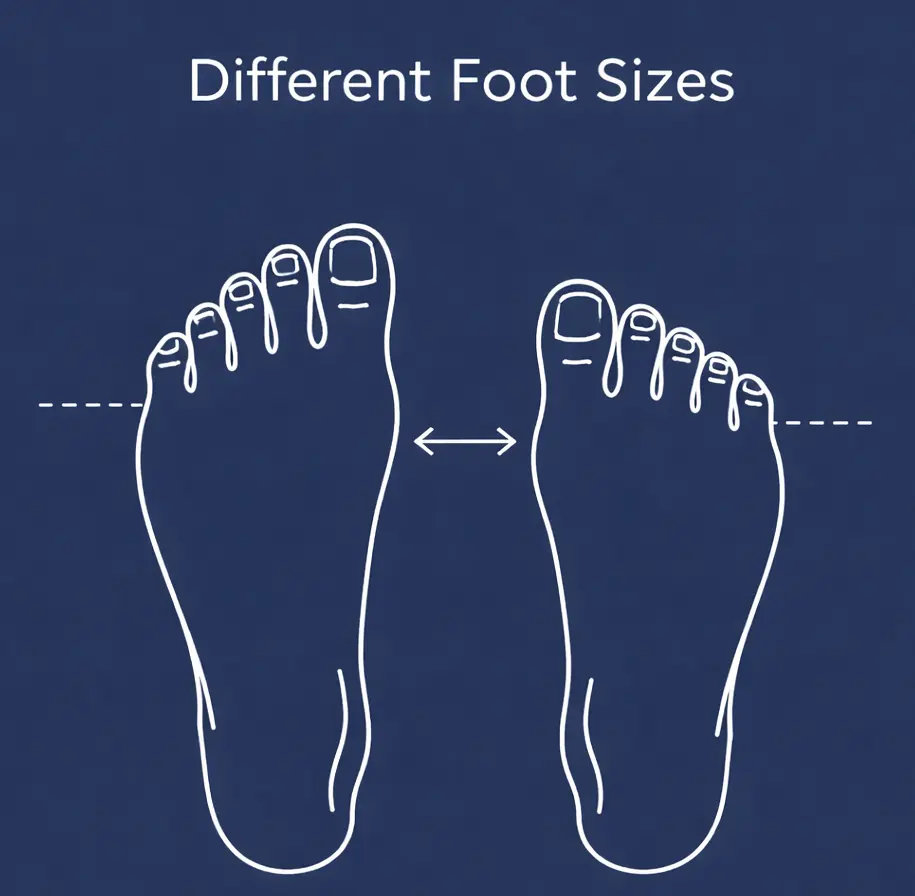
Human feet are rarely perfectly symmetrical. Small differences in length, width, arch height, or volume between the left and right foot are common.
Clinical and anthropometric research has documented measurable bilateral differences in foot dimensions in the general population.
For example, studies analyzing foot measurements have found statistically significant differences between left and right feet in many individuals.
These differences are usually small, often a few millimeters, but even minor variation can affect fit inside a structured shoe.
Why You Should Size to the Larger Foot
Because shoes come in whole and half sizes rather than millimeter precision, sizing decisions must account for the larger foot.
If one foot is longer or wider, selecting a size based on the smaller foot increases the risk of compression, toe pressure, or friction on the larger side.
Professional fitting guidance, including recommendations from footwear fitting authorities such as the Brannock Device Company, advises measuring both feet and fitting to the larger one.
This approach reduces the risk of forward toe impact, lateral compression, and nail trauma on the larger foot.
Adjusting the Smaller Foot
Once the correct size is chosen for the larger foot, the smaller foot may feel slightly roomier. In most cases, this can be managed without changing shoe size.
Common adjustment methods include:
Using an insole with slightly greater thickness to reduce internal volume on the smaller side. Adding volume under the foot reduces excess movement without affecting length on the larger side.
Modifying lacing patterns to improve midfoot lockdown. Heel lock or runner’s loop lacing can reduce rearfoot movement without shortening internal length.
Both techniques adjust internal fit without forcing the larger foot into a smaller shoe.
Why This Matters
Ignoring left to right asymmetry can lead to repeated discomfort on one side, even when the overall size seems correct. Sizing to the larger foot and fine-tuning the smaller side is a practical strategy supported by standard fitting practice.
This reinforces a broader pattern seen throughout this guide: shoe fit must account for structural variation, not just a single measurement.
How Materials Interact With Foot Shape
Shoe sizing cannot be separated from material behavior.
Two shoes built on similar dimensions can feel completely different depending on how the upper materials respond to pressure, heat, and movement over time.
Material properties influence stretch potential, break in behavior, and how forgiving a shoe is to structural differences in the foot.
Footwear design literature consistently distinguishes between rigid and adaptive upper constructions, noting that material choice affects fit accommodation over time.
Knit vs Leather
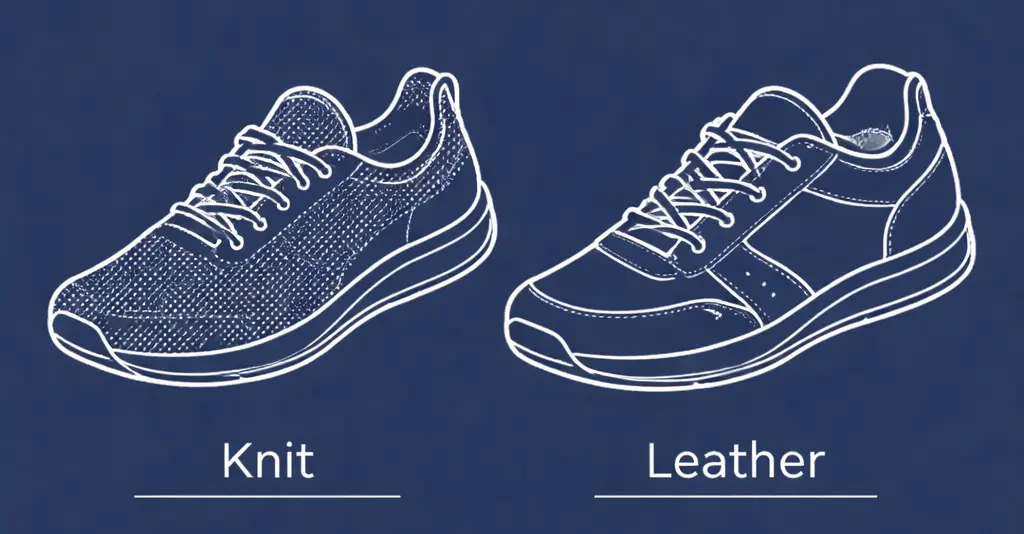
Knit uppers are typically constructed from engineered textiles that allow multidirectional flexibility.
Because knit structures are made from interlocking yarns, they can deform and adapt around areas of pressure more easily than solid materials.
This does not mean they stretch indefinitely, but they generally provide more immediate accommodation to variations in instep height or forefoot width.
Leather behaves differently. Natural leather can stretch over time, particularly in areas of repeated stress, but the stretch is gradual and depends on thickness, finish, and reinforcement.
Full grain leather with internal lining and structural backing will stretch less than thin, unlined leather.
Stiff leather requires different sizing logic…
If a leather shoe feels tight at the ball of the foot or across the instep on first wear, the question becomes whether the tightness is due to insufficient width or simply initial stiffness.
Leather fibers relax and conform under repeated flexion and moisture exposure, but expansion is limited and not uniform.
If pressure is moderate and located at natural flex points, break in may resolve it. If pressure is severe or located at structural seams, sizing up or selecting a different last may be more appropriate.
Mesh vs Suede
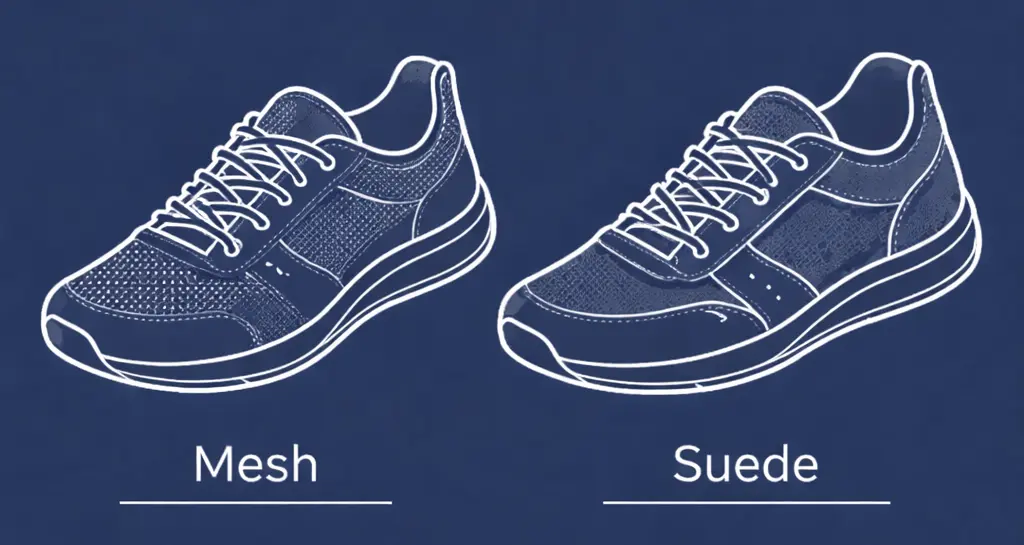
Mesh uppers are typically made from synthetic woven materials designed for breathability and flexibility. Because of their open structure, they tend to accommodate forefoot splay more readily under load.
This makes them more forgiving for individuals whose feet widen significantly when standing or running.
Suede, while technically leather, often feels softer than smooth full-grain leather due to its napped surface. However, suede still has a defined structural limit.
It may feel more pliable initially, but it does not behave like stretch knit. Reinforced suede panels or backed suede will resist expansion in specific zones.
The key distinction is that mesh adapts dynamically during movement, whereas suede adapts gradually over time.
Structured Overlays vs Flexible Uppers
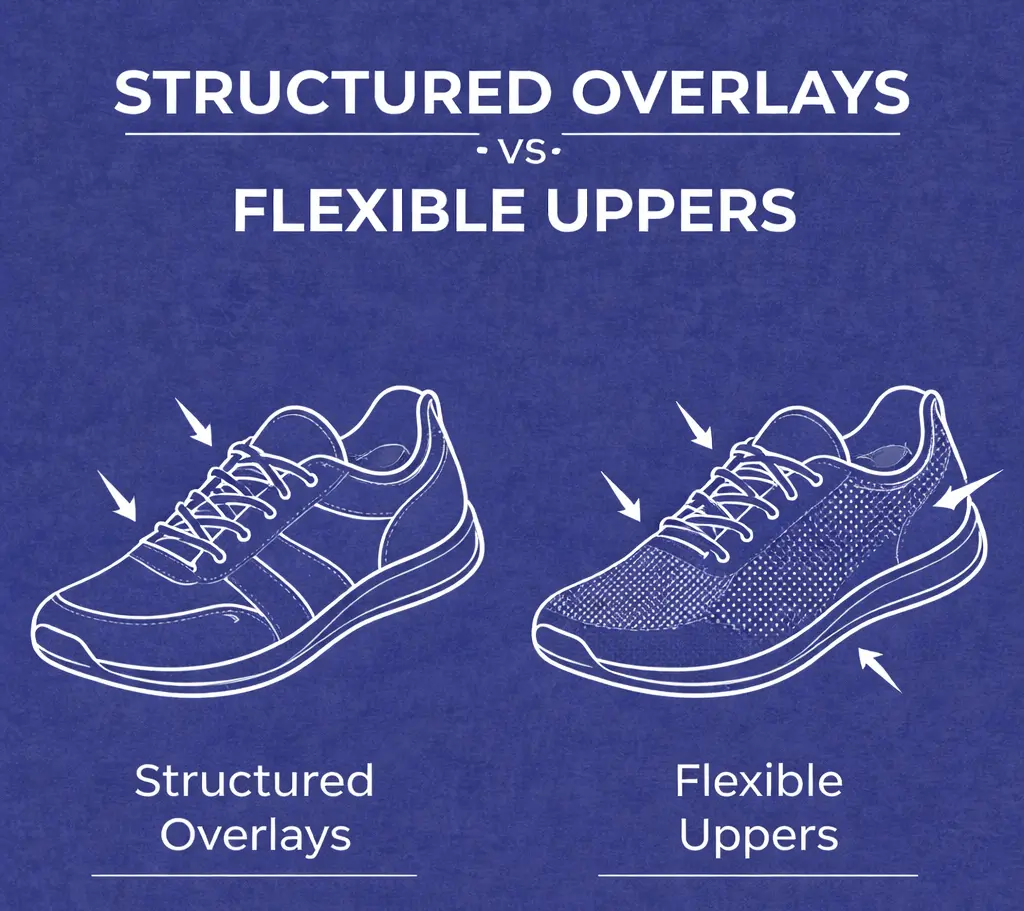
Many athletic shoes incorporate synthetic overlays, plastic reinforcements, or stitched structural panels. These elements limit stretch in targeted areas to improve stability.
While this improves support, it reduces adaptability to foot shape differences.
For example, a shoe with rigid overlays across the forefoot may not accommodate a wide or square toe shape even if the base material underneath is flexible.
In contrast, a minimal upper without overlays will typically adapt more easily to variations in foot width and instep height.
Stretch Potential and Break-in Time
Break-in time varies significantly by material:
- Knit and soft mesh generally require minimal break-in because they conform quickly.
- Thin leather may stretch moderately over time.
- Thick or heavily structured leather may require extended wear and will not expand dramatically in width.
If a shoe feels structurally narrow due to rigid overlays or reinforced leather, break-in alone may not resolve the issue.
Why Material Choice Changes Sizing Strategy
Material flexibility determines how much tolerance exists between foot shape and shoe shape.
A forgiving knit upper may accommodate minor width or instep variations without changing size. A stiff leather dress shoe built on a narrow last may require more precise sizing from the beginning.
Understanding material behavior prevents incorrect assumptions such as “it will stretch” or “it will break in” without considering construction.
Sizing decisions should account for both the static dimensions of the shoe and the mechanical behavior of its materials over time.
How Different Shoe Categories React to Foot Shape
Foot shape does not interact with every type of shoe the same way.
Construction goals differ by category, and those differences affect how forgiving or restrictive a shoe will feel. Materials, internal volume, last shape, and structural reinforcements vary significantly across categories.
Running Shoes
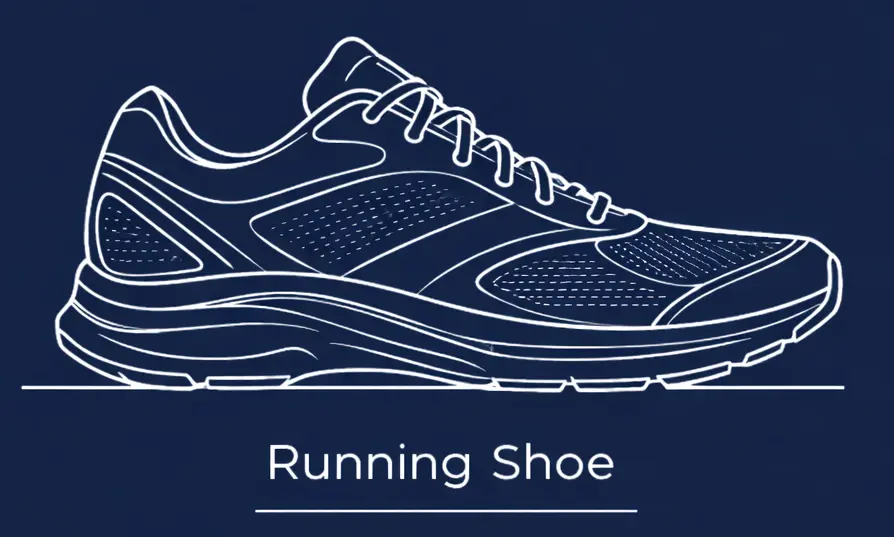
Running shoes are designed to handle repetitive impact forces and forward motion.
Again, ground reaction forces during running can reach approximately two to three times body weight, depending on speed and running style.
Because of this loading and forward movement, running shoes typically allow additional toe clearance compared to casual footwear.
Specialty fitting guidance commonly recommends leaving space in front of the longest toe to accommodate dynamic foot elongation and swelling during activity.
Running shoes often use mesh or engineered knit uppers, which adapt more readily to forefoot splay and instep height. However, performance-oriented models may include overlays that limit stretch in key areas for stability.
For individuals with wide forefeet or high insteps, running shoes are generally more accommodating than rigid dress shoes, but the internal last shape still varies by model.
Lifestyle Sneakers
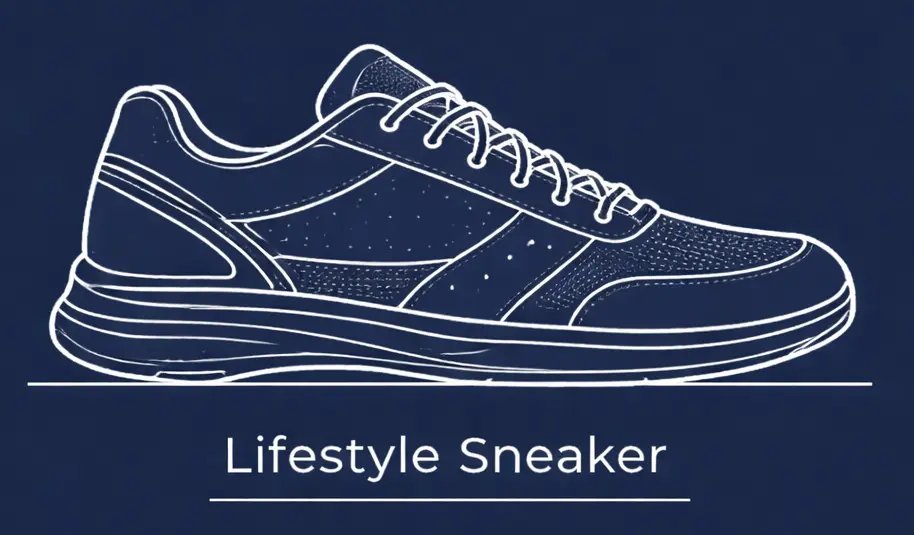
Lifestyle sneakers prioritize aesthetics and casual wear over performance biomechanics. Many are built on narrower or more tapered lasts for visual design reasons.
Materials vary widely. Some use soft leather or suede that gradually conforms to the foot. Others use structured panels that restrict expansion.
Because lifestyle sneakers are not always designed for extended dynamic load, they may not provide as much toe clearance as running shoes.
This means forefoot splay and toe shape become more important. A square or wide forefoot may struggle in tapered lifestyle silhouettes even if the size is technically correct.
Basketball Shoes
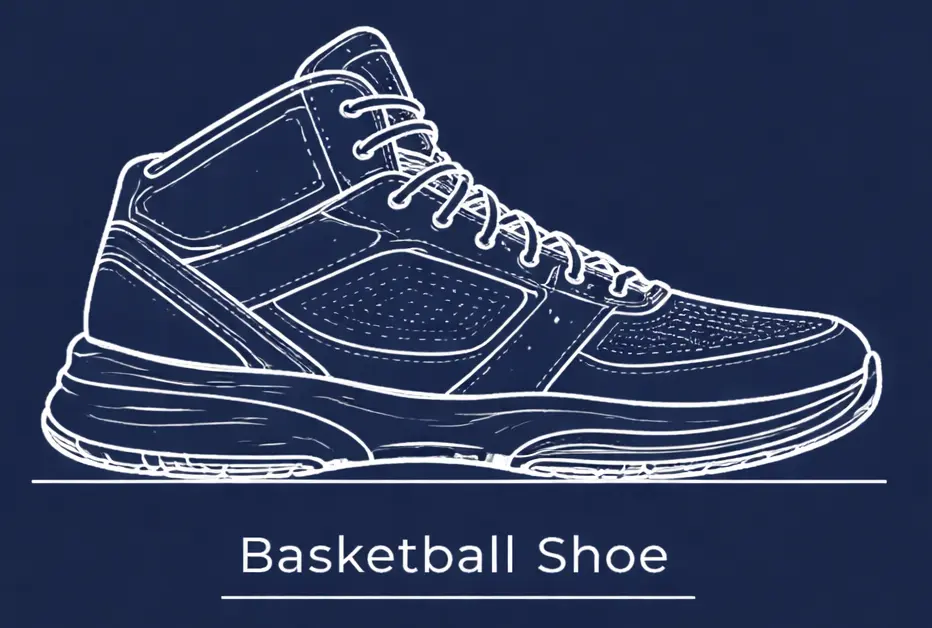
Basketball shoes are built for multidirectional movement, rapid lateral cuts, and high ankle stability. They often feature reinforced uppers, structured overlays, and firm heel counters.
The need for lateral containment means the upper is frequently less forgiving. High instep or high volume feet may feel significant pressure across the midfoot, particularly in models with rigid support structures.
Because of the emphasis on lockdown, sizing up to solve instep pressure can reduce stability, which is a core function of the shoe. Fit in this category requires balancing containment with adequate forefoot space.
Dress Shoes
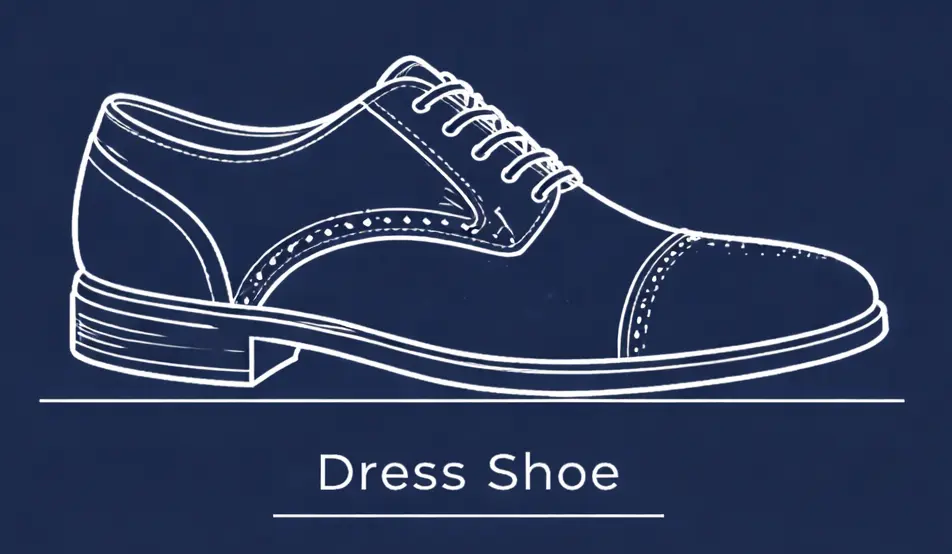
Dress shoes are often constructed from firm leather and built on traditional lasts that may prioritize shape and appearance over anatomical accommodation.
Leather can adapt gradually, but stiff or heavily finished leather has limited stretch capacity. Dress shoes typically have less internal padding and less upper flexibility than athletic shoes.
For individuals with wide forefeet, high insteps, or pronounced toe shapes, precise last selection becomes critical. Simply sizing up can create heel slip while failing to resolve forefoot compression if the last remains narrow.
Because break-in potential is limited and structural support is minimal, dress shoe fit tends to be less forgiving of sizing errors.
Boots
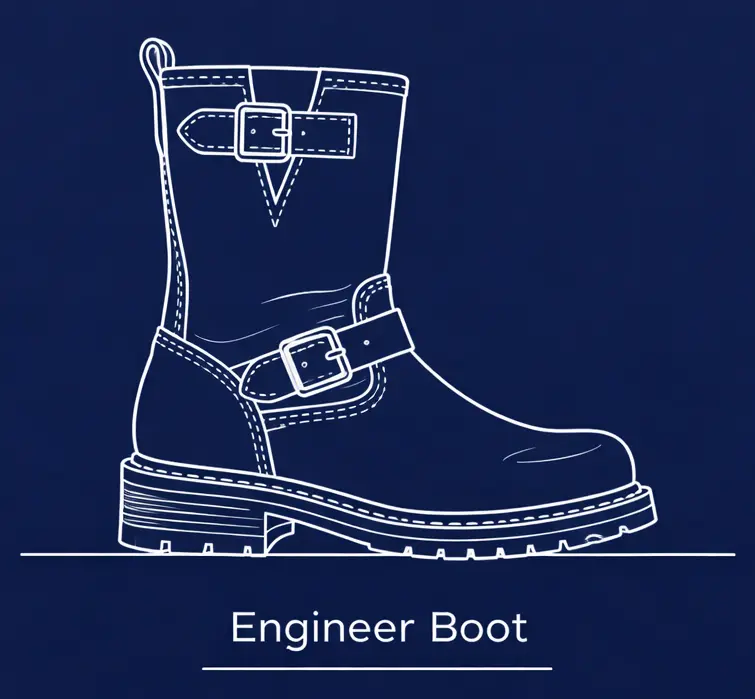
Boot fit varies widely depending on type.
Work boots and heritage boots often use thick leather uppers and rigid construction. Hiking boots may combine stiff materials with structured ankle support.
Thick leather uppers may soften over time, but expansion is gradual and often localized to flex points. If the boot is too narrow at the ball of the foot, break-in may not fully resolve the issue.
Boot shaft height and collar structure also affect fit. Higher collars can influence heel lockdown and ankle stability, which changes how instep height and heel width interact with the shoe.
Because boots often use heavier materials and more rigid construction, they typically require more precise initial sizing than flexible sneakers.
Why Category Matters
Each category is built around a different design objective: cushioning and forward motion for running, aesthetics for lifestyle, containment for basketball, formality for dress shoes, and durability for boots.
These design priorities influence last shape, material flexibility, internal volume, and toe box geometry. As a result, the same foot may require different sizing strategies across categories.
Understanding these structural differences prevents oversimplified conclusions such as assuming one size works universally across all types of footwear.
When to Size Up vs When to Change Models
One of the most common mistakes in shoe sizing is assuming that any discomfort means you need a different size. In many cases, the issue is not length but shape mismatch.
Changing size alters length and overall volume, but it does not change the underlying last shape of the shoe.
Before increasing or decreasing size, the first step is to identify where the tightness or instability occurs.
If It Is Tight in the Toe Box
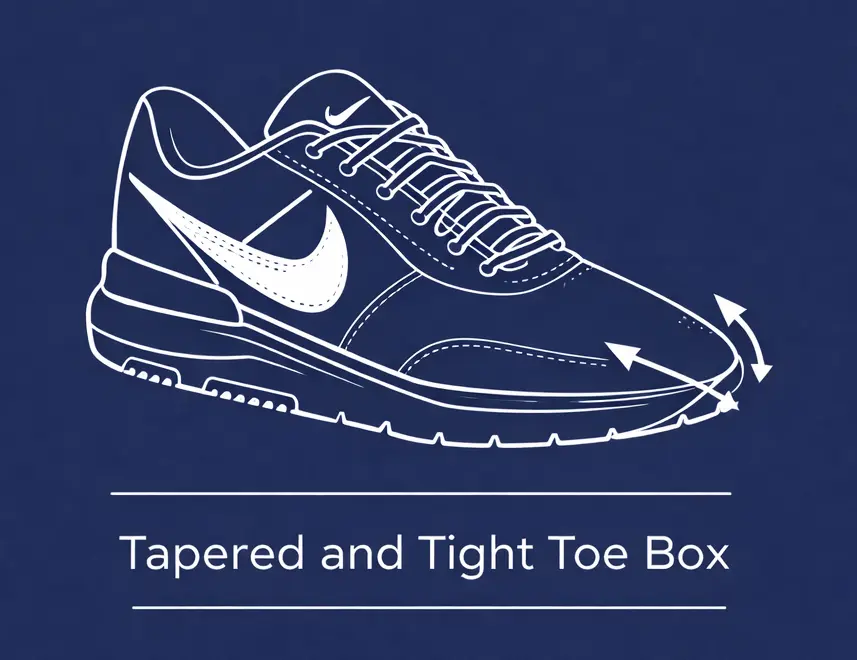
If pressure is concentrated at the front or sides of the toes, the issue may be toe box shape rather than length.
The American Academy of Orthopaedic Surgeons notes that shoes that are too narrow in the forefoot can contribute to toe crowding and irritation.
If the longest toe is contacting the front of the shoe, additional length may be necessary. However, if the discomfort is lateral, meaning the toes feel squeezed from the sides, a wider model or a shoe built on a less tapered last is often more appropriate than simply increasing size.
Sizing up increases internal length, but if the toe box remains narrow in shape, the underlying compression may persist.
Decision logic:
- If forward pressure → consider more length.
- If side compression → consider wider or differently shaped model.
If It Is Tight in the Midfoot
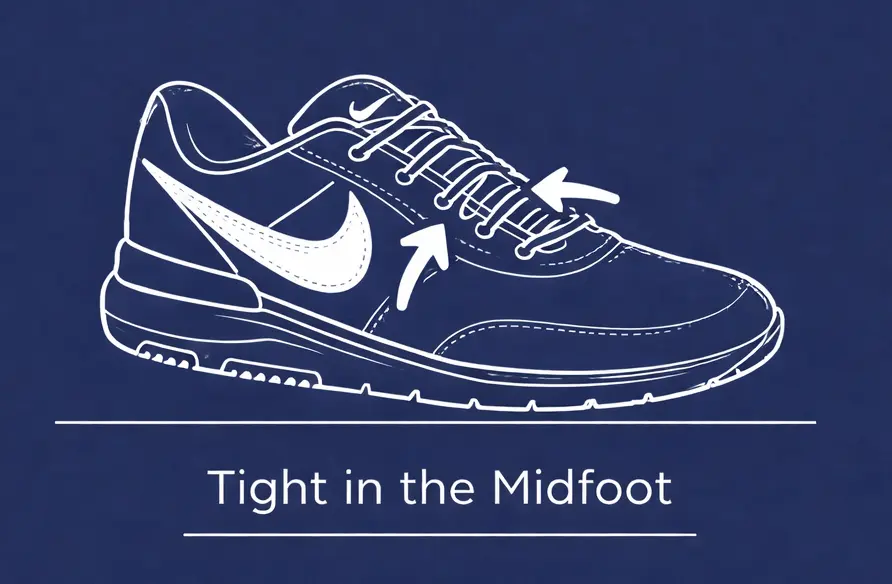
Midfoot tightness often relates to instep height or overall foot volume rather than length. Pressure under the laces or across the top of the foot is commonly associated with insufficient vertical space.
If the shoe feels tight only when laced securely, loosening the laces or adjusting lacing patterns may relieve pressure without changing size.
If the upper is rigid and continues to compress the instep even when loosened, a model with greater depth or more flexible materials may be necessary.
Sizing up can increase vertical volume slightly, but it also increases length. If toe clearance is already adequate, increasing length may introduce instability without fully solving instep compression.
Decision logic:
- If pressure across laces → evaluate instep height and upper flexibility before increasing size.
If There Is Heel Slip
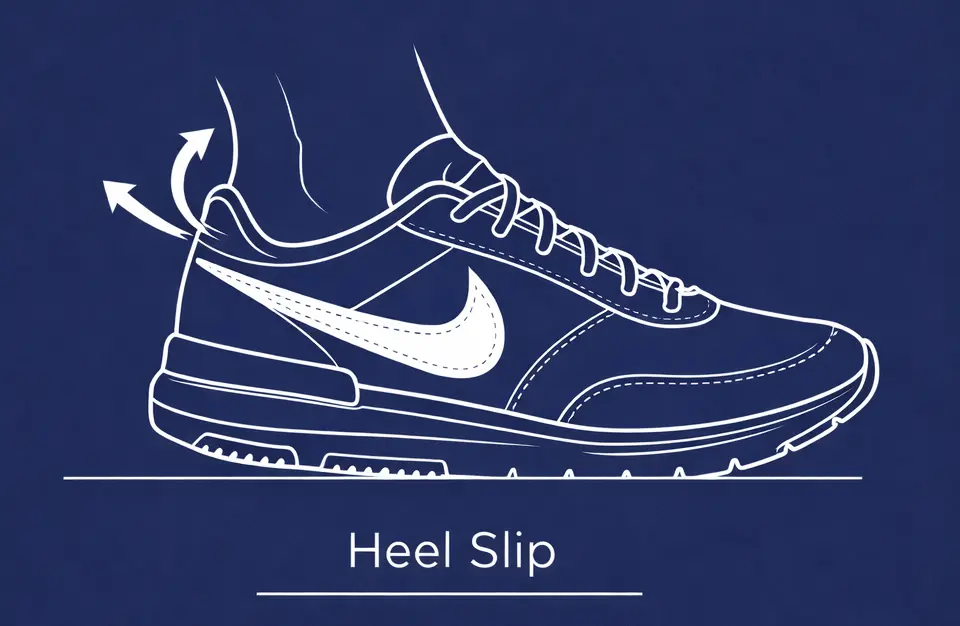
Heel slip can result from excess length, a narrow heel, or insufficient midfoot lockdown.
If heel lift occurs but toe space is already minimal, sizing down may create forefoot compression. In these cases, adjusting lacing techniques such as a runner’s loop may improve heel security without reducing internal length.
If the heel cup shape is incompatible with the foot structure, a different model built on a narrower or more sculpted heel may be more effective than changing size.
Decision logic:
- If heel lifts but toes are fine → adjust lacing first.
- If heel lifts and shoe feels long → consider sizing down cautiously.
Why Changing Models Is Sometimes the Correct Solution
Sizing changes length and overall internal volume. It does not fundamentally change toe box geometry, heel cup shape, or upper structure.
If the discomfort is caused by last design or silhouette mismatch, altering size alone may not resolve the issue.
For example, a person with a square toe shape may continue to feel lateral compression in a tapered silhouette regardless of size adjustments.
In that case, selecting a wider or differently shaped model addresses the structural mismatch directly.
The key principle is that fit problems must be diagnosed by location. Increasing or decreasing size should be based on measurable length issues, not used as a universal solution for all discomfort.
Understanding when to change size and when to change model prevents overcorrection and reduces the risk of introducing new fit problems while trying to solve an existing one.
How to Measure Your Feet at Home (Step-by-Step Guide)
Understanding foot structure is only useful if the measurements are taken correctly. Inaccurate measurement leads to incorrect sizing decisions, even when the underlying logic is sound.
Below are practical methods supported by established footwear fitting standards.
Use a Brannock Device When Possible
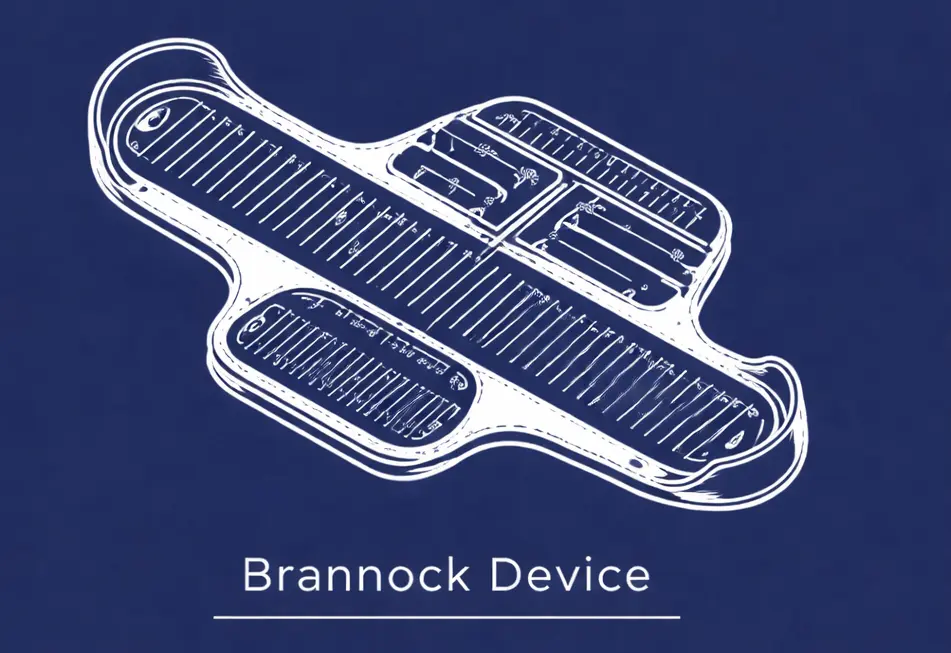
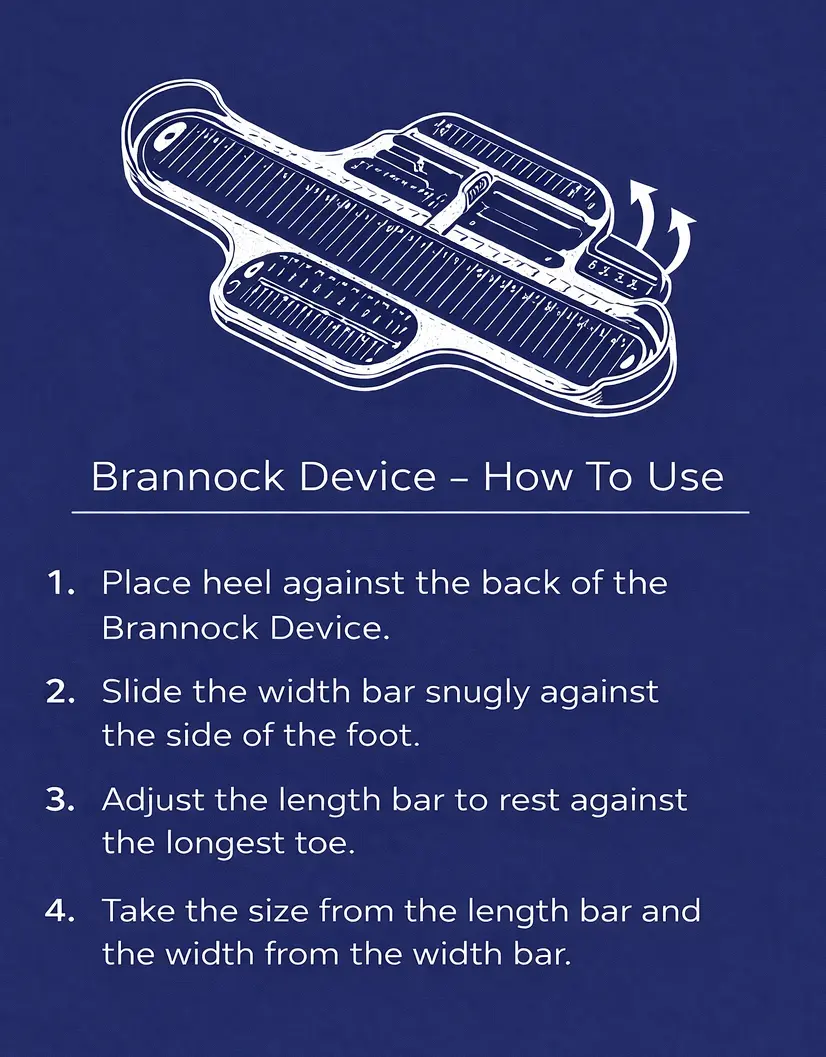
The Brannock Device is the standard measuring tool used in footwear retail. It measures heel to toe length, arch length, and ball width.
The manufacturer’s official fitting instructions state that measurements should be taken while standing with weight evenly distributed.
Arch length measurement is especially important because it determines where the ball of the foot sits inside the shoe. If arch length is longer than the heel-to-toe length suggests, the flex point of the shoe may not align properly with the foot.
Both feet should be measured, and sizing decisions should be based on the larger foot.
The Wall Method for Home Measurement
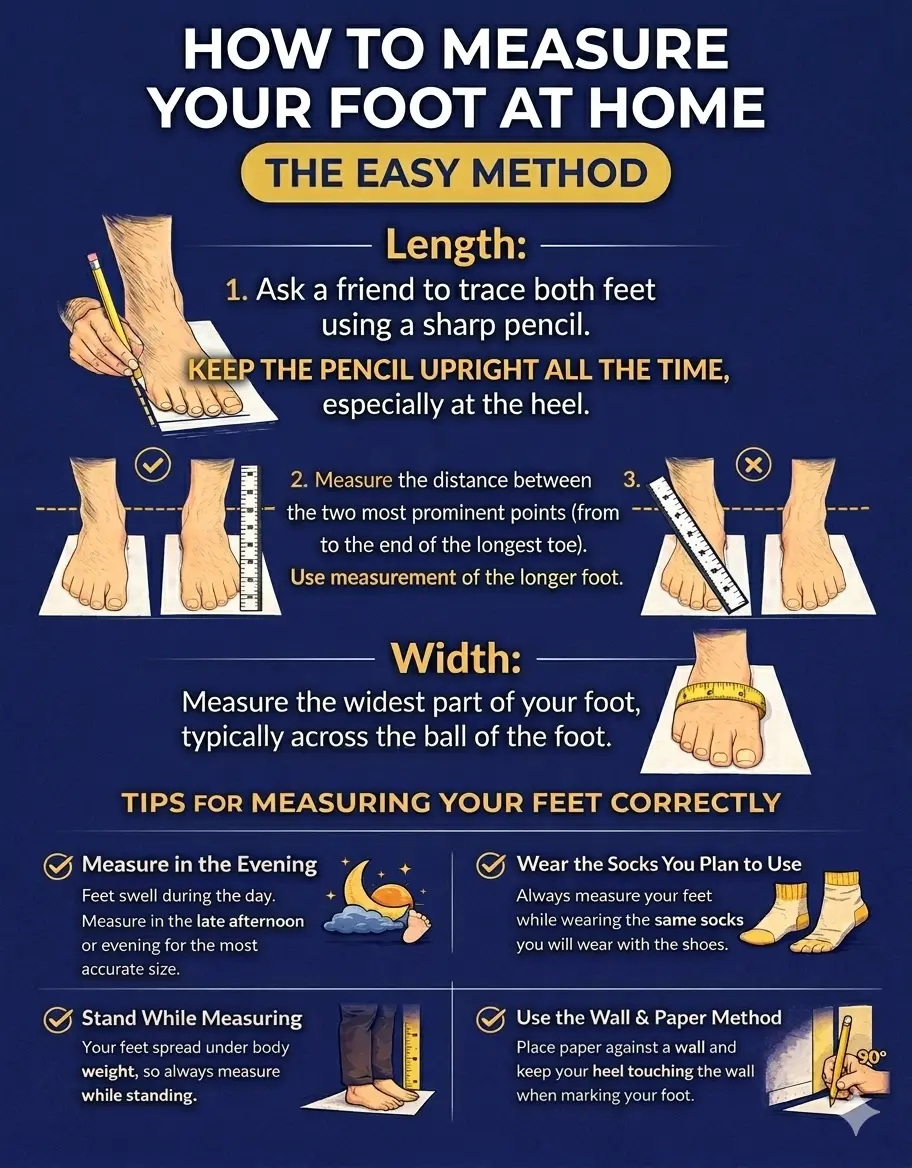
If a Brannock Device is not available, the wall method provides a reasonable approximation of heel-to-toe length.
Step 1: Gather the Right Tools
Before you start, make sure you have the following items:
- A sheet of paper larger than your foot
- A pencil or pen*
- A ruler or measuring tape
- A wall
- The socks you plan to wear with the shoes
Tip: Use a sharp pencil so your tracing is accurate.
Step 2: Choose the Right Time
Feet naturally swell during the day due to activity and gravity.
Always measure your feet in the late afternoon or evening.
Why this matters:
- Your feet are at their largest size later in the day
- Measuring in the morning often results in shoes that feel too tight later
Bonus tip: If buying running or athletic shoes, measure after a walk or workout.
Step 3: Prepare the Measuring Surface
The surface you stand on matters more than most people realize.
Do this:
- Use a hard floor (wood, tile, or concrete)
- Place the paper flat against a wall
Avoid:
- Carpet
- Rugs
- Soft mats
Soft surfaces allow your heel to sink and will shorten the measurement.
Step 4: Position Your Foot Correctly
Place one foot on the sheet of paper.
Important positioning details:
- Your heel should touch the wall
- Your weight should be evenly distributed
- Stand upright (do not sit)
Why this matters:
Your foot spreads under body weight, so measuring while sitting will give a smaller and inaccurate size.
Step 5: Trace Your Foot
Ask a friend to help if possible.
Instructions:
- Hold the pencil completely vertical (90°)
- Trace around your foot slowly
- Keep the pencil tight against the foot
Common mistake to avoid:
If the pencil tilts inward, it can reduce your size by up to half a shoe size.
Step 6: Measure Foot Length
Now measure the length of the traced outline.
Measure from:
- Back of the heel → tip of the longest toe
Important notes:
- The longest toe is not always the big toe
- For some people, the second toe is longer
Record the measurement in:
- centimeters (cm)
or - inches
Step 7: Measure Foot Width
Width is just as important as length.
To measure width:
- Find the widest part of the tracing
- This is usually across the ball of the foot
Measure from one side of the outline to the other.
This measurement determines whether you need:
- Standard width
- Wide (E / EE)
- Extra wide (EEE / EEEE)
Step 8: Measure Both Feet
Most people have one foot slightly larger than the other.
Always measure:
- Left foot*
- Right foot
Then:
- Use the measurement of the larger foot when selecting shoe size.
Step 9: Add Proper Toe Space
When trying shoes, ensure there is enough space in front.
Rule of thumb:
- Leave about a thumb’s width (½ inch / 1–1.3 cm) between your longest toe and the shoe tip.
This prevents:
- toe pressure
- blisters
- toenail damage
Quick Summary
For accurate sizing:
- Measure in the evening
- Stand while measuring
- Trace with a vertical pencil
- Measure length and width
- Measure both feet
- Buy shoes based on the larger foot
Arch Assessment
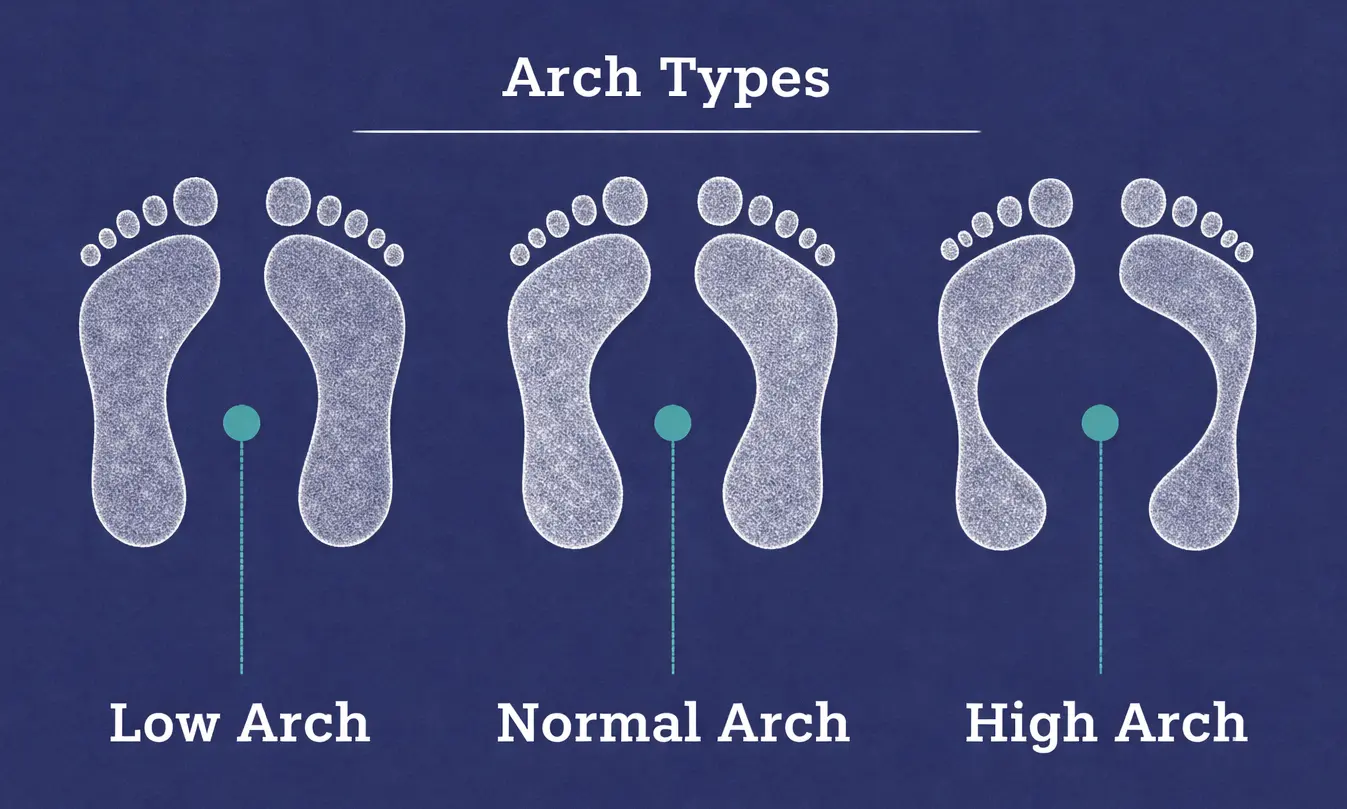
Arch type can be estimated using a simple wet test. Wet the sole of your foot and step onto a flat surface that shows the imprint.
A full footprint with little inward curve suggests a low arch, while a narrow band between heel and forefoot suggests a high arch.
This test does not replace clinical evaluation but provides a general structural reference.
Instep Measurement
Instep height can be approximated by measuring girth over the top of the foot at the midfoot. Pedorthic fitting standards recognize instep girth as a component of overall foot volume.
While most consumers do not measure instep girth numerically, awareness of lace pressure and tongue compression during fitting can serve as a practical indicator of vertical volume needs.
Sock Consideration
Sock thickness directly affects internal volume. A thicker sock increases effective foot volume and can change fit perception.
We highly recommend trying shoes with the same sock type intended for regular use.
Measuring barefoot and fitting with thick socks can produce inconsistent results.
Time of Day
Feet can swell throughout the day due to fluid accumulation and prolonged standing. The University of Florida Health notes that swelling can occur with daily activity and prolonged standing.
For this reason, many fitting guidelines recommend measuring or trying on shoes later in the day, when the foot is closer to its maximum functional size.
Standing vs Seated Measurement
All structural measurements relevant to sizing should be taken while standing. Weight bearing increases both length and width due to arch compression and forefoot splay.
The Brannock Device manufacturer explicitly instructs that measurement must be performed while standing.
Seated measurement does not reflect the dimensions of the foot during actual use.
Real-World Case Studies (From My Own Sizing Mistakes and Wins)
I can talk theory all day (arch height, instep, volume, toe shape), but what really made me understand foot shape was messing up sizes and then figuring out why.
Here’s how it plays out in real life for me across New Balance, Nike, and ASICS.
Case Study 1: Why I Go Half Size Down in NB 990 But TTS in NB 991
This one confuses people all the time.
- In most Made in USA 990s (990v3, v4, v5), I go half size down.
- In the 991? I go true to size.
Why?
The 990 line is:
- Slightly roomier in the forefoot
- More forgiving overall
- A bit more accommodating in volume
I have slightly wide feet, but not wide enough to need wide sizing. In the 990, if I go true to size, I get extra space in the toe box and a bit more length than I need.
Because the forefoot is already generous, going half a size down gives me a cleaner fit without crushing my toes.
Now the 991 is different.
The 991:
- Feels narrower
- Has a more structured midfoot
- Is less forgiving overall
If I tried going half size down in a 991, the forefoot would fight back immediately. Even at true to size, I can feel that snugness around the ball of my foot at first.
It softens over time, but it never feels as roomy as a 990.
Case Study 2: Why a Narrow Foot Can Size Down Safely
I’ve said this a lot in my guides, especially with models like:
- New Balance 1890
- Some Nike lifestyle models
- Even certain Asics runners
If you have a narrow foot and you like a snug fit, you can often get away with going half size down in shoes that run slightly long.
Take the Action Bronson x New Balance 1890 for example…
For me (slightly wide foot), true to size works because although it runs long, it’s also narrow. That narrowness balances the extra length.
But if someone has:
- Narrow forefoot
- Low volume foot
- Slim heel
That extra length isn’t being “used up” by width. So sizing down half a size can clean up the fit without creating pressure.
I’ve noticed this especially when I compare how some Nike models fit me versus friends with narrower feet. On certain Air Max pairs that feel perfect to me at true to size, they’ll size down and still feel locked in.
The key is this:
A narrow foot doesn’t fill out the volume of the shoe. So you can remove length without causing width problems. But if you have even slightly wide feet like I do, that move can backfire fast.
Case Study 3: Why Wide Forefoot People Struggle With Tapered Sneakers
This one hits home for me.
My forefoot is slightly wide. Not 2E wide, but wide enough that I notice taper. Tapered sneakers are my enemy if I don’t size correctly.
Examples:
- New Balance 991
- Certain Nike basketball models
- Some Asics performance runners
- Even the Action Bronson Cyborg Tears 1890 compared to the Hornet Tusk
What happens is this:
- The shoe might be long enough.
- It might even feel fine when you first try it on.
But when you walk, your foot spreads. And if the toe box tapers aggressively, the lateral side of your forefoot starts pushing against the wall of the shoe.
That’s where you feel:
- Pressure near the pinky toe
- Tightness at the ball of the foot
- That “this should fit but it doesn’t” feeling
This is why wide-forefoot wearers often think a shoe runs small when really, it runs narrow.
I’ve experienced this in:
- Structured 991 pairs
- Some Nike basketball shoes where performance fit = narrow
- Stiffer uppers like leather or fused materials
And here’s the trap:
Sizing up doesn’t always fix it. You just get more length, but the taper stays the same. That’s when you realize it’s not a sizing issue. It’s a shape mismatch.
Case Study 4: Why I Don’t Size Down in the 1890 Even Though It Runs Long
The Action Bronson 1890 runs slightly long and I get over a thumb’s space. Old me would’ve said, “Alright, half size down.” But because I understand my foot shape now, I didn’t.
Why?
- Slightly wide forefoot
- Medium instep
- I don’t like forefoot pressure
If I went half size down, the narrow forefoot would become the main problem. So I accept a little extra length in exchange for width comfort.
Foot shape forces you to choose what matters more:
- Length precision or width comfort.
Case Study 5: Nike vs Asics vs New Balance – Same Size, Different Reality
I wear the same numerical size across most Nike, Asics, and New Balance pairs.
But they don’t feel the same.
Nike:
- Often more performance-shaped
- Tapered forefoot in many models
- Feels more snug around midfoot
Asics:
- Performance runners can feel structured
- Some models are surprisingly narrow up front
New Balance:
- Generally more accommodating, especially 990 and 992
If someone copied my Nike size into a tapered basketball model without considering foot shape, they might think Nike runs small.
But really, their foot shape just doesn’t like the taper. That’s why brand comparisons without foot shape context are incomplete.
Common Myths About Foot Shape and Sizing
Misinformation around shoe sizing often leads to preventable fit problems.
Below are common claims that are frequently repeated but not supported when examined against footwear construction principles and foot health guidance.
Myth 1: Shoes Always Stretch
Not all shoes stretch, and those that do stretch have limits.
Natural leather can stretch to some degree because of its fibrous structure, particularly in areas of repeated flexion.
However, material science research shows that leather deformation depends on thickness, tanning process, backing materials, and structural reinforcements, whereas thick or lined leather will stretch less than thin, unlined leather.
Synthetic materials such as thermoplastic overlays, reinforced mesh, and engineered support panels are designed to resist deformation. These materials do not significantly stretch with wear.
Myth 2: Break In Fixes Everything
Break-in refers to the softening and minor adaptation of materials through wear. It does not change the fundamental dimensions of the shoe.
While leather may become more flexible over time, break-in does not significantly increase internal length. If the longest toe is pressing against the front of the shoe, additional wear will not create meaningful extra space.
If a shoe feels severely tight in the toe box or midfoot on first wear, break-in is unlikely to correct a structural mismatch.
Myth 3: All Brands Fit the Same
Shoe sizing systems use standardized scales such as UK, US, and EU measurements. However, the labeled size does not guarantee identical internal shape or volume.
Even when length measurements follow the same numerical scale, differences in last design, toe box geometry, heel cup shape, and internal depth can produce significantly different fit experiences.
Length and width measurements must be interpreted relative to each manufacturer’s last design.
There is no universal internal template across brands. A size 9 in one brand may have a different toe box taper or midfoot depth than a size 9 in another brand.
Myth 4: True to Size Means Universal
The phrase “true to size” is commonly used in marketing and reviews, but it lacks a standardized technical definition.
At most, “true to size” typically means that the shoe’s length aligns with the expected measurement scale for that labeled size. It does not account for width, instep height, arch structure, or toe shape.
Because foot structure varies significantly between individuals, a shoe described as true to size by one person may feel narrow, shallow, or long to another.
Without defining what aspect of sizing is being referenced, the term provides limited technical value. It does not guarantee compatibility with a specific foot shape.
These myths persist because they simplify a complex process.
In reality, shoe fit depends on measurable structure, material behavior, and last design. Replacing assumptions with structural evaluation leads to more consistent sizing decisions.
Frequently Asked Questions About Foot Shape and Sizing
1. Can foot shape change over time?
Yes. Foot structure can change due to aging, ligament laxity, pregnancy, injury, or progressive conditions affecting the arch.
2. Does weight affect shoe size?
Body weight influences load-bearing compression of the arch. Under increased load, the arch may flatten slightly, increasing foot length and width during standing.
This does not automatically change your labeled size, but it can affect how a shoe feels under prolonged standing.
3. Does running change your foot shape?
Running does not permanently change bone structure in most individuals, but it increases dynamic foot expansion during activity.
Ground reaction forces during running can reach two to three times body weight, which increases forefoot splay and toe pressure during movement.
4. Why do my toes hit the front even in the right size?
This can happen if the shoe’s internal length is shorter than expected, if the toe box tapers sharply, or if the foot elongates under load. Measuring while seated instead of standing can underestimate functional length.
Toe contact may also occur if the second toe is longer than the big toe and sizing was based only on the hallux.
5. Why do shoes feel tight only at night?
Feet commonly swell throughout the day due to fluid accumulation and prolonged standing. Swelling can increase as the day progresses. Even small increases in volume can make shoes feel tighter later in the day.
6. Should I always size up if a shoe feels tight?
Not necessarily. Tightness location matters. Forefoot compression may require a wider model, while midfoot pressure may relate to instep height. Increasing length to solve a width or volume issue can introduce instability. Professional fitting standards recommend identifying pressure location before altering size.
7. How much space should I have in front of my toes?
In running shoes, fitting guidance commonly recommends leaving space in front of the longest toe to account for dynamic expansion during activity. Because running increases load and forward motion inside the shoe, additional clearance helps reduce repetitive toe impact. Specialty running retailers often suggest leaving approximately a thumb’s width of space in front of the longest toe, although exact recommendations vary by brand and fitting philosophy.
For lifestyle sneakers, slightly less space is typically needed compared to running shoes because the movement demands are lower. There should still be clear toe clearance to prevent contact during normal walking.
In basketball shoes, enough space is needed to prevent toe impact during stops and direction changes, but excessive space can reduce stability. The goal is functional clearance without allowing the foot to slide forward.
For boots, especially structured leather or hiking models, proper toe space is important because stiff materials do not adapt quickly.
In hiking boots, extra space is particularly important to prevent toe impact during downhill movement.
8. Do wider shoes automatically mean more volume?
No. Width letters refer to ball width measurement, not overall depth or instep height. A shoe can be wide at the forefoot but shallow in vertical space. Instep girth and volume are separate structural factors.
9. Why does the same size feel different across brands?
Shoe sizes follow general measurement systems, but internal shape depends on last design. Toe box geometry, heel cup shape, and internal depth vary by manufacturer and model. Measurements must be interpreted relative to brand construction. There is no universal internal template across brands.
10. Can insoles change how a shoe fits?
Yes. Adding an insole increases internal volume occupation and can reduce available depth. This may increase pressure across the instep or reduce toe clearance. Orthotic devices alter internal space and must be factored into sizing decisions.
Final Thoughts – The Big Message
Shoe sizing is not just about picking the number you have always worn. It is about matching the structure of your foot to the structure of the shoe.
Length matters, but so do toe shape, arch height, instep volume, heel width, and how your foot behaves under load. A shoe can be the correct numerical size and still feel wrong if the last shape, internal depth, or material construction does not align with your anatomy.
Many fit problems are not sizing errors. They are shape mismatches.
Two people can both wear a size 9 and have completely different fit experiences because their foot structures are different. That is why copying someone else’s size, even if they wear the same brand or model, rarely guarantees the same result.
The more productive approach is to understand your own foot first. Measure it correctly. Pay attention to where pressure develops. Identify whether tightness is coming from length, width, instep height, or toe box shape.
When you stop treating shoe size as a fixed identity and start treating fit as a structural match, the process becomes clearer and more predictable.