
With nearly a century of experience crafting some of the finest men’s shoes in America, Allen Edmonds takes fit seriously, almost as seriously as craftsmanship itself.
Every pair is built with precision, from the cork-filled insoles to the Goodyear welt construction, but none of that matters if the fit isn’t right.
In this guide, I’ll walk you through how Allen Edmonds sizing really works, how each last fits, and how to measure your feet the right way (both in-store and at home).
I’ll also cover how socks can affect fit, what to expect when breaking them in, and how to choose the right size, whether you’re buying boots or dress shoes.
If you’ve ever been unsure whether to size up, down, or stay true to size, or wondered why one pair of Allen Edmonds fits like a glove while another feels off, this article will clear that up once and for all.
Time to jump into the details…

Allen Edmonds Sizing

Key Takeaways on Allen Edmonds Sizing
Allen Edmonds uses a wide range of lasts, each one shaped differently, so fit can vary noticeably between models.
Depending on the last, you might need to go up or down half a size for the best fit.
For example, some of their boot lasts, like the 511 or 1757, offer a bit more room in the toe box, while the 108 or 2016 lasts run slightly narrower and longer.
Allen Edmonds also offers a generous range of widths (from AAAA to EEE), which is one of the biggest advantages of buying from them.
Small differences in arch length or instep height can make a big difference in comfort, especially for Goodyear-welted shoes that take time to break in.
Now, let’s talk about the boots…
How do Allen Edmonds boots fit?
View this post on Instagram
Like most heritage boots, Allen Edmonds boots tend to fit a little large. If you’re a size 9 on the Brannock device, going for an 8.5 usually nails it.
Think of the “half size down” rule as a solid starting point, not a strict formula. Try one on if you can. It’ll tell you more than any chart ever could.
But of course, not all feet are the same. Some people like a snug fit for that locked-in feel, while others prefer a bit more room for thicker socks.
Certain foot shapes can also change what size feels right. If your big toe curls in toward the others, try going up half a size.
And if your second toe is longer than your big toe, a full size up usually feels better and gives your toes enough space to spread naturally.
If Size Chart Guru has been helpful with your sizing questions, consider adding it as a Preferred Source on Google.
Related: If you’re into brands that pay real attention to lasts and foot shape, you might also want to read my full Wootten sizing guide.
How do Allen Edmonds dress shoes fit?
View this post on Instagram
Now, when you move to their dress shoes, things change a little.
Most of their classic models fit true to size. So if you’re a 9D in your regular sneakers or dress shoes, that same size should work fine in most Allen Edmonds oxfords or derbies.
The Park Avenue, for example, is built on the 65 last, which runs slightly long and narrow, so some people go down half a size or choose a wider width for a better balance.
But overall, AE’s dress shoes don’t have that oversized feeling you get from their boots.
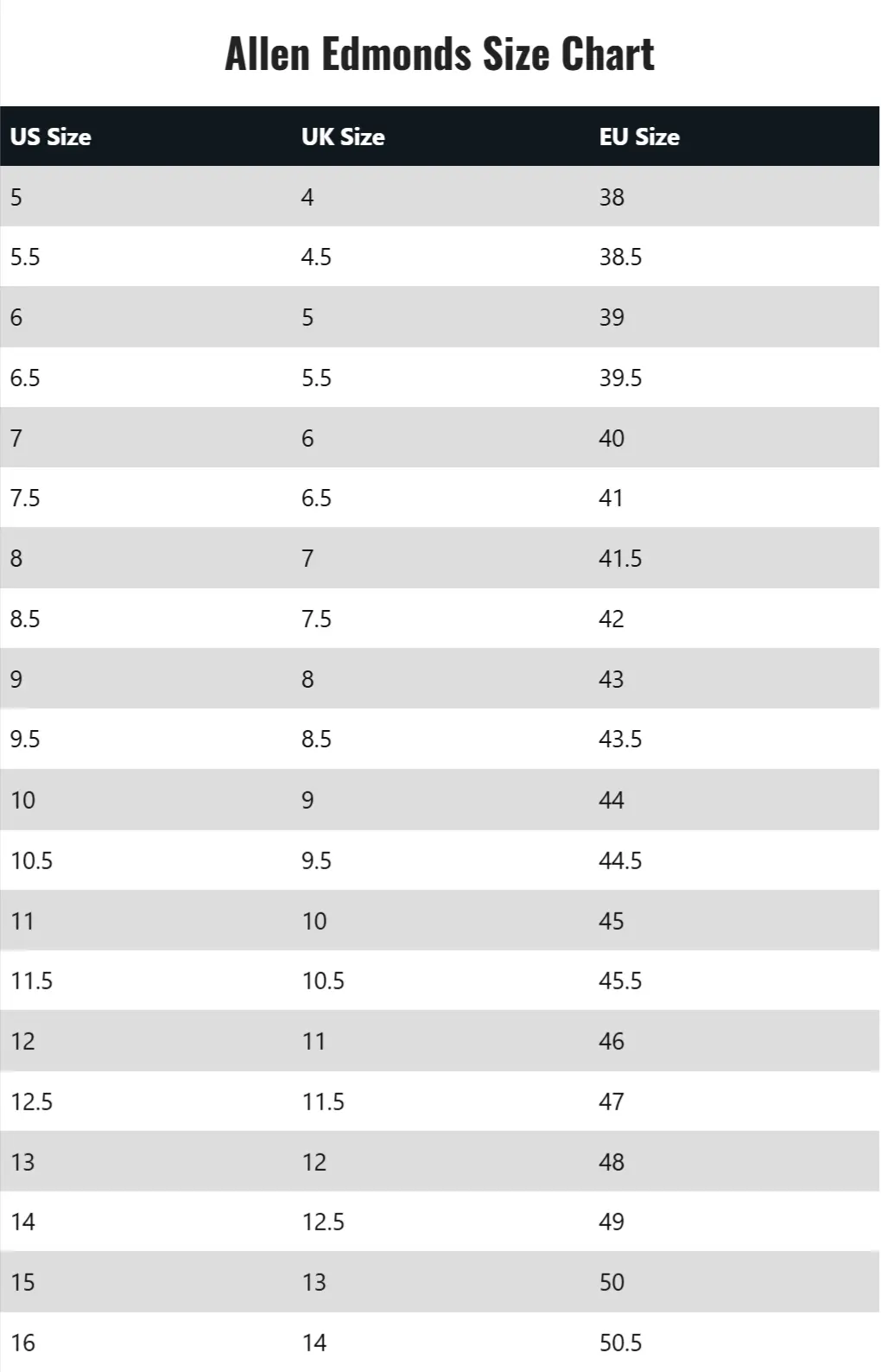
Allen Edmonds Size Chart
| US Size | UK Size | EU Size |
|---|---|---|
| 5 | 4 | 38 |
| 5.5 | 4.5 | 38.5 |
| 6 | 5 | 39 |
| 6.5 | 5.5 | 39.5 |
| 7 | 6 | 40 |
| 7.5 | 6.5 | 41 |
| 8 | 7 | 41.5 |
| 8.5 | 7.5 | 42 |
| 9 | 8 | 43 |
| 9.5 | 8.5 | 43.5 |
| 10 | 9 | 44 |
| 10.5 | 9.5 | 44.5 |
| 11 | 10 | 45 |
| 11.5 | 10.5 | 45.5 |
| 12 | 11 | 46 |
| 12.5 | 11.5 | 47 |
| 13 | 12 | 48 |
| 14 | 12.5 | 49 |
| 15 | 13 | 50 |
| 16 | 14 | 50.5 |
Allen Edmonds Size & Widths
| Widths | Available Sizes | Category |
|---|---|---|
| AAAA | 8.5-16 | Narrow |
| AAA | 10-12, 13, 14 | Narrow |
| AA | 10-12, 13, 14 | Narrow |
| A | 9-12, 13, 14 | Narrow |
| B | 8-12, 13, 14, 15 | Narrow |
| C | 8-12, 13, 14, 15 | Narrow |
| D | 6-13, 14, 15, 16 | Medium |
| E | 6-12, 13, 14 | Medium |
| EE | 6-12, 13 | Medium |
| EEE | 7-12, 13, 14 | Wide |
One of the best parts about Allen Edmonds is that you’re never boxed into one size or width.
They offer shoes from size 5 all the way up to 16 and in nine different widths, from the very narrow AAAA to the very wide EEE.
That’s something you just don’t see often outside of custom or bespoke shoemaking.
If you’ve ever been frustrated that your favorite style didn’t come in your width, you’ll appreciate how inclusive Allen Edmonds really is.
This wide sizing range also makes AE a sort of benchmark for fit. Once you figure out your perfect AE size and width, it becomes a reference point for almost any other brand you try later.
How to tell if your Allen Edmonds fit right
A good fit in Allen Edmonds feels natural. The ball of your foot should sit right at the widest part of the shoe, and your toes should have just enough space to move without hitting the front.
When you flex your foot, the leather should crease in a clean, even line across the shoe, not at an angle or in a weird spot. That crease tells you the shoe is flexing where it should.
And that’s part of what makes these shoes special.
Oh, and if you’re not sure what your size or width is, they have stores where you can get fitted properly.
But even if you’re ordering online, their 90-day return policy makes it easy to try, test, and exchange until you find your perfect match.
Why Socks Matter More Than You Think
It sounds obvious, but the kind of socks you wear can completely change how your shoes or boots feel.
If you’re buying a pair of Allen Edmonds boots, remember that most people size them slightly larger anyway, and there’s a good reason for that.
In the fall and winter, thicker socks help keep your feet warm and dry, so a half size up can make all the difference when you switch from lightweight summer socks to heavy merino or wool blends.
With dress shoes, it’s a bit different. You’ll usually wear thinner socks, and those take up much less space inside the shoe.
Going just a touch bigger gives you the option to wear both thin dress socks and thicker winter ones without feeling squeezed or losing comfort.
AE’s Classic Fit vs. Relaxed Fit
Comfort is one of those things that’s hard to define because it’s different for everyone.
Some people want their shoes to fit snug and secure, while others like a little extra breathing room. That’s why Allen Edmonds offers two main fit options: Classic Fit and Relaxed Fit.
Classic Fit
The Classic Fit gives you that traditional feel Allen Edmonds is known for. It hugs your foot just enough to keep things structured but still allows for natural movement.
If you like your shoes to feel precise and connected, this is probably the one for you. It’s the kind of fit that molds to your foot over time, so the longer you wear it, the better it feels.
Relaxed Fit
The Relaxed Fit takes a different approach. It’s built with a touch more room in the toe box and around the forefoot.
That little bit of extra space makes a big difference if you like wearing thicker socks, or if you simply don’t enjoy that snug, glove-like feel.
Some people also find the relaxed fit more forgiving if their feet swell slightly throughout the day.
Allen Edmonds Higgins Mill Sizing
I measure a 9D on the Brannock device, but in most of my heritage boots, like Red Wing, Thursday, Truman, Grant Stone, and Parkhurst, I usually wear an 8.5D.
So naturally, when I went for the Higgins Mill, I started there.
At first, I picked up an 8.5E because I’d read that the Higgins Mill ran a bit narrow.
The length turned out perfect, and while the width felt generous, I actually liked the bit of extra space around the ball of my foot and the toes.
My Thursday Captains in 8.5D fit fine, but they can feel a little snug in that area. That’s why I tend to prefer lasts like Grant Stone’s Leo or Parkhurst’s 602 because they’re narrow at the heel but open up at the forefoot and toes, which gives me that nice balance of support and room.
The Higgins Mill, built on Allen Edmonds’ 1757 last, has a slightly different feel. It’s snug all along the foot, from heel to toe, not uncomfortably tight, just a close, shapely fit.
It’s actually a lot like the Thursday Captain last: sleek, clean, and a bit more dressy than bulky. If you like your boots to look trim and follow the shape of your foot, you’ll probably enjoy it.
Personally, I like a touch more width through the ball, so the E width gave me breathing room, though I did add an orthotic insole to take up some of the extra volume. That snugged things up nicely, even if it dulled a bit of that “leather feel” underfoot.
So, if you’re a 9D on the Brannock, my advice is simple: go half a size down in the Higgins Mill, just like you would with most other heritage boots.
As for the break-in, there really isn’t one. The soft rubber sole and the flexible leather make it ready to wear straight out of the box. No heel bite, no pinching, no stiffness.
See my guide to reading shoe sizes with width letters.
Allen Edmonds Landon Sizing
Again, I measure a 9D on the Brannock, and for reference, UK and Australian sizes run about one full size down from US sizing.
For most of my American heritage boots, I usually go half a size down to an 8.5D, and that’s exactly what I did with the Landon. The fit turned out great.
The 2622 last that the Landon is built on feels quite different from other Allen Edmonds lasts. It’s a wide last overall, but the heel is snug enough to give you that secure, locked-in feel.
Then, as the boot opens up through the ball of the foot, there’s plenty of space where you actually need it.
My widest part doesn’t feel squeezed, and that makes a big difference when you’re on your feet all day.
The toe shape is rounded with a gentle slope. There’s no sharp tapering like you often see on European lasts.
That smooth roundness keeps your smaller toes from getting pushed inward, which is something I really appreciate.
The overall length at 8.5D feels right for me: there’s enough room at the toes without the boot feeling oversized or sloppy.
Compared to the Higgins Mill above, the Landon definitely has less internal volume, but that lower profile is part of what gives it such a sleek, refined silhouette.
2622 Last
Now, the interesting part about this last is how it changes the way the boot looks when laced up.
Because of how wide the 2622 is shaped, there’s a noticeable gap between the lace facings, almost two inches at the widest point when I pull them snug.
It’s not a fit issue; that’s just how the boot is designed. The quarters are cut wide, and the low-profile structure of the last exaggerates that open-lace look.
The Landon’s 2622 last is described as broad through the forefoot with a round toe and low profile, made to give a relaxed yet balanced fit.
Allen Edmonds Dalton Sizing
The Dalton is one of those boots that looks incredible but can be tricky to size right.
I measure a 9D on the Brannock, and in most of my American boots, I go down half a size to an 8.5D.
That’s what I tried first with the Dalton, but the fit felt a little off. The heel was perfect, snug, no lift, but the forefoot was tight, especially around the ball of my foot.
When I tried the same size in an E width (8.5E), it gave me the extra room I needed in the forefoot. The boot no longer squeezed, but the heel started feeling a bit loose.
I had to lace them up tighter than usual to keep my foot from slipping, and when I walked downhill or climbed stairs, I could feel that “flip-flop” heel movement.
At one point, my foot kept pressing into the top of the laces, which caused some discomfort across the top of my instep.
That experience sums up the Dalton pretty well. It’s built more like a dress shoe than a work or casual boot. The last it’s made on (the 511) runs a bit narrow through the forefoot and slightly roomy in the heel.
So, while it gives you that sharp, tailored look, it doesn’t have the same kind of forgiving shape you’d find in something like the Red Wing Iron Ranger.
The Iron Ranger, for example, has a tighter heel grip but a noticeably wider toe box, so your toes have more breathing room even when the rest of the boot feels secure.
The 511 last also has low internal volume, which means the upper sits closer to your foot. If you have wider feet or a higher instep, you’ll probably feel it right away, even with thin socks.
Compared to other brands, a Grant Stone Diesel in the same size (8.5D) feels a touch longer and definitely roomier across the forefoot.
If you’re in between widths or your feet lean toward the wider side, I’d recommend trying a half size wider in the Dalton.
Allen Edmonds makes width options from AAAA (4A) all the way to EEE (3E), so there’s some flexibility to find the right balance.
For me, the 8.5E works best. It’s still snug across the forefoot, but it breaks in comfortably without that sharp toe crimping.
Allen Edmonds Last Guide
View this post on Instagram
One thing that makes Allen Edmonds stand out is that they design all their lasts in-house. They don’t buy them from outside last makers.
Every shape is built around their own fit philosophy, which explains why their boots and shoes often feel distinct from other American heritage brands.
42N
This one is based on the 42 last but tweaked to make space for Allen Edmonds’ removable LightForm footbed. The fit is relaxed, with about 3mm of extra depth built in.
1757
This last has a rounder, fuller forefoot that gives the boot a more casual and modern look. The toe shape is smooth and rounded, which works perfectly for boots and dress-casual shoes.
It fits comfortably and feels roomy without being sloppy, striking a nice balance between refined and relaxed.
64
Think of the 64 as a slightly roomier version of their classic 65. It keeps the same sleek shape but adds a touch more space around the ball and forefoot. It’s also a bit longer, giving it a refined but easygoing fit.
2321
This one is close to the 1757 but a little narrower at the toe. It’s designed for dress-casual shoes.
65
The 65 (often just called the 5) is Allen Edmonds’ signature last. It’s long, narrow, and elegant, which is a great match for people with higher arches. It’s the foundation of many of their most iconic models, including the Park Avenue.
1943
A dress shoe last with a modern edge. The toe is softly squared, and the front of the shoe is sculpted for a longer, more refined look.
79
This one sits lower across the top of the foot thanks to its shorter vamp. It’s ideal for low-cut designs where you want a close, tailored fit.
943B
This shares the same shape and proportions as the 1943 but with a slightly raised cone to fit taller boots.
97
Also called the 7 last, this one fits the “average” foot really well. It has a soft, slightly pointed toe and a flatter front profile, which gives it that timeless American look.
2042
Designed for loafers and slip-ons, the 2042 has a sleek silhouette with a soft, rounded toe. It hugs the foot with a fuller forepart and a tapered heel for a secure, comfortable fit.
201
Built with a higher cone for more instep room, the 201 feels a bit more generous up top. The toe is slightly chiseled, giving it a sharp, modern profile while still keeping the forefoot nice and full.
2072
This is one of the flatter lasts in the lineup. It has a very low instep and a more relaxed fit through the ball and forefoot, which is ideal for people who like a bit more breathing room across the front.
511
Known as the 1 last, it’s similar to the 97 through the heel and ball but has a rounder, fuller toe. It’s often used for boots since that extra space up front adds comfort for long wear.
2622
This one’s built broad through the forefoot with a soft, rounded toe and a lower profile. It gives a relaxed, slightly elongated look that works well for both casual and smart-casual styles.
108
Referred to as the 8 last, it’s longer and narrower with a flatter, more tapered toe, which is perfect for sleek dress shoes.
2623
This last is designed for flexibility. It has room for a removable insole or custom orthotics, and the toe is softly tapered with a hint of a chisel.
511G
Similar in concept to the 511 but with extra depth to fit orthotics or thicker socks. The toe is rounded and forgiving, making it great for everyday wear.
APL
Built as a true boot last, the APL has more room in the forefoot and a higher toe box. It’s comfortable, supportive, and shaped to handle thicker socks and longer days on your feet.
2016
Originally made for the Randolph bit loafer, the 2016 last is sleek and elegant. It has an almond-shaped toe and long, narrow proportions that look refined and modern. Best for medium to low arches.
View this post on Instagram
2020
This one has a subtle shelf at the toe and a streamlined profile that fits close but still feels relaxed.
How to Measure Your Feet for Allen Edmonds
You may think you know your shoe size, but there’s a lot more to finding the right fit than just checking the number printed inside your sneakers or checking the Allen Edmonds size chart.
Foot shape, arch length, width, and even the time of day can all change how a shoe feels on your foot.
Why It’s Worth Getting Fitted Professionally
If you can, visit an Allen Edmonds store and get measured by one of their master fitters.
These guys have fitted thousands of people over the years. They look at how your foot behaves in motion, how fleshy or bony it is, and how it expands throughout the day.
They’ll measure:
- Heel-to-toe length (your overall size)
- Arch length (heel to the ball of your foot)
- Width (from side to side)
The Allen Edmonds Fitting Process
They’ll start by having you stand on a Brannock device.
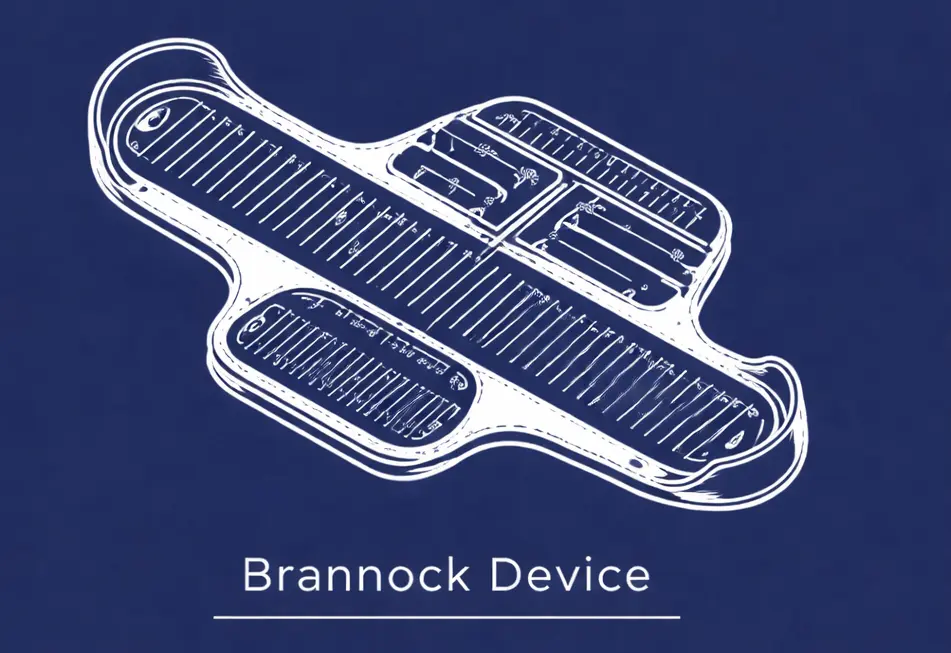
Standing up helps your foot spread naturally so the fitter gets your true length and width. But that’s only step one.
They’ll also measure your arch length (that’s the distance from your heel to the ball of your foot) and compare it to your overall length to find your true size.
Each foot gets measured separately, because most people have one foot that’s slightly larger than the other. It sounds small, but that tiny difference can affect comfort, especially in structured leather shoes.
Checking the Fit
Once the numbers are in, the real fitting starts. The fitter will slide your foot into a test shoe and look for how it lines up with the shape of the last.
The ball of your foot should sit right in the widest part of the shoe where the shoe flexes. Your toes need a bit of breathing room, and your little toe shouldn’t be pushing against the side.
They’ll watch how the leather creases when you bend your foot. A clean, straight crease across the ball area means the fit is right.
They’ll also check the upper edge of the shoe around your ankle to make sure there’s no pinching or tension.
Heel fit is key. It should feel snug enough to prevent slipping but not so tight that it pushes your toes forward.
And across the instep, you want gentle contact, not pressure.
Why Allen Edmonds Can Fit So Many Foot Types
Part of what makes Allen Edmonds unique is their use of different lasts. A “last” is the mold the shoe is built on, and each one has its own personality.

Some lasts are short and round, while others are long and sleek. Some have extra room in the instep or heel and each one fits a certain type of foot better.
Finding the last that fits the contours of your foot shape makes all the difference between a decent fit and a perfect one.
Measuring at Home
If you can’t make it to a store, you can still get a close estimate at home. There are two easy ways: using a Brannock device (if you own one or can borrow one) or using the classic pen-and-paper method.
1. Using a Brannock Device at Home:
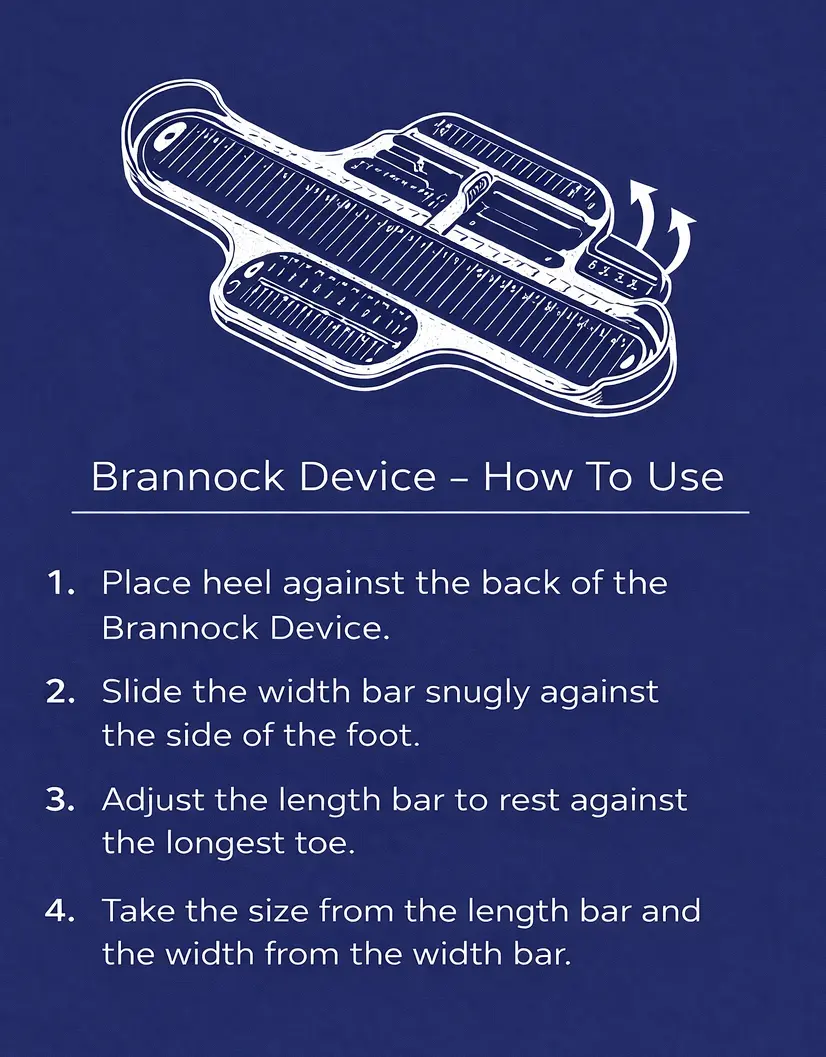
- Place the device on a flat surface.
- Stand on it with your full weight evenly distributed.
- Adjust the heel cup so your heel fits snugly.
- Slide the pointer to your longest toe to find your length.
- Then, slide the width bar until it gently touches the side of your foot.
- Repeat the process for your other foot.
- Always measure both feet, and use the larger measurements when choosing your size.
2. Using the Pen and Paper Method:

- Place a blank sheet of paper on the floor against a wall.
- Stand with your heel lightly touching the wall and your full weight on your foot.
- Trace around your foot with a pen held straight up and down (not angled).
- Measure the length from the heel to your longest toe, and the width at the widest point.
- Do the same with your other foot.
- Compare your measurements to Allen Edmonds’ size chart and width chart below to find your closest match.

Fit Tips You Should Know
- Measure at the end of the day.
Your feet swell slightly throughout the day, so this gives a more realistic reading.
- Always wear the socks you plan to wear with the shoes.
Thicker socks can add half a size or more.
- Fit the larger foot.
Never size down for the smaller one.
- Don’t rely only on length.
Arch length and width are just as important for proper support.
- Pay attention to break-in.
Leather shoes, especially structured ones like Allen Edmonds, can feel snug at first but should not cause pain or pinching.
The Story of Allen Edmonds
Allen Edmonds sits in that mid-to-high-end range of American footwear, not luxury, but far above the mass-produced crowd.
The company started in 1922 in Belgium, Wisconsin, founded by Elbert W. Allen and Ralph Spiegel under the name Allen-Spiegel Shoe Company.
When Spiegel eventually left the business, Allen continued running it until his passing. In 1946, William “Bill” Edmonds joined the company alongside Allen’s sons, and that’s when the name Allen Edmonds Shoe Corporation was born.
Early Innovation
From the beginning, Allen Edmonds shoes stood out for comfort. At a time when most shoes used metal nails, steel shanks, and thick, rigid leather midsoles, Allen’s approach was different.
He used cork-filled insoles that flexed with the foot, creating shoes that felt far more natural to walk in. It doesn’t sound revolutionary today, but back then, it was a big deal, especially for men wearing their shoes all day, every day.
World War II and a Growing Legacy
When World War II hit, Allen Edmonds supplied shoes to both the U.S. Army and Navy. Many servicemen wore them during the war and kept buying them after coming home.
That loyalty helped build the brand’s reputation, and soon, their Oxford dress shoes, like the Park Avenue and Strand, became synonymous with American craftsmanship and timeless style.
Changing Hands
Fast-forward to the 2000s, and the company’s ownership started to shift. In 2006, investment firm Goldner Hawn Johnson & Morrison (not “Golden Horn”) bought a majority stake.
Then in 2013, private equity group Brentwood Associates took over. Just three years later, in 2016, Allen Edmonds was sold to Caleres, Inc. (formerly Brown Shoe Company) for around $255 million.
Caleres owns several other footwear names you’ve probably seen on shelves, like Dr. Scholl’s, Famous Footwear, Vince, Blowfish Malibu, and LifeStride among them.
Where They’re Made Today
While the brand still proudly uses the tagline “Handcrafted in Port Washington, Wisconsin,” not every pair is entirely U.S.-made anymore.
The handsewn collection, for example, is crafted in company-owned factories in the Dominican Republic, then finished in Wisconsin.
Some of their newer lines are also made in Italy, though their classic Goodyear-welted shoes still roll out of their Port Washington factory.
So yes, Allen Edmonds is still an American shoemaker at its core, even if a few stitches now happen outside U.S. borders.
Final Thoughts
I’ve learned that with Allen Edmonds, patience pays off. The first time you put them on, they might feel a bit stiff or snug, but give them a few wears, and the leather starts to shape around your feet like it’s taking notes.
Suddenly, that stiffness disappears, and you realize what a proper fit actually feels like.
The truth is, you can’t really talk about Allen Edmonds sizing without talking about their philosophy. It’s all about longevity and comfort that develops over time.
So if you’re in between sizes or trying to pick your first pair, try different lasts, different widths, maybe even different socks, depending on the season.
And who knows? Your first pair might just be the start of a long and slightly addictive collection.