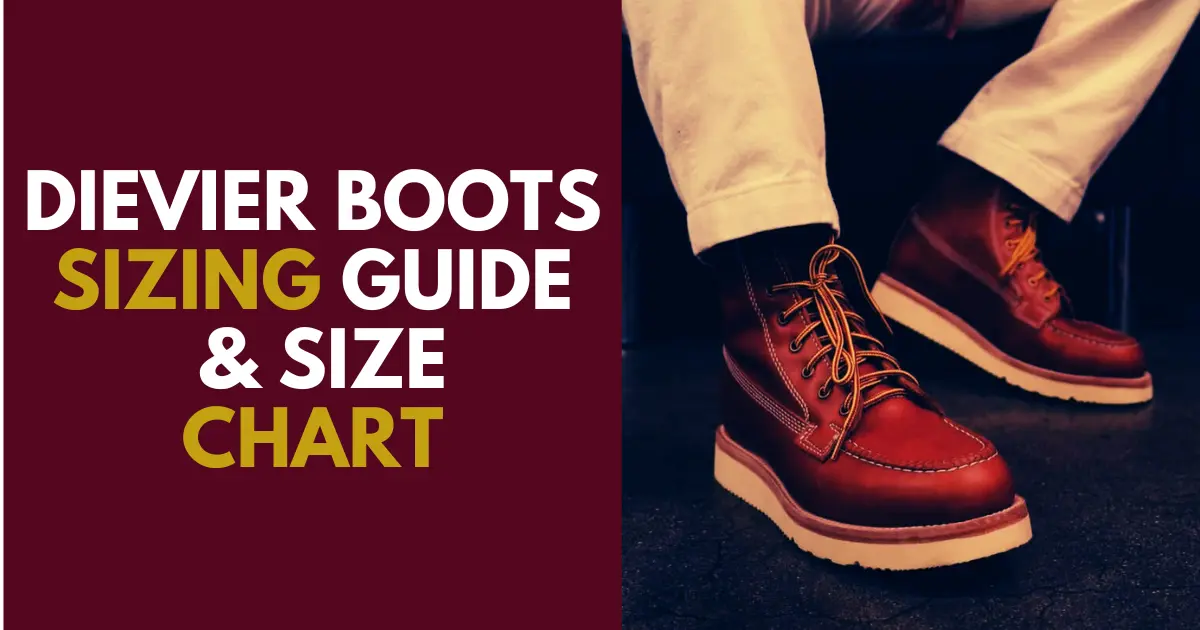
As always, when you try a new boot brand, the first question is always about sizing.
Dievier is one of those brands that quietly does things right. Their boots feel comfortable out of the box, the leather is soft and forgiving, and the lasts actually fit real feet instead of just looking good on a shelf.
In this guide, I’ll walk you through everything you need to know about Dievier boots sizing.
We’ll
- Cover how the boots fit in general
- Break down specific models like the Nomad and Prospect
- Compare them to other heritage brands
- Have a look at the size chart
… and I’ll show you exactly how to measure your feet to pick the perfect size.
I’ll also share:
- My own experience trying different sizes
- What works if you have wider feet or a higher instep
- When it makes sense to go true to size versus dropping a half size.
Sounds interesting?
Let’s jump in.
Dievier Boots Sizing
Generally speaking, Dievier boots run true to size for most people, but the last and leather make them pretty forgiving.
If you have regular-width feet or you like your boots a little roomy, especially for work, or if you’re planning to wear thick socks, sticking to your true size works really well. Your foot has space to move without feeling loose, and the soft leather adapts over time.
Now, if your feet are wider or you have a high-volume instep and want a snug fit, dropping a half size is usually the sweet spot.
I do this myself. Take the Nomad or the Prospect, I go a half size down from my Brannock 9, and the boots hug my feet perfectly. They’re snug, but the soft leather molds to my foot, so I never feel pinched.
It all comes down to how you like your boots to feel and what you plan to wear them with. Personally, I like that little extra hug on my foot. It keeps me secure without ever feeling tight.
So when in doubt, check your foot volume and sock plans.
Related: If sizing advice is your thing, don’t miss my Crown Northampton fit guide.
Dievier Boots Size Chart
Normally, when you convert UK to US sizing, the general rule is to go one full size up. For example, a UK 8 usually equals a US 9. That’s the case with most heritage and work boot brands made in England or influenced by English sizing systems.
However, Dievier’s size chart doesn’t follow that standard pattern. According to their chart, the difference between UK and US sizes is only half a size, not a full one.
That means a UK 8 in Dievier is listed as a US 8.5, not a US 9.
It might sound like a small difference, but it can actually change how the boots fit. If you usually size down a full number when converting between regions, you could end up with a tighter fit than you expect.
So it’s really important to follow Dievier’s chart specifically rather than assuming the typical UK-to-US conversion applies here.
| Dievier Size | US | UK | EU | JP (cm) |
|---|---|---|---|---|
| 6 | 6 | 5.5 | 38 | 24 |
| 6.5 | 6.5 | 6 | 38.5 | 24.5 |
| 7 | 7 | 6.5 | 39 | 25 |
| 7.5 | 7.5 | 7 | 40 | 25.5 |
| 8 | 8 | 7.5 | 41 | 26 |
| 8.5 | 8.5 | 8 | 42 | 26.5 |
| 9 | 9 | 8.5 | 43 | 27 |
| 9.5 | 9.5 | 9 | 43.5 | 27.5 |
| 10 | 10 | 9.5 | 44 | 28 |
| 10.5 | 10.5 | 10 | 44.5 | 28.5 |
| 11 | 11 | 10.5 | 45 | 29 |
| 11.5 | 11.5 | 11 | 45.5 | 29.5 |
| 12 | 12 | 11.5 | 46 | 30 |
| 12.5 | 12.5 | 12 | 46.5 | 30.5 |
| 13 | 13 | 12.5 | 47 | 31 |
With the general sizing and chart out of the way, let’s see how the Nomad and Prospect feel when you actually put them on.
Related: If you want to see another heritage boot fit, check out my Caswell sizing guide.
Dievier Nomad Sizing
View this post on Instagram
Dievier says their Nomad boots run true to size, and technically, that’s not wrong. But I decided to go a half size down and here’s why…
My Brannock size is a US 9, and while the 9 fits fine with thick socks, I actually prefer the 8.5. The smaller size feels more balanced on my foot. It’s comfortably snug and has just the right amount of space where I need it.
The Nomad is pretty roomy, especially around the toe. It’s nicely rounded up front, so your toes don’t feel cramped.
That’s one reason I like going a half size down.
When I wear thin socks or even no socks, the 8.5 feels perfect. The size 9 gives me a bit more space, which is nice for winter when I pull out the heavy socks.
So think about how you’ll wear them. If it’s mostly warm weather or casual use, half a size down makes sense. If it’s cold weather and thick socks, true to size is the safer bet.
Construction is important too…
The leather also changes the game. Dievier uses soft, forgiving leather that almost feels like a slipper. It molds to your foot fast and bends naturally with each step.
That’s why I think you can size down a little without worrying about discomfort. The leather stretches and adapts to you.
If it were a stiff, high-temper leather like some heritage boots, I’d probably say stick to your Brannock size. But since this one feels more velvety and flexible, a closer fit just works better.
Their newer last fits me better, too. It has more room in the front, which I like since my feet lean a bit wide.
Plus, if the toe box is too big, your toes end up working harder than they should. They keep trying to grip the inside of the boot with every step, and after a while, that constant effort makes them feel tired and sore.
Still, keep in mind that Dievier’s made in Mexico, and that usually means the fit is slightly narrower than what you’d find with American boots.
If you’ve worn Alden Indy boots before, those actually feel about half to a full size larger than the Nomad in the same size. For reference, I wear 8.5 in Thursday and Red Wing, and 8.5 in Dievier fits me the same way.
Here’s the simple version:
- If you like your boots snug and precise, go half a size down.
- If you want a little more room or you’ll wear thick socks, stay true to size.
So, ask yourself how you’ll wear them and what kind of fit you like. Personally, I’d go with the smaller size. Once the leather molds to your feet, it’s going to feel just right.
What about you? Would you size down or stay true to size?
Now, if you’ve worn other heritage boots before, here’s how the Dievier Nomad stacks up…
How the Dievier Nomad Fits Compared to Alden, Grant Stone, and Thursday
View this post on Instagram
Compared to the Alden Tanker on the Barrie last, the Alden feels a bit longer overall but has less room in the toe box.
The Dievier, on the other hand, gives your toes more space to spread out. The Alden’s toe profile is lower and sleeker, which makes it look more like a dress boot.
That’s why the 8.5 Barrie works for me. It’s snug across the top but not cramped. In the Nomad, that same 8.5 gives me a little extra breathing room, which feels nice for casual wear.
The Grant Stone Diesel on the Leo last fits a bit differently too. The Leo toe looks about half a size longer, but the Dievier has more space across the instep and vamp.
I first tried the Nomad in my true size, and while the fit was fine, it felt a bit too relaxed. Dropping half a size gave me a much better feel.
I’d say Grant Stone’s sizing is close to Alden’s Barrie and Truebalance lasts, so if you know your fit in those, you’ll be in familiar territory.
The Grant Stone toe is a touch wider, though, and its leather is much firmer. That’s the key difference. Dievier’s uppers are softer and stretch faster, while brands like Grant Stone, Alden, and Viberg use stiffer hides that take longer to adapt to your foot.
It’s more secure, not tight. It’s also worth noting that Viberg’s 2040 last feels roomier overall, which is why I go a full size down in that one.
And if you’re wondering about Thursday, I’d say take your regular Thursday size. For me, the 8.5 in Dievier fits a bit more snug than my Thursday Rogue boots, but in a good way.
So, here’s my quick take. If you know your fit in Alden, Grant Stone, or Thursday, you’ll find Dievier sizing easy to figure out.
Just remember, the Nomad’s soft leather gives more than most, so that half-size down often ends up being the sweet spot.
Related: For practical sizing guidance across brands, my Bordon boots fit guide is helpful.
Dievier Generation 2 Nomad Sizing
View this post on Instagram
Dievier says the Generation 2 Nomad fits true to size, but “true to size” depends on who you ask.
I’m a Brannock 9, and after testing both 9 and 8.5, I keep coming back to the half-size down. The 8.5 just feels right. It hugs my foot without squeezing it, and the overall balance is spot on.
If you’ve worn Thursday Boots before, you’ll feel right at home here. Dievier’s sizing runs very similar to Thursday and even lines up well with Red Wing.
So, if you usually go a half down from your Brannock in those brands, you can confidently do the same with Dievier. It’s that easy.
Now, here’s something I really like about this new version. The Generation 2 has a slightly higher vamp wall, and that small tweak changes everything.
I’ve got a bit of a sensitive, raised instep, and the extra height gives me the space I need without that annoying top pressure some boots cause. It’s like they finally listened to people with real feet.
Related: If you like what Dievier is doing with their handmade approach, you might also want to look at John Lofgren boots. I wrote a full John Lofgren sizing guide where I share how their Engineers, Combat Boots, and sneakers fit.
Dievier Prospect Sizing
Again, Dievier says go true to size, but for me, the half down works better. I’m a Brannock 9, and the 8.5 in the Prospect fits perfectly.
It feels snug in a good way through the heel and instep, with just enough room for my toes. I usually wear them with medium or thin socks, and I wouldn’t change a thing.
If you’ve worn Parkhurst Allen boots before, you’ll find the length quite similar, even though the lasts are completely different.
The Prospect feels a bit more tapered at the toe, while the Parkhurst has a softer, more open shape. Still, I wouldn’t size differently between the two.
The Truman 79 last is another good comparison. In terms of length, it’s almost identical to the Dievier Prospect. The Truman feels a little wider and rounder up front, though.
The Prospect, being made in Mexico, follows a slightly narrower pattern that reminds me of many Spanish-made boots. My toes feel a touch snug in the Prospect, but not uncomfortably so.
Against the Wolverine 1000 Mile, the sizing lines up almost perfectly. The only real difference is in the toe shape.
The Wolverine has a bit more height and bump at the front, but the instep feels nearly the same. If you know your Wolverine size, stick with it in Dievier.
Now, things get a little more interesting when you compare Dievier to Grant Stone. On the Leo last, the Grant Stone Ottawa looks about half a size longer.
The Ottawa fits me a bit more generously overall, though my foot still seats nicely in an 8.5.
I’ve even tried dropping to an 8E for a more locked-in feel, which reduced the toe room but kept the same volume. So, if your Grant Stone fit is already snug, you might want to go up a half size in Dievier.
That same logic applies to Alden. The Truebalance last tends to run roomier, so if your Truebalance size is perfect, you’ll likely need a half size up in Dievier to match that feel.
The Alden Barrie last also runs longer, roughly a half size compared to the Prospect.
So, to sum it up, if you’ve got regular to skinny feet, I’d say go true to say. If you’ve got wider feet and/or a high instep or you’re planning on wearing thinner, I’d recommend going a half size down from Brannock.
If you already know your Thursday or Red Wing size, take that. If you’re used to Alden or Grant Stone, you may need to tweak slightly depending on how snug you like your fit.
View this post on Instagram
How to Measure Your Feet for Dievier Boots
You’d be surprised how many people just skip measuring their feet. DOn’t be one of them! With Dievier, that can mean the difference between a perfect fit and a boot that feels just a little off.
Get Professionally Measured (If You Can)

If there’s one thing I always tell people, it’s this: get your feet measured at a proper shoe store. Those Brannock devices exist for a reason.

The Brannock device measures the length, width, and arch length. All three matter, especially if you’re torn between two sizes.
Professionals can spot things you won’t notice yourself, like if your instep is a bit high or one foot runs slightly longer. That’s the kind of detail that makes all the difference when you’re buying boots made to last.
Measuring with a Brannock Device
If you already have access to a Brannock, here’s how to use it:

- Stand up straight with your full weight evenly on both feet.
- Slide your heel back until it touches the heel cup.
- Look at the line that runs just past your longest toe (that’s your foot length).
- Check the width by seeing where the outside edge lines up with the scale.
- Repeat on the other foot. (Most people have one foot slightly larger, so base your size on the bigger one.)
For example, my Brannock size is 9D. That’s my “true” size, and it’s the one I use as a reference for every boot brand, including Dievier.
The Pen and Paper Method (At Home)
You can still get a solid measurement at home with just a piece of paper, a pen, and a ruler.
Here’s what to do:

- Place the paper flat on the floor against a wall.
- Stand on it with your heel gently touching the wall.
- Mark where your longest toe ends.
- Measure the distance from the wall to that mark (that’s your foot length).
- Do both feet and use the longer one for your size.
- Compare your number with the Dievier boots size chart below.

If your measurement falls between two sizes, think about how you like your boots to fit. If you want a snug fit that breaks in over time, go with the smaller one. If you want more room for thicker socks or long days, stick with the larger.
A Few Fitting Tips
- Try boots on in the afternoon.
Feet swell a little during the day, and this helps you avoid buying something that feels great at 9 a.m. but tight by 5 p.m.
- Wear the socks you plan to use. It changes how the boot feels more than you’d think.
- Don’t ignore width.
Dievier’s lasts are slightly narrower than American brands, so if you’ve got wider feet, that’s something to keep in mind.
- Remember, leather stretches.
Their soft uppers mold to your foot, so what feels snug at first often turns into the perfect fit after a few wears.
- Take the time to measure properly.
Once you get your exact numbers, you’ll never second-guess your size again. And trust me, that small effort pays off every single time you lace up a new pair.
Dievier: Brand Overview
View this post on Instagram
From San Diego to León
Dievier was started by a small group of people based around San Diego, California. They design everything there, but the boots themselves are made in León, Mexico.
If you’ve spent any time reading about boots, you’ve probably heard of León. It’s one of the biggest footwear hubs in the world.
The city produces shoes and boots for global giants like Nike and Timberland, and it’s also home to American brands like Thursday and even some lines of Drew’s Boots.
The Craft Behind the Boots
Quality in León can range from okay to genuinely impressive, depending on the factory and materials used.
Some of my favorite boots, like the Thursday Captain, come from there. The Dievier Nomad Heritage sits right in that same class with solid construction, great finishing, and thoughtful design choices.
They source their materials locally, from the uppers to the soles, and they seem to care about keeping the process environmentally friendly while supporting local craftsmen.
A Brand That Lets the Product Speak
What’s interesting about Dievier is that they don’t spend much time talking about themselves. Their website barely mentions their story or their founders.
Instead, it’s all about the boots. And honestly, I find that refreshing. These days, when every brand tries to build a myth around their name, it’s nice to see one just focus on making something good.
Built for Comfort and Structure
One detail that stands out in the Nomad is how the roomy last allows them to add a removable foam insole topped with leather.
That gives you comfort without sacrificing the boot feel. The leather lining itself adds thickness and brings the total upper to over 3mm, giving the boot a bit more structure and stability.
It’s a small touch, but it adds up to a boot that feels both sturdy and forgiving.
Final Thoughts
I’ve got to say, Dievier surprised me in the best way. You can tell these boots were made by people who actually wear boots, not just design them.
The leather feels soft from day one, the lasts make sense for real feet, and the fit options let you fine-tune things without overthinking.
If you’ve been jumping between brands trying to find that sweet spot between comfort and structure, Dievier lands right in that zone.
For most people wondering about how Dievier boots sizing works, stick to your true size and you will be perfectly fine.
But if you like a snugger feel or plan to wear thin socks, that half size down makes all the difference. Once the leather settles in, you’ll know exactly what I mean.
So, if you’ve been curious about trying something new but don’t want to gamble with sizing, I’d say start here. Get your measurements right, pick the fit that matches how you wear your boots, and let the leather do the rest.