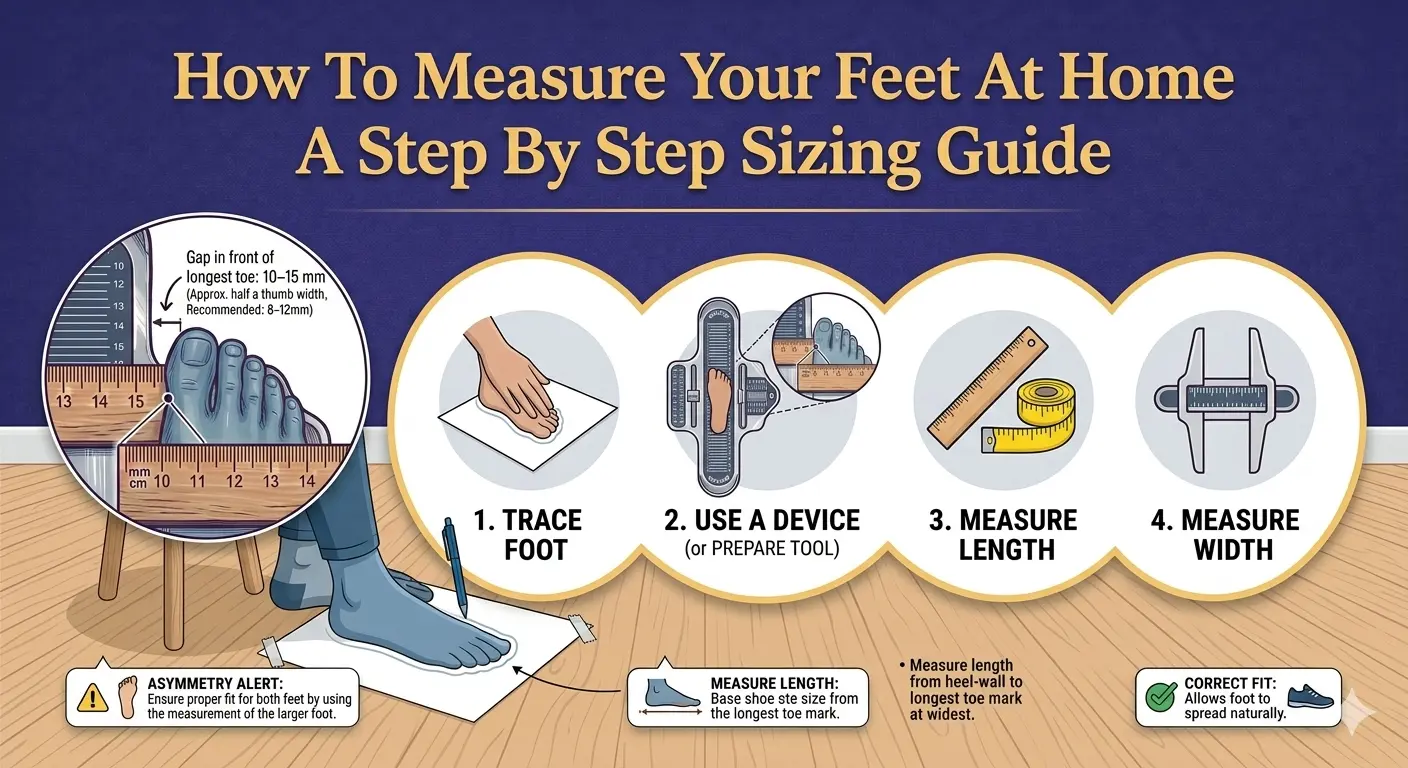
You might assume you already know your shoe size. But in reality, you might be wearing shoes that don’t fit properly.
This often happens because your foot size can change over time, and sizing can vary between brands and different types of shoes.
Measuring your feet correctly is one of the simplest ways to find shoes that feel comfortable and supportive.
The shape and structure of your feet, including their length, width, and arch, all play an important role in how a shoe fits.
Even small differences in size can lead to common problems such as toe pain, heel slip, or blisters.
Taking accurate measurements helps you avoid these issues. It allows you to choose footwear that matches the true size and shape of your feet, rather than relying only on the number printed inside the shoe.
In this guide, you’ll learn how to measure your feet at home like a pro, how to measure both the length and width of your feet at home, and how to account for foot shape so you can choose the right shoe size with confidence.
How to Measure Your Feet at Home
Many people rely on the shoe size they have worn for years. But shoe sizes are not always consistent across brands or even between different models from the same brand.
This means a size that fits well in one pair of shoes may feel tight or loose in another. Your feet can also change over time.
Factors such as age, weight changes, pregnancy, and long periods of standing or walking can slightly alter the shape and size of your feet.
Because of this, the size you wore a few years ago may not be the best fit today. Wearing the wrong shoe size can cause several common problems.
- Shoes that are too small can put pressure on your toes and lead to discomfort or pain.
- Shoes that are too large may cause your heel to slip while walking or running.
Bryan T. Sullivan, DPM, shows that shoes that are too tight or poorly fitted can contribute to irritation, friction, and blister formation.
Measuring your feet gives you a clearer starting point when choosing shoes. It helps you understand your true foot length and width, which makes it easier to find footwear that fits comfortably.
Why Measuring Your Feet Correctly Matters
Before you start measuring, take a moment to gather a few simple items. The process does not require specialized equipment, and most people already have everything they need at home.
The goal is simply to create a stable setup that allows you to mark the true outline and length of your foot while you are standing.
You will need the following:
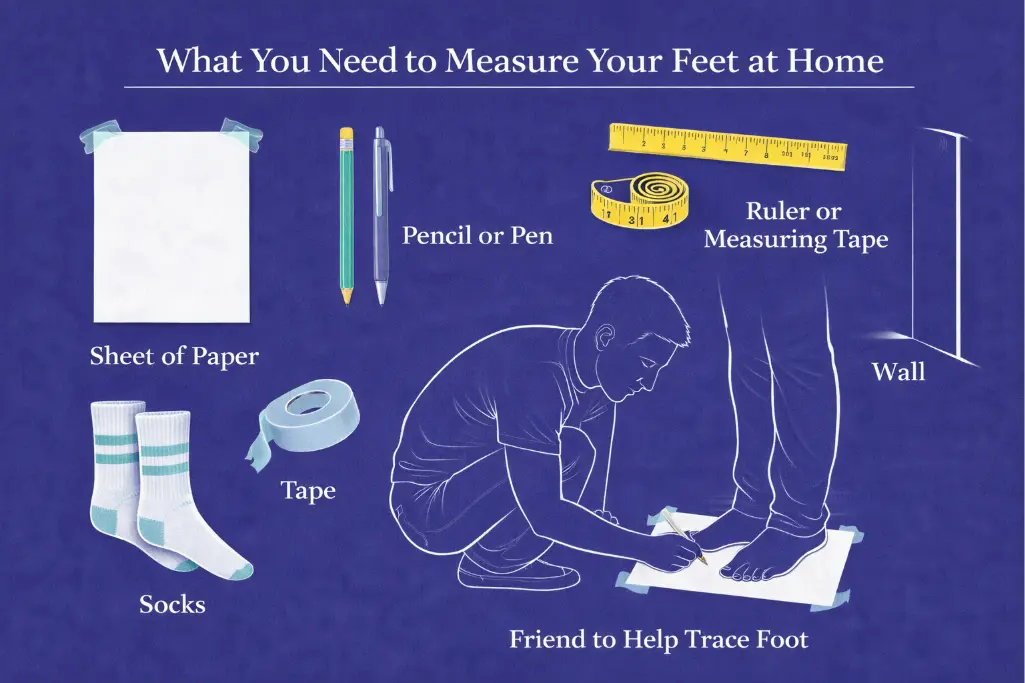
- A sheet of paper
This will be used to trace the outline of your foot.
- A pencil or pen
You’ll use this to mark the longest and widest points of your foot.
- A ruler or measuring tape
This helps you measure the exact length and width of the traced outline.
- A wall
Placing your heel against a wall ensures you measure your full foot length.
- The socks you plan to wear with the shoes
If you plan to wear socks with your shoes, you should measure your feet while wearing them.
Optional but useful
These items are not required, but they can make the process easier.
- Tape to secure the paper
Taping the paper to the floor prevents it from moving while you trace your foot.
- A friend to help trace your foot
Having someone else trace your foot can make the outline more accurate, especially around the heel and toes.
Why socks matter when measuring your feet
One detail people often overlook is socks. If you normally wear socks with the shoes you are measuring for, put them on before you begin. This is going to help you choose a size that feels comfortable during regular wear.
The thickness of your socks can slightly change how a shoe fits.
For example, someone measuring their feet for hiking boots may use thicker wool socks, while someone measuring for lightweight sneakers may wear thin athletic socks.
If you measure your feet without socks but plan to wear thick socks with your shoes, the fit may feel tighter than expected.
A Few Helpful Extras
Two small additions can make the process easier.
You can use tape to secure the paper to the floor so it does not move while you are standing on it. This helps keep the measurement consistent.
Having another person assist can also improve accuracy…
A friend can mark the position of your longest toe or trace the outline of your foot while you remain standing with your weight evenly distributed.
This avoids the small shifts in posture that sometimes happen when people try to mark their own foot.
When to Measure Your Feet
Timing matters more than most people expect…
The time of day can affect the size of your feet. For the most accurate results, it’s best to measure your feet in the late afternoon or evening.
Your feet do not stay exactly the same size throughout the day. Their dimensions change slightly depending on activity, body heat, and gravity pulling fluid into your lower limbs.
If you measure your feet early in the morning, they may be slightly smaller than they are later in the day.
Measuring later helps you choose a shoe size that will still feel comfortable after hours of walking or standing.
If you are measuring your feet for running shoes, it can also help to measure them after light exercise.
If you are measuring specifically for running shoes, it can help to measure your feet after a walk, run, or other period of exercise.
Physical activity increases circulation and loading through the foot, which can temporarily increase foot volume.
Research examining changes in foot dimensions during activity has shown that the foot can expand slightly in both length and width after repetitive loading.
Taking your measurements after activity helps ensure your shoes will remain comfortable during longer runs or workouts.
Step-by-Step Guide: How to Measure Foot Length
Accurate foot length measurement starts with positioning your foot in a way that reflects how it behaves during normal standing and walking.
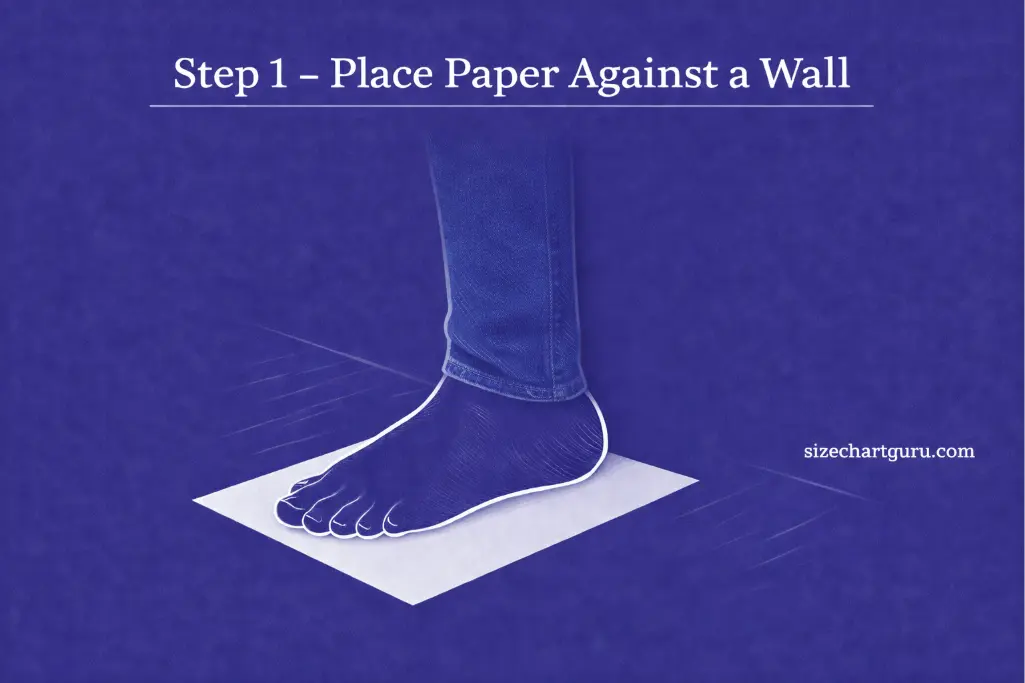
Step 1 – Place Paper Against a Wall
- Start by placing a sheet of paper flat on the floor with one edge touching a wall.
- Position one edge of the paper so it touches the wall.
The wall acts as a fixed reference point for your heel, which helps ensure you measure the full length of your foot.
Make sure the paper does not shift while you stand on it. If the floor surface is smooth, taping the paper lightly to the floor can help keep it in place.
Step 2 – Stand With Your Heel Against the Wall
- Step onto the paper and place your heel gently against the wall.
- Stand upright with your weight evenly distributed on both feet.
It’s important to remain standing rather than sitting during this step.
When you stand, your body weight causes your foot to spread slightly. This natural spreading, sometimes called foot splay, affects how your foot fits inside a shoe.
Measuring while standing helps you capture the true size your foot reaches when walking or running.
Step 3 – Mark the Longest Toe
While keeping your heel against the wall,
- Use a pencil or pen to mark the tip of your longest toe on the paper.
- Hold the pencil straight up and down so the mark reflects the true position of the toe rather than the angle of the pencil.
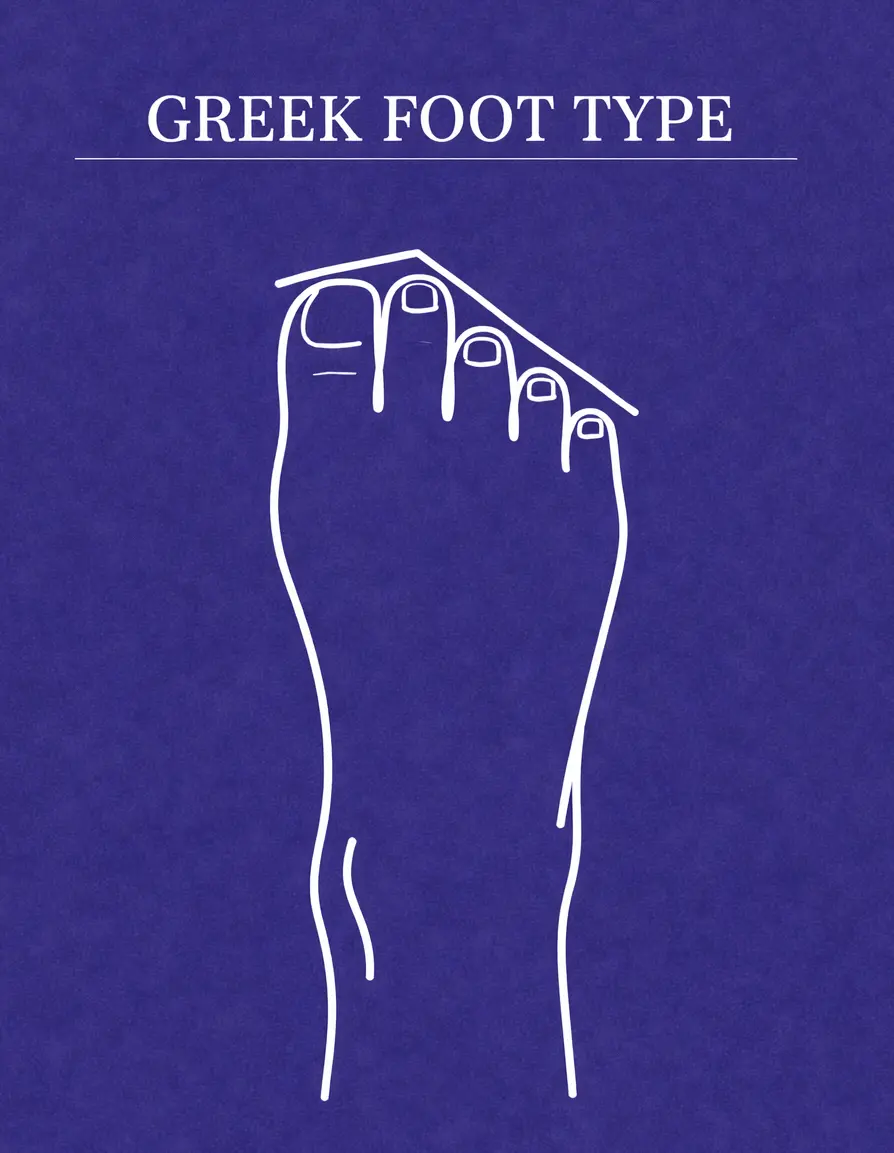
It’s also important to note that your longest toe may not always be your big toe. For some people, the second toe extends slightly further forward.
Step 4 – Measure the Distance
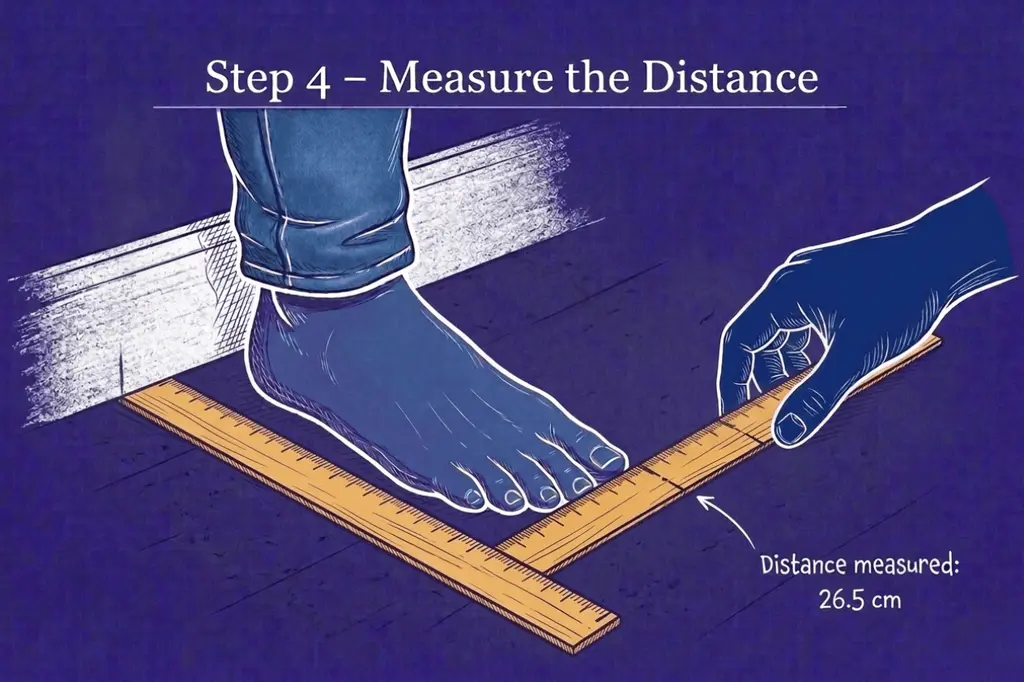
- Step off the paper and use a ruler or measuring tape to measure the distance.
- Measure from the edge of the paper touching the wall to the mark you made at your longest toe.
- Record this measurement carefully.
- You can write it down in centimeters or inches, depending on the sizing chart you plan to use.
Now, foot length is important, but width also plays a major role in how comfortable a shoe feels…
Step by Step Guide: How to Measure Foot Width
Foot width is measured across the forefoot, specifically at the ball of the foot, which is the widest part of your foot.
Professional sizing tools such as the Brannock Device measure width at this same location, which is why the ball of the foot is the standard reference point for width classification.
Shoes that match your foot length but are too narrow or too wide can still cause discomfort, so measuring your foot width helps you choose a shoe that better matches the shape of your foot.
Step 1 – Find the Widest Part of Your Foot
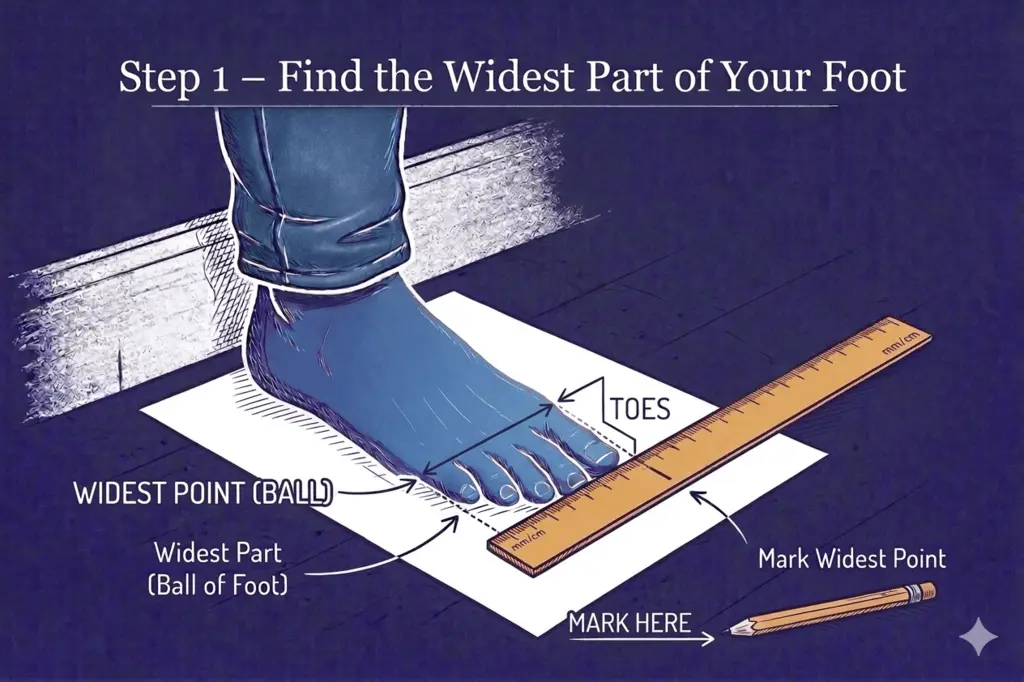
Stand on the sheet of paper you used for the length measurement so your weight is evenly distributed.
The forefoot will spread slightly under your body weight, which allows you to identify the true widest point.
The widest part of the foot typically sits across the ball area just behind the toes. If you traced the outline of your foot earlier, this area will usually appear where the foot begins to broaden before the toes.
Step 2 – Measure Across the Ball of the Foot
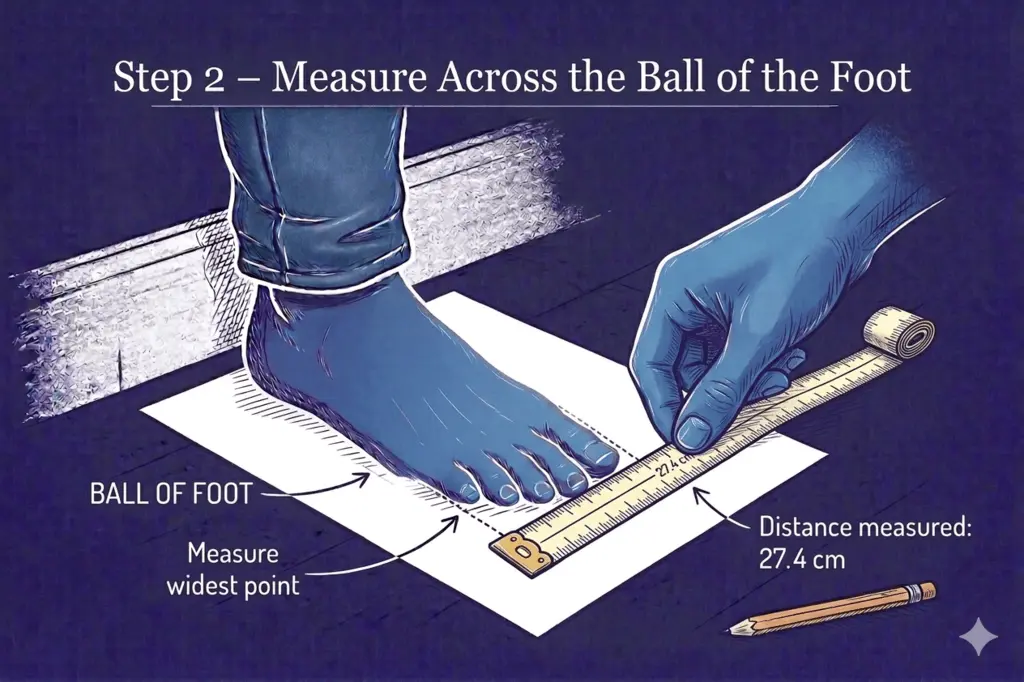
- Use a ruler or measuring tape.
- Measure straight across the widest points of the forefoot.
- Measure from one side of the outline to the other.
- Try to keep the ruler level and measure the widest part as accurately as possible.
Step 3 – Record the Measurement
Write down the width measurement alongside your foot length.
Just like length, you can record this measurement in centimeters or inches, depending on the sizing chart you plan to use.
Now, knowing both your foot length and width makes it much easier to find shoes that feel comfortable and supportive.
To give you a practical reference, here is an example of what these measurements might look like.
When I measured my own feet using the wall and paper method, I recorded a foot length of 26.4 cm (264 mm).
The width across the ball of my foot measured 10.3 cm (103 mm), which places my foot slightly between a standard D width and a wide E width in many sizing systems.
This aligns closely with the shoe size I usually wear, which is US 9.
Your measurements may differ slightly, but examples like this can help you understand how foot measurements translate into common shoe sizes.
Men’s International Shoe Size Conversion Chart
Use the chart below to compare common shoe sizes across US & Canada, UK, Europe, inches, and centimeters.
The most common sizes appear first. Open the full chart if you need the extended size range.
| US & Canada | UK | Europe | Inches | Centimeters |
|---|---|---|---|---|
| 6 | 5.5 | 39 | 9.3 | 23.5 |
| 6.5 | 6 | 39 | 9.5 | 24.1 |
| 7 | 6.5 | 40 | 9.6 | 24.4 |
| 7.5 | 7 | 40-41 | 9.8 | 24.8 |
| 8 | 7.5 | 41 | 9.9 | 25.4 |
| 8.5 | 8 | 41-42 | 10.1 | 25.7 |
| 9 | 8.5 | 42 | 10.3 | 26 |
View full size chart
| US & Canada | UK | Europe | Inches | Centimeters |
|---|---|---|---|---|
| 9.5 | 9 | 42-43 | 10.4 | 26.7 |
| 10 | 9.5 | 43 | 10.6 | 27 |
| 10.5 | 10 | 43-44 | 10.8 | 27.3 |
| 11 | 10.5 | 44 | 10.9 | 27.9 |
| 11.5 | 11 | 44-45 | 11.1 | 28.3 |
| 12 | 11.5 | 45 | 11.3 | 28.6 |
| 13 | 12.5 | 46 | 11.6 | 29.4 |
| 14 | 13.5 | 47 | 11.9 | 30.2 |
| 15 | 14.5 | 48 | 12.2 | 31 |
| 16 | 15.5 | 49 | 12.5 | 31.8 |
Women’s International Shoe Size Conversion Chart
Use the chart below to compare women’s shoe sizes across US & Canada, UK, Europe, inches, and centimeters.
Common sizes are shown first. Open the full chart if you need the extended size range.
| US & Canada | UK | Europe | Inches | Centimeters |
|---|---|---|---|---|
| 4 | 2 | 35 | 8.2 | 20.8 |
| 4.5 | 2.5 | 35 | 8.3 | 21.3 |
| 5 | 3 | 35-36 | 8.5 | 21.6 |
| 5.5 | 3.5 | 36 | 8.8 | 22.2 |
| 6 | 4 | 36-37 | 8.9 | 22.5 |
| 6.5 | 4.5 | 37 | 9.1 | 23 |
| 7 | 5 | 37-38 | 9.3 | 23.5 |
| 7.5 | 5.5 | 38 | 9.4 | 23.8 |
| 8 | 6 | 38-39 | 9.5 | 24.1 |
| 8.5 | 6.5 | 39 | 9.7 | 24.6 |
| 9 | 7 | 39-40 | 9.9 | 25.1 |
View full size chart
| US & Canada | UK | Europe | Inches | Centimeters |
|---|---|---|---|---|
| 9.5 | 7.5 | 40 | 10 | 25.4 |
| 10 | 8 | 40-41 | 10.2 | 25.9 |
| 10.5 | 8.5 | 41 | 10.3 | 26.2 |
| 11 | 9 | 41-42 | 10.5 | 26.7 |
| 11.5 | 9.5 | 42 | 10.7 | 27.1 |
| 12 | 10 | 42-43 | 10.9 | 27.6 |
How Foot Width Affects Shoe Fit
Foot width measurements are commonly translated into width categories in shoe sizing systems. These categories help match shoes to the natural shape of your feet.
In many sizing systems used in the United States, width categories include standard, wide, and extra wide designations. These are often represented by letters such as D, E, and EE, depending on the system being used.
Common width options include:
- Standard width
This is the most common fit and works for people with average foot width.
- Wide width
Wide shoes provide additional space in the forefoot. They can help reduce pressure if your feet feel squeezed in regular shoes.
- Extra-wide width
Extra-wide shoes offer even more room and may be helpful for people with naturally broad feet or specific foot conditions.
Knowing both your foot length and width makes it much easier to find shoes that feel comfortable and supportive.
Now, once you have measured length and width, repeat the process for the other foot. Many people skip this step, but it is an important part of accurate shoe sizing.
If you want to understand these differences in more detail, you can read my guides on boot width sizing and sneaker width and fit, where I explain how width categories and shoe construction affect comfort and support.
Measure Both Feet
It’s important to measure both of your feet, not just one. You might assume that your feet are exactly the same size. In fact, it’s very common for one foot to be slightly larger than the other.
For some people, the difference is small. But it can still be several millimeters, which may affect how a shoe fits.
Even a small size difference can lead to pressure points or discomfort if the shoe is too tight on the larger foot.
Always Size Based on the Larger Foot
When choosing a shoe size, it’s generally best to select the size that fits your larger foot. This helps prevent issues such as toe pressure, tightness in the forefoot, or rubbing during walking or running.
A slightly roomier fit on the smaller foot is usually easier to adjust than a shoe that feels too tight.
How to Adjust for the Smaller Foot
When shoes are sized to the larger foot, the smaller foot may feel slightly roomier. But there are a few simple ways to improve the fit.
- Wear a slightly thicker sock
A thicker sock can help take up extra space inside the shoe and improve overall comfort.
- Use an insole
Adding an insole can reduce extra room and provide additional cushioning and support.
- Adjust your lacing technique
Tightening the laces slightly more on the smaller foot can help keep your foot secure and reduce movement inside the shoe.
Once you have measured the length and width of your feet, the next step is to convert those numbers into a shoe size…
How to Interpret Your Measurements
Shoe sizing systems vary across different regions. The most common systems are US, UK, and EU sizes.
Each system uses a different numbering method, which is why the same foot measurement may correspond to different numbers depending on the chart you use.
US Shoe Sizing
US shoe sizes are widely used in North America and follow a scale based primarily on foot length. This system typically increases in small increments, with each half size representing a small change in foot length.
According to the Brannock Device Company, which developed the most widely used foot measuring device in footwear retail, US sizing measures heel-to-toe length and ball width while the person stands, so the foot spreads under body weight.
Men’s and women’s sizes also use different scales. For example, a women’s US size will usually be about 1 to 1.5 sizes larger than the equivalent men’s size.
Width designations such as standard, wide, or extra wide appear alongside the length size in many US sizing systems.
UK Shoe Sizing
UK sizing is similar to the US system but uses a different numerical scale. In many cases, a UK shoe size is about one size smaller than the equivalent US size.
For example, a US men’s size 10 is often close to a UK size 9, although exact conversions can vary.
EU Shoe Sizing
The European sizing system uses a unit called the Paris Point, which equals two-thirds of a centimeter. It’s based on the length of the shoe last, which is the mold used to create the shoe.
Now, because the measurement relates to internal shoe length rather than only foot length, EU sizes often increase in larger numerical steps than US or UK systems.
This is why EU sizes usually appear as whole numbers, such as 42 or 43.
Why Size Conversions Can Vary
Although conversion charts are helpful, they are not always perfectly consistent and cannot guarantee identical fit.
Two shoes labeled with the same converted size may still feel different because the internal length allowance, toe box shape, and overall volume vary across brands.
Because of this, your measured foot length should always be used as the starting point when choosing a size.
If you want a detailed breakdown of how these systems compare, you can read our guide on American Shoe Size to European conversion.
Common Mistakes When Measuring Your Feet
Measuring your feet at home is simple. But a few small mistakes can change the result and lead to the wrong shoe size.
Most errors happen because of small habits that slightly distort the measurement. Being aware of these mistakes can help you get a more accurate result.
Measuring While Sitting
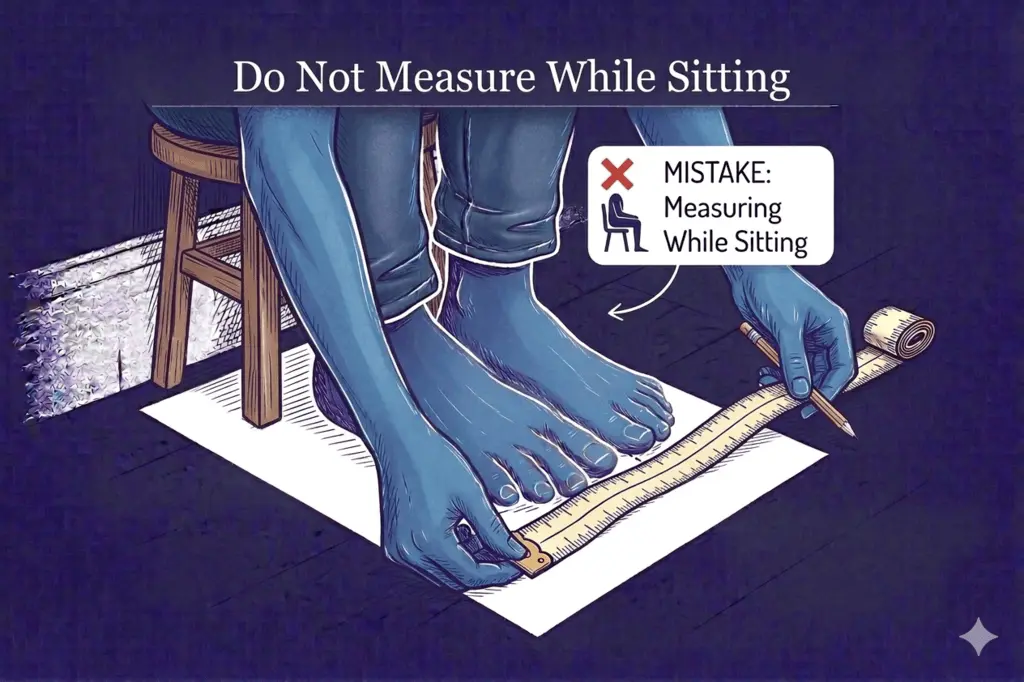
Some people sit down when they measure their feet. That seems convenient, but it changes the shape of the foot.
When you sit, your body weight is not pressing down on your feet. This means the arch does not compress fully, and the forefoot does not spread as much.
Researchers have found that when you stand, your feet naturally expand slightly under body weight, so measuring while standing gives a more accurate representation of how your feet behave during walking or running.
Measuring Without Socks
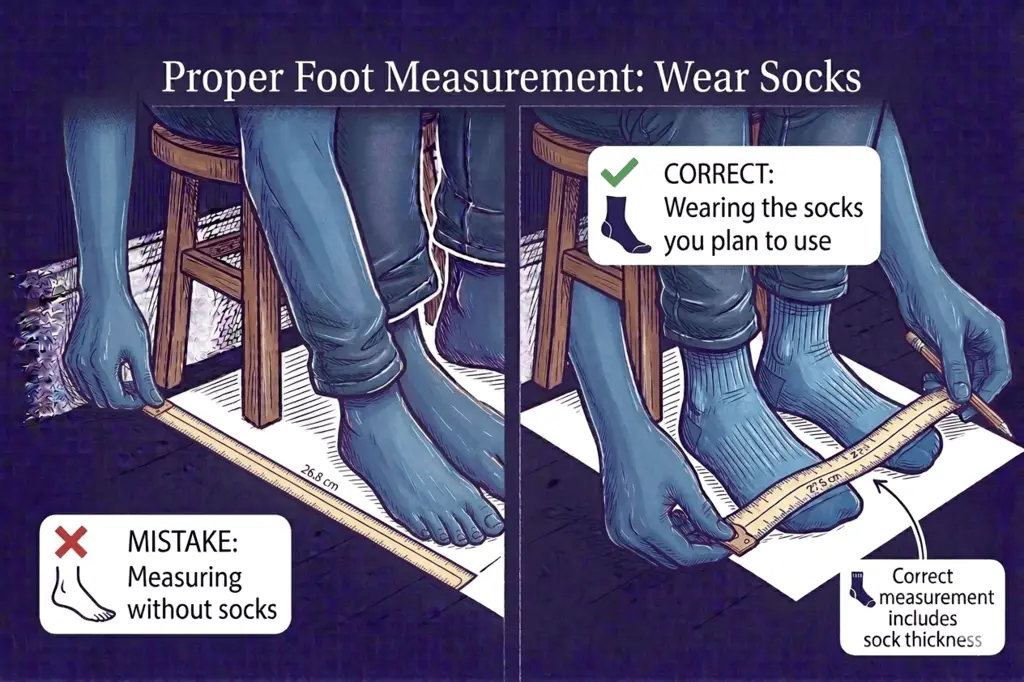
Think about how you normally wear your shoes.
If you usually wear socks with your shoes, you should measure your feet while wearing the same type of socks.
Socks add a small amount of thickness around the foot. Thin athletic socks and thick hiking socks can create noticeably different internal space requirements inside a shoe.
If you measure barefoot and later wear thicker socks, the shoe may feel tighter than expected.
Using Carpet Instead of a Hard Floor
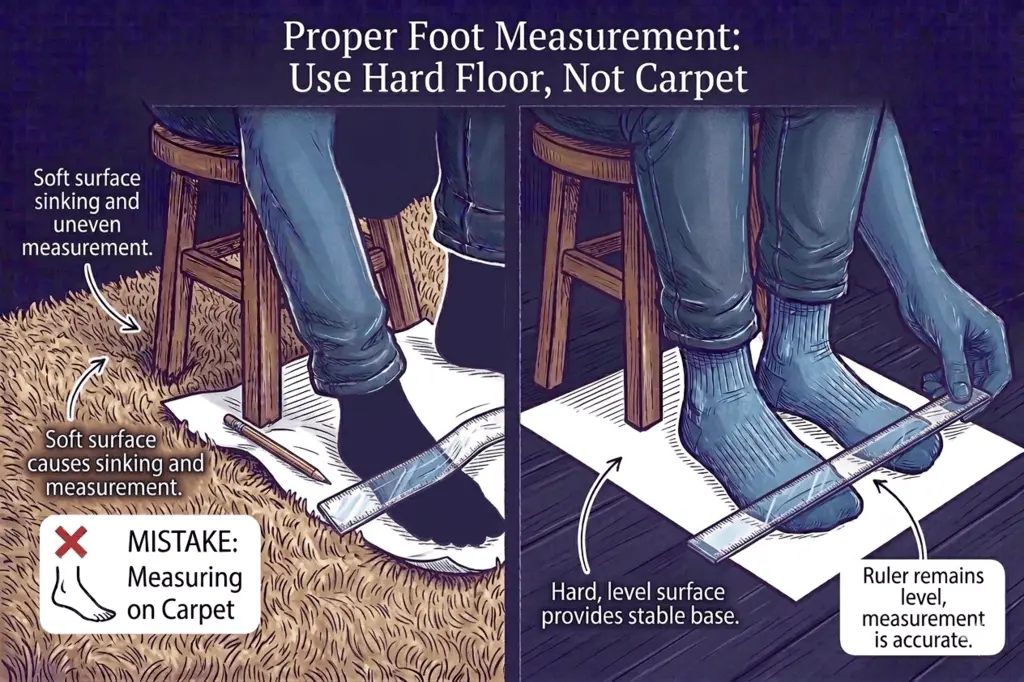
The surface you stand on can also affect the measurement.
While it is a comfortable place to measure, a carpet is soft and allows your heel to sink slightly into the floor, which can shorten the measured distance between your heel and the longest toe.
A hard surface, such as wood, tile, or concrete, keeps the foot level and produces a more accurate measurement.
Angling the Pencil
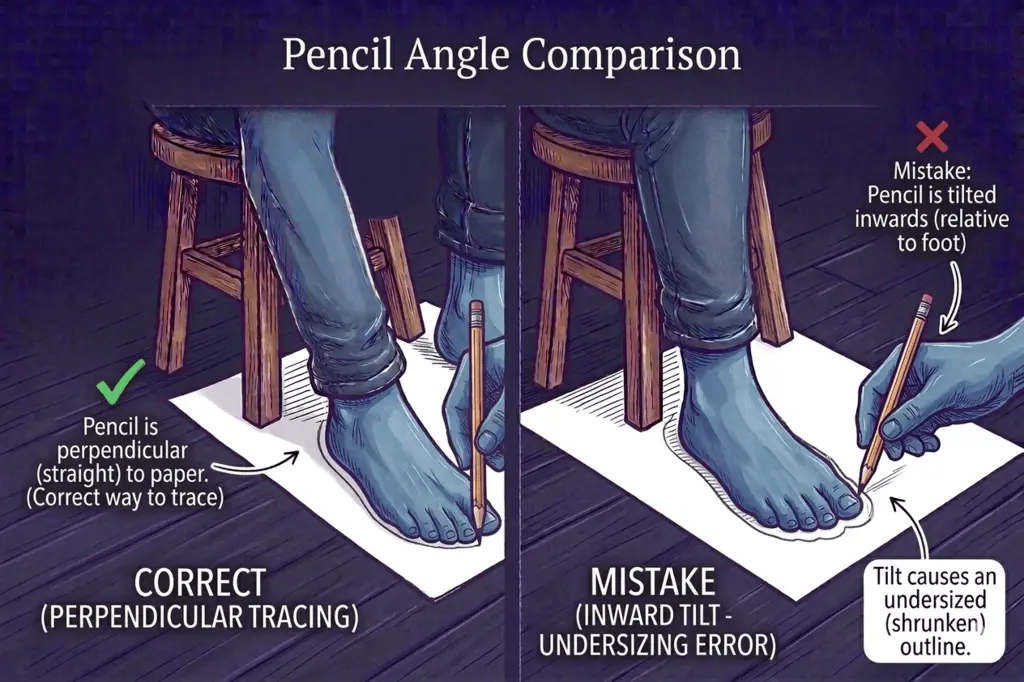
When you mark the longest toe, keep the pencil straight up and down. If the pencil tilts inward under the toe, the mark will land closer to the heel than the actual tip of the toe, which can reduce the recorded length of the foot.
In some cases, it can shift the measurement enough to change the recommended shoe size.
Measuring Only One Foot
Many people measure only one foot and assume both are identical in terms of size. In reality, small differences between the left and right foot are common.
If you measure only one foot, you might choose a size that fits the smaller foot but compresses the larger one. Always measure both feet and use the larger measurement as your sizing reference.
How Much Space Should You Leave in Front of Your Toes
Once you know your foot length, the next step is making sure the shoe leaves enough room in front of your toes.
Shoes should not match the exact length of your foot. A small amount of extra space is needed so your toes can move naturally when you walk or run.
The General Guideline
A widely used guideline in footwear fitting is to leave about ½ inch (around 12–13 mm) of space between the longest toe and the front of the shoe.
This distance is often described as roughly the width of a thumb.
This extra space helps prevent the toes from repeatedly contacting the front of the shoe. It also allows the foot to move slightly forward inside the shoe during normal walking.
Your foot can lengthen a small amount when your arch compresses under body weight. The small gap at the front of the shoe helps accommodate that movement.
Dr. Doug Richie often recommends leaving toe clearance to reduce repeated toe impact and pressure inside footwear.
Running Shoes
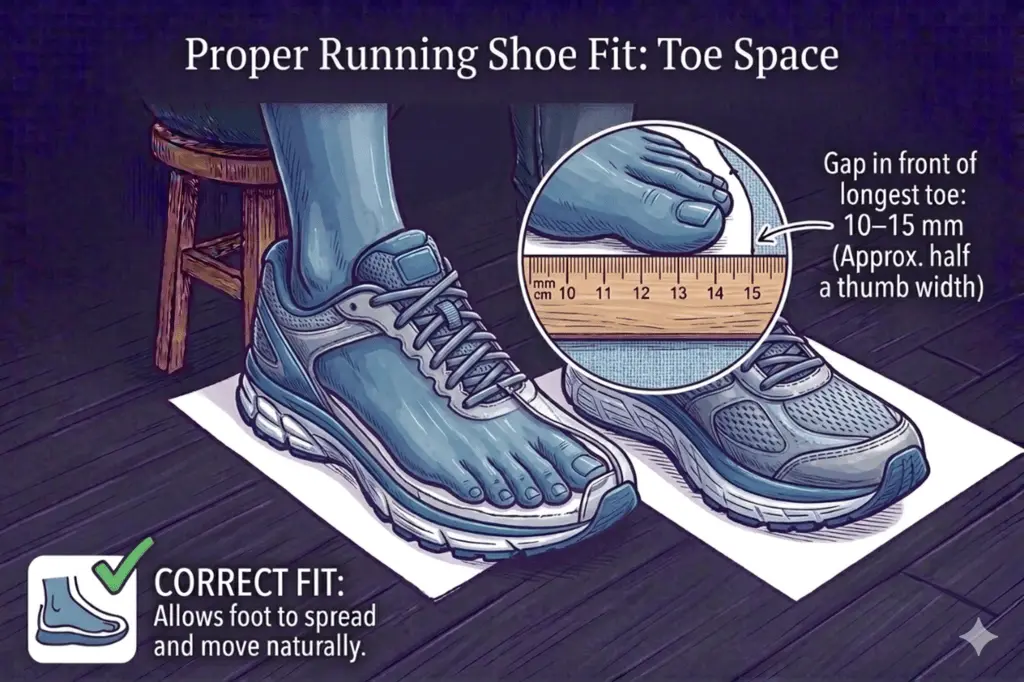
Running shoes usually require slightly more toe room than casual footwear.
When running, your foot experiences repeated impact and forward movement inside the shoe. Because of this, many fitting recommendations suggest maintaining about 10–15 mm of space in front of the longest toe.
This extra room helps prevent the toes from striking the front of the shoe during longer runs.
Lifestyle Sneakers
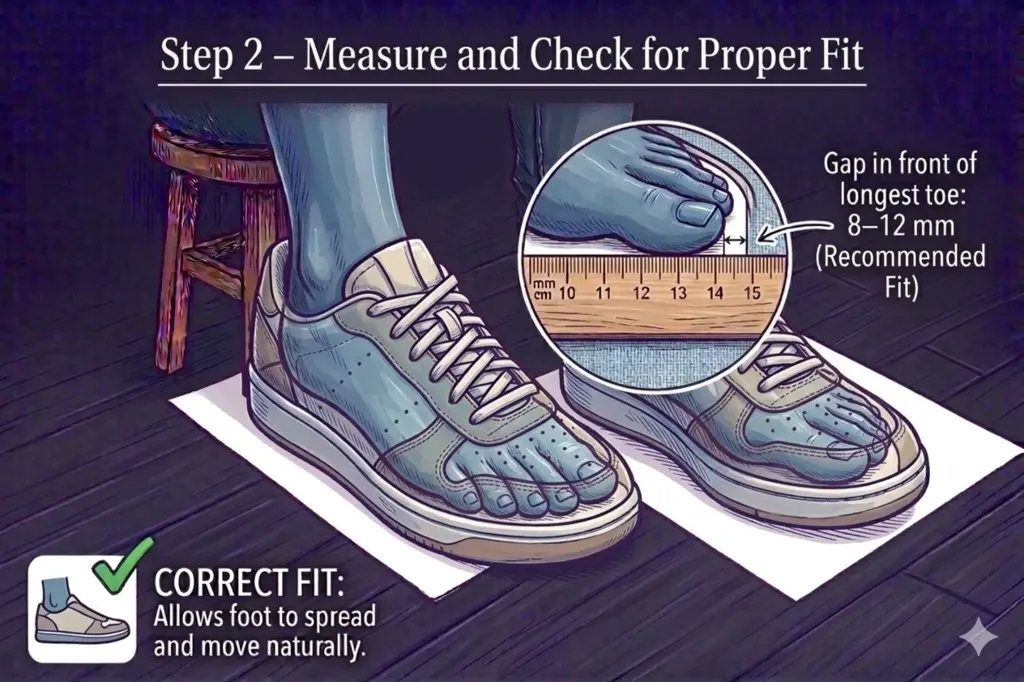
Lifestyle sneakers are typically used for walking and everyday movement rather than repetitive impact.
In many cases, they can fit slightly closer to the foot than running shoes. Even so, the toes should still have visible room inside the shoe.
If the longest toe touches the front while standing or walking, the shoe is likely too short. So, a gap of around 8–12 mm between the longest toe and the front of the shoe is commonly considered comfortable for everyday sneakers.
Boots
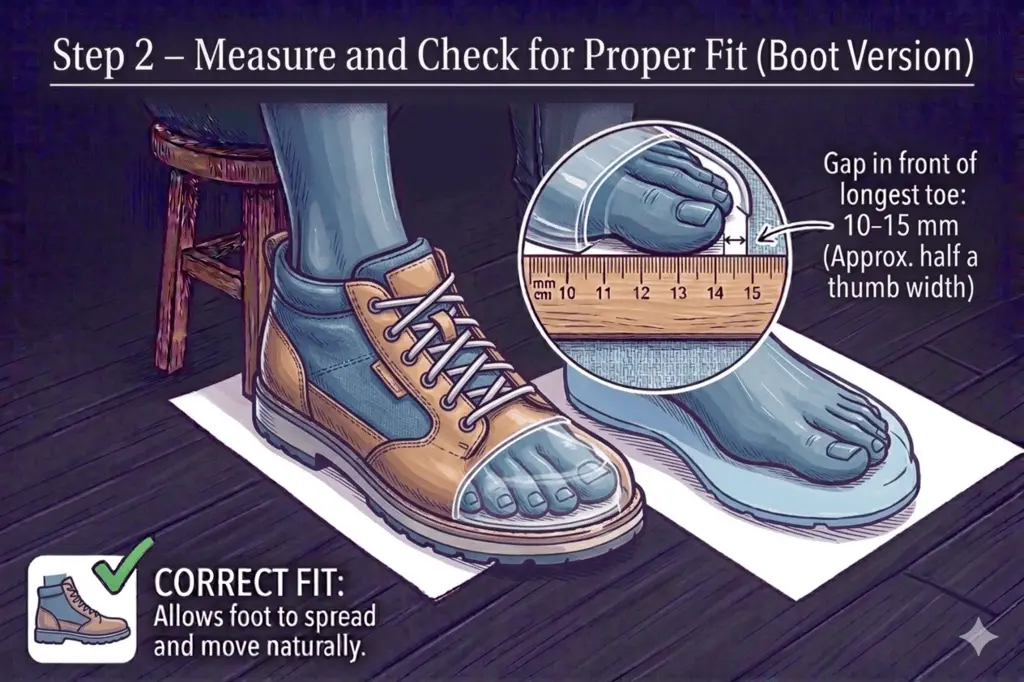
Boots, particularly structured leather boots, usually stretch very little in length.
Because of this, make sure you have enough toe space from the beginning. A toe room of around 10–15 mm is often recommended to allow comfortable movement inside the boot.
Toe room becomes especially important in hiking boots. When walking downhill, your foot naturally slides slightly forward inside the boot. The extra space helps prevent your toes from pressing into the front.
How Foot Shape Changes Measurement Interpretation
Foot measurements provide a helpful starting point. But length and width numbers alone do not fully explain how a shoe will fit.
Two people can have the same measurements and still experience very different shoe fit. The reason is simple: foot structure differs from person to person.
Once you have your measurements, the next step is understanding how your foot shape interacts with the shape of the shoe.
Toe Shape
Toe shape determines how the front of your foot fits inside the toe box.
For some people, the big toe extends the furthest forward. For others, the second toe reaches slightly farther than the big toe.
In some cases, the first three toes appear nearly equal in length.
These patterns affect where pressure develops in the front of the shoe. If the longest toe does not have enough space, it may repeatedly hit the front of the shoe when you’re walking or running.
Instep Height
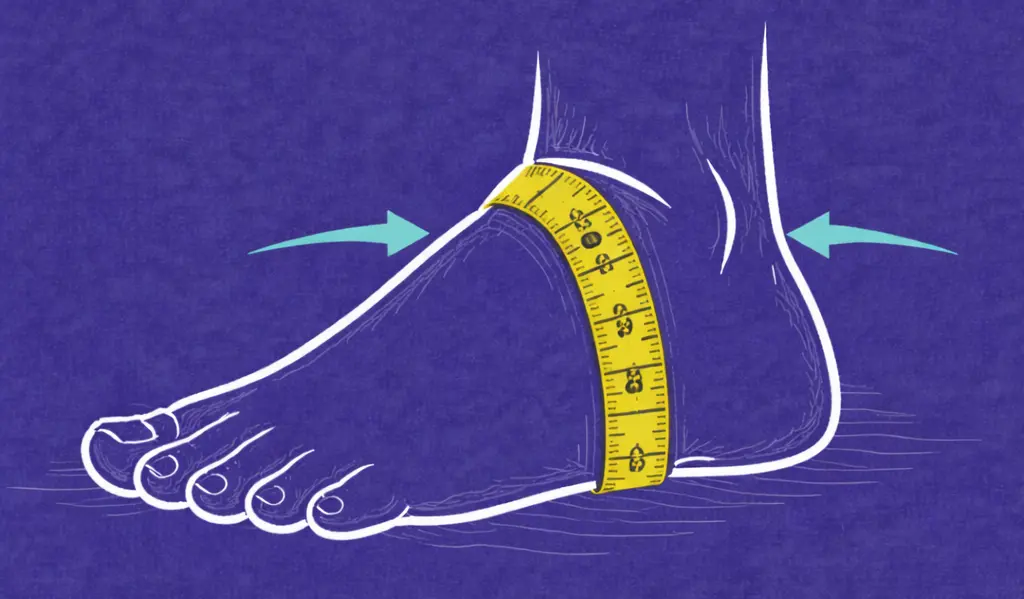
Instep height refers to the vertical height of the foot across the midfoot, where the laces usually sit.
A higher instep means the foot occupies more vertical space inside the shoe. Even when length and width measurements look correct, the shoe may still feel tight across the top of the foot if the shoe does not provide enough depth.
Foot Volume
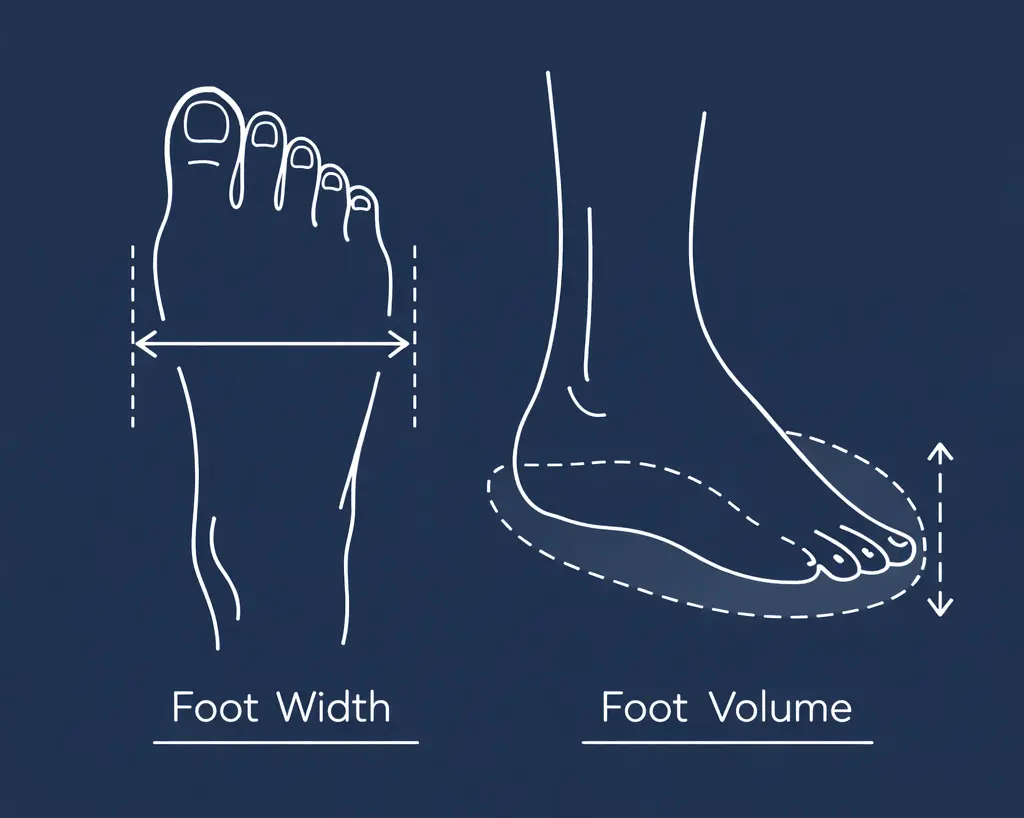
Foot volume describes how much three-dimensional space the foot occupies inside the shoe. It combines several structural factors, including width, instep height, and overall girth.
This explains why two people may have the same width measurement and yet their feet may fill the shoe differently. One foot may be relatively low in height, while another may have greater vertical volume.
In this situation, you may need to choose a shoe with more internal depth rather than simply choosing a wider size.
Arch Structure
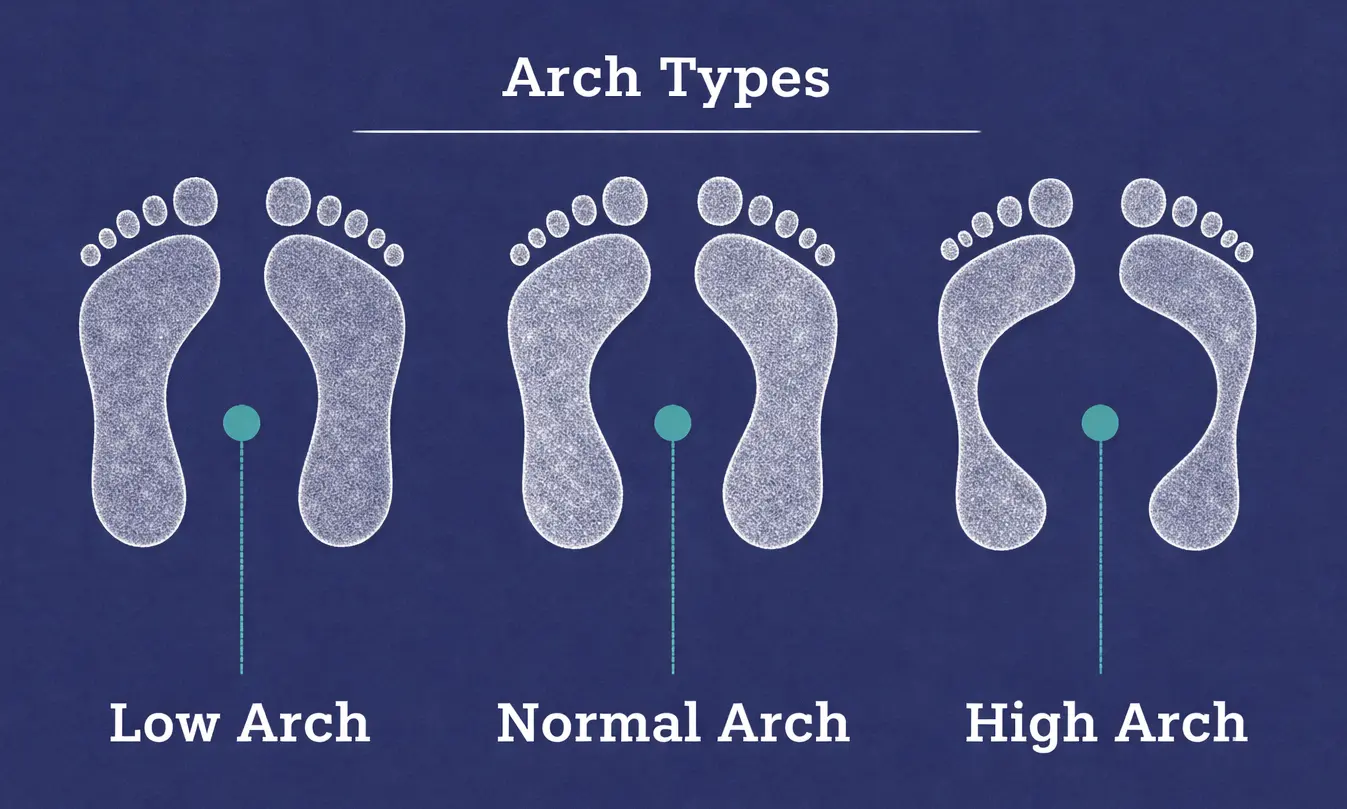
Arch structure also affects how the foot behaves under body weight.
Feet with lower arches often spread more across the forefoot, while feet with higher arches may place more pressure across the midfoot.
Research explains that arch structure influences weight distribution across the foot and can affect how pressure develops during walking.
These structural differences explain why two feet with identical measurements can still require different shoe shapes.
If you want a deeper explanation of these factors, you can read our full guide: How Foot Shape Affects Shoe Sizing.
That article explains how toe shape, arch height, instep structure, and heel shape influence shoe fit and why the same labeled size can feel different from one model to another.
Measuring Width vs Measuring Volume
Foot width is an important measurement, but it does not describe the entire shape of the foot.
Many people assume that if a shoe feels tight, the problem must be width. In reality, the issue is often related to foot volume, which refers to how much overall space the foot occupies inside the shoe.
Understanding the difference between width and volume can help explain why a shoe may feel tight even when the width measurement seems correct.
What Foot Width Actually Measures
Foot width refers to the distance across the widest part of the forefoot.
This area sits around the ball of the foot, just behind the toes. It is the part of the foot that usually spreads the most when you stand.
Most footwear sizing systems use this area to classify shoes as standard, wide, or extra wide.
Because the forefoot is typically the widest part of the foot, it serves as the reference point for width categories in many sizing charts.
What Foot Volume Means
Foot volume describes the overall three-dimensional space the foot occupies inside the shoe. Several structural factors contribute to foot volume, including:
- Instep height refers to the vertical height of the foot across the midfoot where the laces sit.
- Foot depth describes the vertical thickness of the foot from the sole to the top of the midfoot.
- Midfoot girth refers to the circumference around the middle of the foot.
When these measurements increase, the foot occupies more internal space inside the shoe, even if the forefoot width remains the same.
Why Volume Can Cause Tightness Across the Laces
You might assume tightness across the top of the foot means your shoe is too narrow. In many cases, the real issue is volume.
If the instep is higher or the foot has greater depth, the upper part of the shoe may press down on the top of the foot. This pressure usually appears under the laces or across the tongue of the shoe.
If the shoe does not provide enough vertical space, tightening the laces can increase pressure across the instep. Loosening the laces may relieve the pressure slightly, but can reduce heel security.
This pattern often indicates a volume mismatch rather than a width problem.
The other solution may be choosing a shoe with greater internal depth or a more flexible upper material.
When Home Measurement Is Not Enough
Measuring your feet at home works well in many situations. A simple wall and paper method can give you a reliable estimate of your foot length and width.
But some situations make accurate sizing more complicated.
In those cases, a professional measurement can provide a clearer picture of how your feet interact with a shoe.
When Your Feet Are Significantly Different Sizes
Most people have one foot that is slightly larger than the other. In many cases, the difference is small and easy to manage by choosing the size that fits the larger foot.
However, some people have more noticeable asymmetry between their feet. The length, width, or volume may differ enough that a single size does not feel balanced.
If you notice that one shoe consistently feels tighter or looser than the other, professional measurement can help identify the exact difference between your feet and guide the sizing decision.
When You Have Orthopedic Foot Conditions
Certain foot conditions can change how the foot interacts with a shoe. Conditions such as bunions, hammertoes, or structural arch differences can alter the shape of the forefoot or midfoot.
When this happens, measuring length and width alone may not fully explain why a shoe feels tight or unstable.
A trained fitter can evaluate how the shoe accommodates these structural differences and recommend a shape or construction that matches your foot more closely.
When Width Differences Are Extreme
Some people fall outside the range of standard width categories. For example, the forefoot may be significantly wider than the midfoot, or the heel may be much narrower than the forefoot.
If you frequently experience tightness across the forefoot or heel slipping, even when the size seems correct, the issue may relate to the internal shape of the shoe rather than the size number itself.
Professional fitting can help identify these mismatches and determine whether a different width category or shoe last would fit better.
Tools Professionals Use
Professional shoe fitters often use measuring tools designed specifically for footwear sizing. One of the most widely used tools is the Brannock Device.
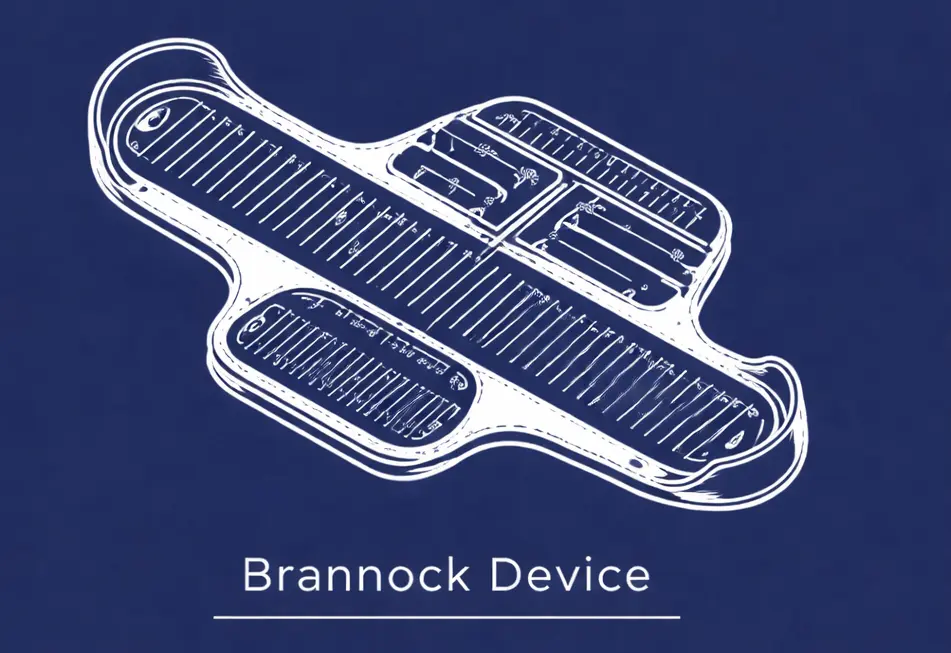
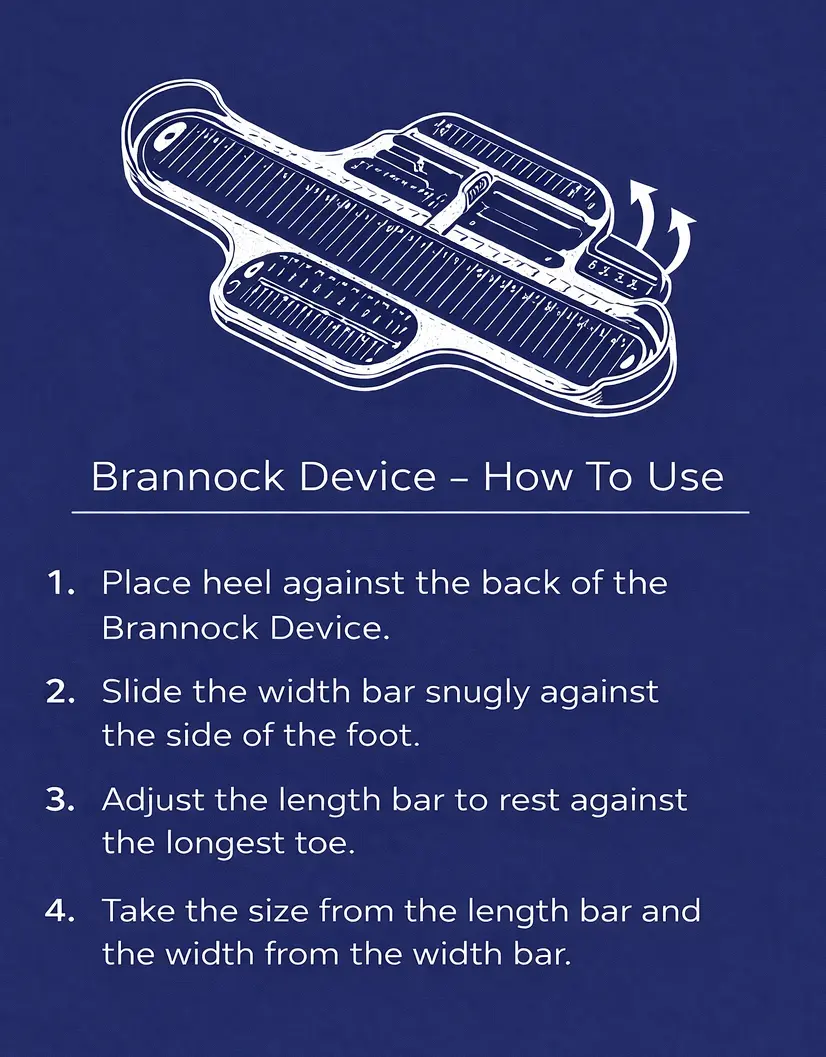
The Brannock Device measures heel-to-toe length, arch length, and ball width. The device also helps align the ball of the foot with the flex point of the shoe, which improves overall fit.
Final Thoughts
Learning how to measure your feet at home can help you understand your true foot length and width, but the number on the size label is only part of the picture.
Your toe shape, arch height, instep height, and heel width all influence how your foot sits inside a shoe. You might measure the correct length and still find that one model feels tighter or looser than another.
You should also consider the materials used in the shoe. Knit and mesh uppers usually adapt more easily to the shape of your foot, while stiffer leather or heavily reinforced uppers tend to provide less flexibility.
Different types of footwear are built differently as well. Running shoes, lifestyle sneakers, dress shoes, and boots often use different construction methods and internal shapes.
Because of this, the same size can feel slightly different depending on the style.